• About

A Desert Father

~ The Rev'd Robert Hendrickson

A Desert Father

Monthly Archives: December 2011

The Perfect Christmas: A Sermon for the Christ Mass

24 Saturday Dec 2011

Posted by RHendrickson in Uncategorized

≈ 1 Comment

Christmas at our house was always met with lots of joy mingled with a little bit of fear. You see, whenever we had some big event coming up like a camping trip, a vacation, or a weekend away, there would come the inevitable moment when my mother, overwhelmed with preparations (and our apparent lack of concern about those preparations), would suddenly declare, “Let’s just cancel it!”

So as Christmas lights needed to be hung, cookies needed to be baked, guest rooms prepared, travelers picked up, the house cleaned, the Christmas china found – as things got hectic and details seemed overwhelming, we always feared that we would hear that dreaded phrase, “Let’s just cancel it!” I remain convinced to this day that if any mortal might, with a word, cancel Christmas, it is my mother!

She always wanted us to have the perfect Christmas. And we all do this to some degree or another. We try to recreate that perfect memory, moment, or meal when Christmas day was just as it should be.

Yet, I wonder, if that first Christmas was just as Mary would have had it? Was that her perfect Christmas? Here she was, traveling at the government’s command, finding no room for shelter, giving birth amidst barnyard animals. This may not have been her perfect Christmas – but it is ours.

Thankfully, the perfect Christmas has already been had. That first night of Jesus’ birth was our perfect Christmas. God, at work in the meanest of circumstances, created a holy night which made possible our own new birth.

Too often we let the perfect get in the way of the joys of the moment. In our search for something just beyond our reach we fail to grasp the raw beauty of just what we have been given. Lying beneath the surface of what we see often lie true gifts of love, beauty, and grace.

A number of years ago, I was given a small box for Christmas. As I opened the box I saw a tarnished, dented, and rather well worn coin. It was an 1891 silver dollar coin. At first I was rather underwhelmed with this gift. I had hoped for an x-box or even a new book (when I was a child I was particularly fond of the Guinness Book of World Records or perhaps some new tome of Arthurian legends). Yet I had gotten a coin – and not even one I could use in a Coke machine.

Then my father began to talk about this coin. It had been in my great-grandfather’s pockets as a good luck charm in the trenches of World War I. It had been in my grand-father’s pocket in World War II. It had been in my father’s pocket as a good luck token since he was young. That coin, with all its dents and tarnish, told a story that no book could capture.

It was not its shine that made it beautiful but its tarnish.

My wife, a couple of years ago, received a spoon for Christmas. It was a red cooking spoon. It was rather a mess. Melted in places, a little bent, and discolored from use. She, unlike me, was overwhelmed with the gift – or perhaps as a Southerner she was just better at being graceful about odd presents than I was.

I tend to think not though, because this had been her grandmother and grandfather’s cooking spoon. It had served black-eyed peas on New Year’s Day, banana pudding at Christmas, and sweet potato casserole at Thanksgiving. Year after year it had been used at her family’s most cherished times together.

It was not its newness or shine that made it cherished but its years of use and the love it conveyed.

Beneath every seemingly less than perfect moment and gift is more. More of life, more of love, more of God’s many gifts to us. How often do we let the search for the perfect overshadow all that we are given?

The wonder of Christmas, of Christ’s coming, is that it was done in such a very human and raw way – filled with excitement and exhaustion. Beneath dirt and dust, fear and trembling, cold and night lay joy, hope, and promise.

Less than perfect circumstances revealed a perfect love.

It is the essence, the heart of things, that makes them perfect rather than our efforts to make them so. Whether a coin, a spoon, or a holiday – there is a heart in them all that makes them more – and for that we give thanks.

Our struggle is to remain ever mindful of our blessings despite living in a culture that sells us celluloid visions of perfect days, precious moments, toned selves, and richer futures if we just have more – if we were just more.

A Christian view of the world is one that sees the movement of the divine all about us, not in what we could have if we just worked harder, but in all that we have, in all of the gifts, people, and moments we have been given.

An art historian, looking a painting, sees the brushstrokes, use of color, symmetry, and perspective and knows that this is the work of Rembrandt. A trained musician listens to the chords, notes, and form of a piece and hears Beethoven.

Faith is both art and discipline because it is no easy or precise task to hear the voice of the Holy One – to receive the one whose own received him not – and it takes practice, a lifetime of practice, to know the God who knows us.

Christmas reminds us that God is not a deity of serene detachment, content to create the cosmos, and then stand aside as it grinds along to its natural ends. Creation is not God’s hobby. This is a Father whose passionate Love is offered for us, for me, and for you – whose whole being is drawn to dwell with us. This is a God whose first dwelling here was a creche, whose sign a cross, and who promises to be with us always. In the face of such love, all we can do is give thanks.

Tonight we sang “Once in Royal David’s City.” As it began, we strained a bit to hear that voice begins the story, “Once in royal David’s city stood a lowly cattle shed…” It echoes around us and then we realize that, from some place deeper than memory, we know the tune.

New voices join in, accompanied by the lush sound of the organ. We hear a bit more, “He came down to earth from heaven…”

All around us people move, smoke comes forth, and we sing. Before we even know it, we are singing loudly, some smiling, some with tears in their eyes as we hear the voices of those gone before us singing too, and with one loud voice we know and sing “our eyes at last shall see him, through his own redeeming love.”

The song swells and we sing not of an old story, something of the past alone, but of a promise that still echoes across the ages and resounds deep in our chest, “And He leads His children on, to the place where He is gone.”

We are constantly, throughout our short days, being asked to join in God’s song of redeeming love and to give thanks as we listen for the one who is Love in voices all around us.

We experience God’s love in the imperfect people and world around us. In being given a second chance by someone we have hurt. In the self-less love we receive from our friends, parents, children, partners and even our pets. In the gracious beauty of the liturgy here tonight.

The Christmas story, this perfect story, reminds us that it is through very real, rarely noble, and sometimes challenging people and experiences that we come to know the love of God – and we give thanks for that.

May this Christmas reveal more and more of God’s transforming love. May we see the gifts of God all about us in simple moments, loving friends, and even in odd gifts given and received. May we see signs of a God who takes all things (those new and those well-worn, those still shining and those tarnished by age), all people, and all our lives and ever holds them in perfect Love.

Robert+
Share this:

  • Share on X (Opens in new window) X
  • Share on Facebook (Opens in new window) Facebook
  • Share on Reddit (Opens in new window) Reddit
  • Share on Tumblr (Opens in new window) Tumblr
  • Email a link to a friend (Opens in new window) Email
Like Loading...

Of the Conception: Immaculate, Immaculate?

11 Sunday Dec 2011

Posted by RHendrickson in Uncategorized

≈ 4 Comments

The Blessed Virgin is compelling to so many, in part, because of her very human role in the story of Jesus Christ. She is a figure of adoration that shares in the very human joys of birth, the challenges of obeying God’s will, and the agony of loss.

The Magnificat, the Virgin’s Song, is the anthem of the Church. It is our song of hope that saves the spirit. It is our “yes” to the will of God that we will stand in the face of doubt, fear, and suffering to witness to the love of a living and present God.

Mary’s “yes” to God calls us to an ever-deeper awareness of the Incarnate Lord. Those who follow Jesus in the way are alike to his Mother and grow to do the will of the Father. Karl Rahner writes, “To honour God’s work in her is in fact a unique way of praising and being grateful for the one great and comprehensive benefit that God has conferred on mankind.”

Our honoring of Mary carries with it the hope that all of the children of God will grow into a life of perfect freedom. In part, this begins at Baptism, the point at which we are “dead to sin” and born into new life and put on Christ through the same movement of the Spirit by which Mary became the ark of the New Covenant.

We often hear the phrase “For God so loved the world that He gave his only begotten Son” and immediately think of the Crucifixion and the Atonement. When we hear those words we would do well to remember also the Nativity and the Incarnation. For God so loved the world that he gave his only begotten Son to be loved, cared for, and raised by his Blessed Mother.

God does so love the world and that very fact is always held in tension with our own betrayal of that trust which leads us to Jesus begging his Father to “Forgive them.” We are always the beloved and forgiven of God and honoring the Blessed Mother gives us all a deeper sense of our own share in the love made known in the fullness of the Incarnation.

Immaculate, Immaculate?

I rather like the idea of the Immaculate Conception. Or, perhaps, it is simply the big brother in me that enjoys tweaking my colleagues as I sprinkle “immaculate,” “co-redemptrix,” and “assumption” through casual conversations! Call it theological shadenfreude. However, as much as I would enjoy being a fierce advocate for the Immaculate Conception of the Blessed Virgin, I wonder how celebrating such a feast impacts our understanding of her vital and unique role in salvation history?

There is much confusion over the Feast of the Immaculate Conception. A common misperception is that the feast references the conception of Our Lord. There has been a conflation of the Virgin Birth with the Immaculate Conception. The Feast of the Immaculate Conception is a feast that celebrates the Conception of Mary as being one of a unique human unstained by the blemish of sin. Does believing that Our Lady is Full of Grace imply that we believe her to have been conceived without the burdens of human nature?

What do we make of the difficulty of her choice to say “yes” to the indwelling of the Holy Ghost if she never could have said no? To say no would surely have been sin. Part of the compelling vision of Mary is her willingness to accept her unique role in history. If she were born without the ability to sin, it seems that she would have been unable to actually make a real choice – to say no (or yes for that matter) – and thus that pivotal answer to God becomes a fait accompli rather than a momentous, decisive choice made on behalf of humanity in the face of very human fears.

Saint Thomas Aquinas rather vigorously argued against the Immaculate Conception. In his view, to say that any human’s birth was immaculate is to deny the saving work of Jesus Christ for all of humanity. In the Summa Theologica, Aquinas says, “Even in the Blessed Virgin, first was that which is natural, and afterwards that which is spiritual: for she was first conceived in the flesh, and afterwards sanctified in the spirit.” In other words, her conception was of a fully human nature with all that is inherited therein, and the fullness of her grace was a gift of the Spirit.

Aquinas continues,

The sanctification of the Blessed Virgin cannot be understood as having taken place before animation, for two reasons. First, because the sanctification of which we are speaking, is nothing but the cleansing from original sin: for sanctification is a “perfect cleansing,” as Dionysius says (Div. Nom. xii). Now sin cannot be taken away except by grace, the subject of which is the rational creature alone. Therefore before the infusion of the rational soul, the Blessed Virgin was not sanctified.

Secondly, because, since the rational creature alone can be the subject of sin; before the infusion of the rational soul, the offspring conceived is not liable to sin. And thus, in whatever manner the Blessed Virgin would have been sanctified before animation, she could never have incurred the stain of original sin: and thus she would not have needed redemption and salvation which is by Christ

To argue against the notion of an Immaculate Conception of Mary may seem to lessen her status yet, Aquinas writes, “…this (Immaculate Conception) appears to be part of the dignity of the Virgin Mother, yet it is somewhat derogatory to the dignity of Christ, without whose power no one had been freed from the first sentence of condemnation.” Our Lord’s saving work encompasses all of humanity, including his Blessed Mother. Her yes to that work cannot have been an act of foreordained holiness but must have been a “yes” that had consequences, import, and full participation.

The Incarnation is the unifying of the human and the divine by the miraculous working of the Holy in the body of humanity. From that union came the perfect expression of both humanity and divinity, Our Lord Jesus Christ. It seems that the Immaculate Conception, as a theological construct, makes the Incarnation less than the full union of humanity with divinity. It implies that this union was not the coming together of both humanity in its fullness and divinity in its fullness but was a union of divinity with an immaculate being that is something more than human and less than divine.

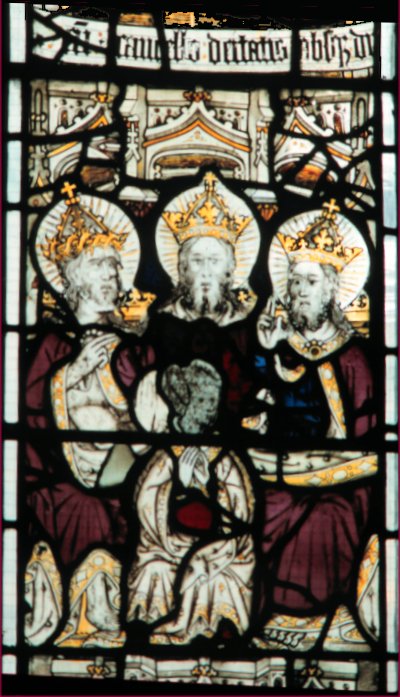
Some time ago I read a rather wonderful piece from the blog Full Homely Divinity. The author writes about Trinity Sunday In particular he focuses on images of the Trinity and on a stained glass window from Yorkshire. He writes,

Coronation of the Virgin by the Trinity, Holy Trinity Church, Goodramgate, York, 1470

…the Trinity is portrayed in this window is significant. Often, the Trinity is portrayed in a manner that might be called modalistic: each Person is characterized in a distinct manner suggestive of a special role: God the Father as a venerable patriarch on his throne, God the Son either crucified or in another manner suggesting his earthly incarnation, and God the Holy Spirit as a dove. In this window, however, the three persons are depicted as virtually identical–the same faces, the same clothing, the same crowns, and all acting in concert. The message, of course, is that God is One, and that the three Persons of the Trinity are equal in every way, and both exist and act as One in everything. Furthermore, they are united in their focus on the person who kneels in their midst and who, as every medieval Christian understood, represents the entire human race. In fact, Mary is virtually surrounded and embraced–in this window she appears to be quite literally overshadowed–becoming a fourth person in the eternal relationship to which all people are invited.

Mary is welcomed into this relationship with the Trinity on behalf of the whole of humanity. Her essential being is our essential being. If Mary is the prototypical human then an Immaculate Conception implies that her very essential humanity is not a full expression of our shared weakness and grace.

It seems that to fully appreciate the great gift we have been given by grace requires a commensurate willingness to believe, in all of our hearts, that we have been given a gift of great price and worth as we too are embraced by the holy and overshadowed by grace that comes through the Son. That gift has been given not to immaculate souls and beings but to very human, real, and beloved human beings. Beings blessed to share in the grace offered to Our Lady.

Robert+

Share this:

  • Share on X (Opens in new window) X
  • Share on Facebook (Opens in new window) Facebook
  • Share on Reddit (Opens in new window) Reddit
  • Share on Tumblr (Opens in new window) Tumblr
  • Email a link to a friend (Opens in new window) Email
Like Loading...

To Preside or to Celebrate?

04 Sunday Dec 2011

Posted by RHendrickson in Uncategorized

≈ 16 Comments

I am honestly struggling to understand why the inelegant and rather business-speak sounding word “preside” is supposed to be preferable, according to many in the know, to the word “celebrate.” This is especially prevalent now as churches refer to the priest celebrating mass as the “presider.” It might be helpful to look at the definition of the word “preside.”

pre·side (pr-zd)

1. To hold the position of authority; act as chairperson or president.

2. To possess or exercise authority or control.

3. Music To be the featured instrumental performer:

Supposedly, the shift in language is to represent the leveling of hierarchy and to imply that no longer will the priest be recognized as the only one “celebrating”- the entire congregation is celebrating too! However, read the definition of preside again.

There is nothing about the definition of preside that in any way suggests an anti-clerical move or a leveling of hierarchy. The very definition of “preside” is to control, hold authority, and to be the featured performer! This is not only an inelegant term but a profoundly counter-productive one if our goal is to truly bring a sense to the worshiping body that they are a vital part of the liturgical action.

One can look at the definition of celebrate and find theological excess within it.

cel·e·brate [sel-uh-breyt]

1. to observe (a day) or commemorate (an event) with ceremonies or festivities: to celebrate Christmas; to celebrate the success of a new play.

2. to make known publicly; proclaim: The newspaper celebrated the end of the war in red headlines.

3. to praise widely or to present to widespread and favorable public notice, as through newspapers or novels: the countryside celebrated in the novels of Hardy.

4. to perform with appropriate rites and ceremonies; solemnize: to celebrate a marriage.

To observe, commemorate, to make known, to proclaim, to praise widely, and to perform with appropriateness. Contrast that definition with “preside” which is suffused with language of control, authority, and management.

What are the synonyms and antonyms for each term?

Synonyms for Celebrate
1. honor, solemnize. 2. laud, glorify, honor, applaud, commend, give, grace, laud, magnify, praise, provide 3. immortalize, keep, memorialize, monument, monumentalize, observe, pay tribute to, perpetuate, remember, salute, solemnize

Antonyms for celebrate: disregard, forget, ignore, neglect, overlook

The synonyms for celebrate are full of the absolute essence of Christian worship! To honor, solemnize, laud, magnify, praise, memorialize, and remember are key elements of the Eucharistic action. They, in large part, define our life as a Body. Celebrate was chosen as the term for what we do for a reason!

Again, by contrast, look at what the synonyms and antonyms for “preside” are:

to preside (from google search)

Synonyms for Preside

administer, advise, be at the head of, be in driver’s seat, call the signals, carry on, chair, conduct, control, direct, do the honors, govern, handle, head, head up, keep, lead, manage, officiate, operate, ordain, oversee, pull the strings, run, run the show, sit on top of, supervise

Antonyms for preside: follow, serve

My eye can’t help but be drawn to the antonyms first as they are so striking. The antonyms for “preside” are to “follow” and “serve.” In the name of some sort of well-intentioned egalitarian impulse we have now made “serve” and “follow” antonyms of the priestly action!

Look at the synonyms for “preside.” One administers, is at the head of, controls, does the honors, pulls the strings, runs the show, and sits on top of. This is the language of manipulation and corporate finagling not the language of holy and life-giving encounter.

Instead of celebrants lauding and magnifying we have presiders managing and controlling. Worship is not a board meeting. It is not an exercise in human resource capitalization. Nor is it a concert in which the priest is the star of the show. It is an encounter with the Holy.

The drive to make worship more “personal” inevitably makes the person more and more central. Rather than the Spirit, the liturgy, and the congregation’s response drawing our energy forward the priest is tasked with entertaining, directing, and presiding over an experience – managing and manipulating emotions.

Good liturgy draws the celebrant in along with the congregation so that the whole Body is worshiping together. This is not the work of “presiding” but the work of “celebrating.”

The priest is not the star or the director or the manager. He or she is the celebrant. They are called to laud, honor, commend, and observe the Holy. They are called to celebrate. They welcome others to celebrate as well in the way they too are called. We are, indeed, all celebrating these Holy Mysteries together. Some in song, some it chant, some in reading, some in greeting, all in prayer, and all around the altar. One person’s voice begins the song and others join in. One person celebrates and others come ‘round.  It is the use of the definite article that, perhaps, should be questioned not the verb.

Identifying the priest as the celebrant is not an act of elevation but an identification of their primary action and role in the liturgy – to celebrate. It is the unfortunate individualism of this age that draws so much attention to the role and title rather than to the significance of the Body’s action that undergirds that very title and labor. In other words the celebrant is the celebrant because of the action of the Body which has heard his or her call to the altar. Now that the priest is there, at the altar, he or she is celebrating those Sacred Mysteries with the congregation gathered around and joining in.

Ask yourself this. Would you rather be asked to celebrate or to preside? To celebrate a joy or to preside over a joy? To celebrate a mystery or to preside over a mystery? To celebrate a birth or to preside over a birth? To celebrate at a meal or to preside over a meal? To celebrate a memory or to preside over a memory? To celebrate a miracle or to preside over a miracle? To celebrate hope or to preside over hope?

You might notice over the course of these questions that it is not really possible for mortals to preside over many of them. God presides. God gives life, joy, mystery, sustenance, and hope. Above all, God has given us his Son made known in the elements. This is something we cannot preside over but only and ever and forever celebrate.

Robert+

PS: It is also worth googling the images for the two words to get a visceral sense of their definition, import, and connotations.

Share this:

  • Share on X (Opens in new window) X
  • Share on Facebook (Opens in new window) Facebook
  • Share on Reddit (Opens in new window) Reddit
  • Share on Tumblr (Opens in new window) Tumblr
  • Email a link to a friend (Opens in new window) Email
Like Loading...

On Healing Masses: Of Anointing and the Eucharist

01 Thursday Dec 2011

Posted by RHendrickson in Uncategorized

≈ 4 Comments

A practice I have recently heard more and more about is the use of the Sacrament of Anointing in the course of the Eucharist.  However, this Anointing is not being offered in the course of a Mass a the Prayers of the People, but is now frequently being offered after a person receives Communion.

The intent seems to be that the individual receives the concentrated prayers of the community and/or a priest.  I read a comment that said “it makes me feel special” and “I get more attention to my need for healing.”

I worry, however, that this understanding of the Sacrament of Anointing distorts our understanding of the Sacrament of Communion.

Jesus is our healing.  All of our Sacraments find their source and power in the person of Jesus Christ.

Saint Paul says in 2 Corinthians, “Power is made perfect in weakness.’ I will rather boast most gladly of my weaknesses, in order that the power of Christ may dwell with me” (12:9).  This is not to say that pain is something to boast of or exult in, but it is something that is shared with Christ.  One of the realities of the Incarnation is that our glory is not only in the image of Christ but our pains as well.  Our human frailty is borne by the one who came among us again bearing those awful wounds.

In Communion, we come to receive the one that is the source of healing and is our triumph over the wounds of this world.  We are offered the one who knows our suffering and that bears our pain.   Christ, who visited and healed the sick, comes to us in Communion in a way like none other.  It is in that moment that we are offered union with the one who continues to visit, heal, and defend the sick.  We come to receive, be visited by, and to commune with the one who heals.

That healing is not restricted to physical healing.  So often the healing we receive is a spiritual one that gives us the strength to bear our pain.  Christ bore pain for us and we are called to bear it with him in mind and heart.  The healing we receive is a spiritual one that calls us to allow our heart and mind to be turned to the world to come – the world yet unseen.  Pain can often focus the soul on what matters most deeply to us.

A healing Mass is a holy experience.  That healing should be placed in the context of the whole of the Eucharistic liturgy though.  Prayers and anointing should be offered along with all of the other prayers of the people.  Those prayers find their consummation in the receiving of Communion.  Healing, an integral part of the encounter with Jesus, should not be something that is done after the encounter with Jesus in the Sacrament but before as we gather all of our prayers and present them to the one who comes among us and hears them all.

Anointing is a Sacrament that offers our pain and longing for wholeness to God to transform in whatever way He will.  In the tradition, when Anointing was done primarily at the end of life, it was a Sacrament that offered eschatalogical hope.  It was a Sacrament of the completion of our earthly struggle.  It was a configuration of our suffering with Christ’s in the final moments of our life.

In the fuller understanding of Anointing we now have all of our life’s infirmities and pain, not just those at the end of it, are offered to God.  Healing is not simply an end-of-life concern in this fuller understanding but a grace bestowed throughout our lives.  That grace comes, however, not in an instantaneous healing but in a conforming of the entirety of our lives to God’s will.

Anointing is like Confession in that its chief fruit is not an immediate transformation but a gradual turning of the heart to perceive the fullness of God – a fullness always offered in the Eucharist.  The healing ministry of Jesus was not simply a momentary transformation but an invitation to know God so that permanent healing could be had.

This turning of the heart and mind happens is part of the Eucharistic life.  We are drawn to a living Jesus who was broken for us and who knows our struggles and we are made one with the resurrected Lord.  This is the fulfillment of all Anointing and Healing – a oneness with Christ.  Think of the healing of the blind, it was not offered simply so that they could see, but so that they could Behold.

All of the Sacraments should be viewed in the context of the others and especially in the context of Baptism.  Each Sacrament builds upon the grace bestowed in the very beginning of our life with Christ.  Each Sacrament gives us further growth in our life with Him as we are drawn ever more fully into a life of trust, service, and self-offering.  Anointing is one part of the pattern of holiness.

The Eucharist is that place where we meet Christ and He meets us.  It is that regular conformation of our life with Christ’s.  Healing takes place, in its fullest spiritual sense, at the altar rail.  Immediately after that most intimate encounter with God there is no need of another healing – just thanksgiving for all the healing and reconciling work of God in Christ.

This is a more intimate sustenance than physical necessities being provided, it is the Lord himself coming to be among and in His people, offering healing and wholeness.

We feed on Christ.  In that moment, we are open to the Lord and Him to us. We are reminded that we depend wholly on God and rest assured of His constant love.  There is always healing to be found in the Eucharist and we should always be offering prayers for healing but we should also remember that true healing is ever on offer in Body and Blood.

Share this:

  • Share on X (Opens in new window) X
  • Share on Facebook (Opens in new window) Facebook
  • Share on Reddit (Opens in new window) Reddit
  • Share on Tumblr (Opens in new window) Tumblr
  • Email a link to a friend (Opens in new window) Email
Like Loading...

Current

  • The Society of Catholic Priests of the Episcopal Church An Anglican society devoted to catholic spirituality welcoming all priests, deacons, seminarians, and religious as members.
  • Saint Philip's in the Hills, Tucson St. Philip’s is a large, active parish known not only for its worship, music, and art, but also for its inclusiveness, educational programs, and its outreach to the community.

Links

  • Saint Hilda's House A residential spiritual formation and service program for recent undergrads.
  • Christ Church New Haven An engaged urban parish in the Anglo-Catholic tradition.
  • Saint John's Cathedral, Denver Saint John’s Cathedral continues its rich Anglican tradition of historic ministry in downtown Denver along with the tradition of forward-looking, public ministry on the frontier.

Recent Publications

  • Yearning: Young Adults, Authentic Transformation, and the Church A recent book by Robert on young adults ministry and the future of the Church. It features contributions from 22 young adults with whom he was privileged to work in New Haven along with his own reflections in addition to three guest essays.

Archived Posts

Recent Entries

  • We’ve Voted: What’s Next? November 4, 2020
  • Dying at the Border of Truth and Beauty: Stories we Need to Hear December 4, 2018
  • A Justice for our Time? Reject Judge Kavanaugh. September 27, 2018
  • The Trump Delusion: What We’re Begging for is a Renewed Church not a New Prayer Book July 9, 2018
  • You can be right or you can be in relationship: You don’t get to choose both July 7, 2018
  • Peace Between the Outrages June 18, 2018
  • The Many Problems with Bishop Michael Curry’s Royal Wedding Sermon May 20, 2018
  • The Torture of Our Souls May 15, 2018
  • A Catholic Future: Universal Discomfort March 11, 2018
  • Priesthood is a Pack Activity January 14, 2018
  • The Women October 17, 2017
  • Story by Story: from Generation to Generation October 16, 2017
  • This Very Night: A Sermon for Maundy Thursday April 14, 2017
  • Midnight Evangelism July 19, 2016
  • Is it Nothing? July 8, 2016
  • A Corpus Christi Moment: Making a Home for the Body June 2, 2016
  • Wonderfully Made: Being Pro-Life and Pro-LGBT April 13, 2016
  • Communion? The Fracturing of Shared Reality April 12, 2016
  • Refrain from Anger: On Anglican Bigotry January 19, 2016
  • Behold, Your Son: Loss, Love, and Family January 6, 2016
  • It Couldn’t Possible Matter, but It Does: The Superficial and the Silly in Liturgical Life December 8, 2015
  • Waiting on God: Advent and Violence December 6, 2015
  • We Believe? On the Limits of Inclusion September 9, 2015
  • The Gift of Joy and Wonder August 26, 2015
  • Considering Abortion: Dialogue and Dignity in the Episcopal Church July 14, 2015
  • One Lesson from China: Belief in a Post-Something Society July 9, 2015
  • Of Papal Encyclicals and Charleston: Mutual Responsibility and the Body June 19, 2015
  • A Message Signed with Blood: A Sermon on the Martyrdom of 21 Christians in Libya March 3, 2015
  • A New Tabernacle: A Home for Homeless and the Host February 23, 2015
  • Must All Episcopal Bishops be Elected? A Modest Proposal January 29, 2015
  • Liturgy: It’s not the Work of the People January 22, 2015
  • An Alcohol Free Lent: A Season of Repentance and Reflection January 14, 2015
  • A Sermon for the Feast of All Saints 2014 November 3, 2014
  • How an Atheist Became a Priest: The Persuasiveness of Simple Things October 12, 2014
  • The Eucharistic Heart of Christian Leaders October 2, 2014
  • Appreciating the Faculty of General Seminary September 30, 2014
  • And There Was War: Remembering General Seminary at Michaelmas September 30, 2014
  • Prayerfully Holding the Center: Leadership in a Changing Church September 29, 2014
  • Why Anglicanism? Catholic Evangelism and Evangelical Catholicism September 11, 2014
  • Why the Church? August 22, 2014
  • It Couldn’t Possibly Matter: On Righteous Dismissiveness, Frivolousness, and Tradition August 21, 2014
  • Somewhere, Somehow: The Geography of Nowhere, Mason Jars, and the Church August 19, 2014
  • The Future Work of the Episcopal Church: Part I July 18, 2014
  • The Diaconate and Lay Religious Orders: The Shape of Future Ministry July 16, 2014
  • Strange Language: Jargon, Tradition, and Essence July 12, 2014
  • Tribal Jargon: A Case for Strange Language in the Church July 10, 2014
  • Faithful Women and the Presence of Christ June 24, 2014
  • The Depressing Regularity of Black Masses May 25, 2014
  • Cassock Albs are Destroying the Church May 21, 2014
  • The Seven Last Words: A Sermon for Easter Sunday April 23, 2014

Enter your email address to follow this blog and receive notifications of new posts by email.

Most Read Posts

  • A Message Signed with Blood: A Sermon on the Martyrdom of 21 Christians in Libya
  • High Church? Low Church? Broad Church? On the Insufficiency of Labels
  • The Consolation of Theology: Or Why We Need Scholar Priests
  • Beloved in the Lord: The Exhortation in the Prayer Book
  • Doing What Since 1784? On Ethos, Advertising, and Identity
  • A Mosaic Faith: Putting the Pieces Together
  • Divine Right or Mandate of Heaven: The Church in the World
  • Why the Church?
  • Fearful Symmetry and the Silence of God
  • "You don't have to leave your brain at the door" - Can we please stop saying this?
Follow A Desert Father on WordPress.com

Create a free website or blog at WordPress.com.

Privacy & Cookies: This site uses cookies. By continuing to use this website, you agree to their use.
To find out more, including how to control cookies, see here: Cookie Policy
  • Subscribe Subscribed
    • A Desert Father
    • Join 316 other subscribers
    • Already have a WordPress.com account? Log in now.
    • A Desert Father
    • Subscribe Subscribed
    • Sign up
    • Log in
    • Report this content
    • View site in Reader
    • Manage subscriptions
    • Collapse this bar
 

Loading Comments...
 

    %d