• About

A Desert Father

~ The Rev'd Robert Hendrickson

A Desert Father

Monthly Archives: October 2013

The Sadness of Reformation Sunday

28 Monday Oct 2013

Posted by RHendrickson in Uncategorized

≈ 5 Comments

There is no such thing as “Reformation Sunday.” Or, at least, there is no such thing as Reformation in the heart of God.  There is only the Church.  Our obsession with the nature of the earthly Church obscures God’s vision for the Church Universal.  In God’s heart, the Church is ever as it was, the Body of the Faithful drawn into the love of the Trinity.
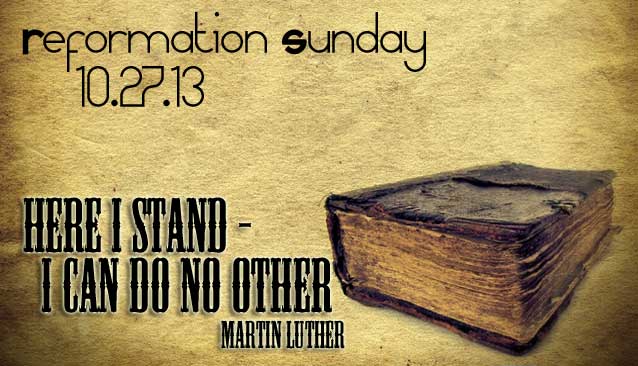
reformation.sunday.13The challenge for the earthly Church is our fixation on right or wrong.  The Body is the fullness of relationship, not the vagaries of belief or doctrine.  Sadly, we have determined that dogma somehow takes precedence over the harder and more essentially catholic work of being in relationship.

Reformation Sunday, as so many celebrate, elevates brokenness over wholeness.  It celebrates the schism, the breaking, of the Body.  It is a sad celebration at its heart.  It reminds me of the families that insist that the funeral is a “celebration of life” rather than a recognition of the loss of and intercession for the deceased.  It is a forced and disjointed thing that insists that pain is merely joy in another gauzy form.

Those churches that celebrate “Reformation Sunday” are celebrating human blindness to the wholeness of Christ’s own Body.  They are celebrating our inability to find wholeness in the midst of division.  They are celebrating the triumph of “rightness” over relationship.  They are celebrating the elevation of “right thought” over grace and comprehension.

It is easy to be right – it is a far more challenging and sacrificial thing to be in relationship.

Of course there were abuses in our past – and there are in our present.  Yet where does division end?  When can we be right enough?

This is the challenge of the Reformation – when are we Reformed enough?  The current state of Protestantism would be unrecognizable to Luther or even Calvin in its distance from tradition and, too often, reason.

The wholeness of Catholicity is not about right or wrong – it is about sacrifice.  The reformers sought to underplay and even eliminate notions of sacrifice in the Eucharist.  There is a necessary self-abnegation that is inherent to notions of Eucharistic sacrifice that is inimical to hyper-Protestantism.  Just as an over-emphasis on table fellowship puts us at the center of the Eucharistic action so too does an emphasis on our need to be right or for others to be wrong put us rather than the Living Presence at the center of the Church’s life.

Catholicity calls us to self-giving – it calls us to be the Body – to hold up one another in brokenness rather than drive one another away.

Christ’s sacrifice, the pierced Body of Christ, the Resurrection Victory of Christ – his self-offering, his forgiveness, his coming again– all that we remember and encounter in the Eucharistic action – call us to remember that our bodies – our earthly bodies and our souls are knit to his in both sacrifice and resurrection – in love for and service to the world around us.

Therein lies one of the glorious mysteries of faith – God counts us precious – knows each of us in our trembling weakness and our tearful joys, in our rightness and our wrongness, for he has walked alongside us, suffered for us, and raises us to glory.

We are given a prayer to pray daily, over time, and with intention that will open the depths of the Kingdom bit by bit, day after day, year after year.

Hallowed be thy name. Thy kingdom come.

We know that even as we are welcomed to call God Father, we are not God, so we place his name above all others and we ask that his reality become ours – that his peace and righteousness may come to pass. We ask that He would fulfill the promises declared unto humanity – and he asks it of us – he lays it out for us in the next line.

We receive our daily bread as a gift of grace and we are to forgive those who are indebted to us, who have wronged us, who owe us – because that is exactly how God has dealt with us. Forgive us our trespasses as we forgive those who trespass against us.  The Church is a Body at the work of forgiveness – we are called to model what it means to strive to be in ever deeper relationship.  This is not simply for the sake of being in relationship but for the sake of showing what it means to follow Christ.

We are not called to draw lines in the sand but to erase the lines between us.

May we all be forgiven for the need for Reformation – for the sins of those who create systems that seem, at times, beyond redemption, and for the sins of those who break away when wholeness is most needed.

postscript

A thoughtful friend raised the question of a relationship that is abusive – are we obliged to remain in such a relationship?  My answer would be, absolutely not.  Yet there too is a cause not for celebration but for a recognition of human sinfulness and our capacity to do violence to one another.  The question, for me, is how do we provide for systems of justice and mercy that hold us together and mutually accountable?  That mercy and justice must include us as well – include our need to be treated with dignity – even as it places demands upon us.

We must grieve the loss of relationships for they represent the places in which we have a chance for our faith to come alive.  The way we treat one another is a point at which we manifest Easter living.  The ending of a relationship is a thing of sadness as it means that we, either by choice or necessity, have found ourselves unable to dwell in peace.  That is the crux of the sadness.  It is no sin to flee abuse – but we need to mourn and address the injustice of the situation.

Robert


Share this:

  • Share on X (Opens in new window) X
  • Share on Facebook (Opens in new window) Facebook
  • Share on Reddit (Opens in new window) Reddit
  • Share on Tumblr (Opens in new window) Tumblr
  • Email a link to a friend (Opens in new window) Email
Like Loading...

The Boat is not the Church: The Sinking Ship Metaphor

07 Monday Oct 2013

Posted by RHendrickson in Uncategorized

≈ 4 Comments

Working in the Church, one often hears the metaphor that we are “rearranging deck chairs on the Titanic” or some other sinking ship metaphor. What is often implied is that whatever is being done is not enough and the Church is sinking fast.

It works, if your definition of the Church is as something that is actually sinkable. The problem with the Church-as-sinking-boat metaphor is that it completely misidentifies who and what the Church is. The Church is not the burst hull and sinking vessel, the Church is the Body of people who are trying to find rescue and respite – who are caring for the lost finding the desperate. The Church existed before the worlds were born for it was held in the heart of the Trinity and revealed in Christ’s walking among us.

The Church is not sinking – the structure of the Church is undoubtedly creaking and cracking – but the Church herself, the Body of her faithful people, is reaching to find some way to a new craft that will carry them in to calmer waters.

The Church is the people who have built and trusted the structure to carry them in relative comfort. The Church is the people who are relying on the institution to help carry them from one place to another. The Church is the people longing to find a place a peace amidst stormy waters. The Church is the people who found themselves with no hope left and then were rescued. The Church is the people who were lost beneath the waters before they could be rescued.

My friend and I were sitting next to one another when we heard the metaphor most recently used. We both had the same reaction at the same time – we need to stop using this metaphor. He offered the image to me of a ship sinking down into the water and landing on something rising up to meet it – something like the City of God rising up through the waters.

In other words, there is no doubt change coming and the Church (both her people and the institution) will look different, sound different, be different. Yet I don’t think it will look that different from the Church of the earliest centuries – a time when the people of God gathered around font and altar and sought ways to share the Good News with a world that was at best indifferent to the message they shared.

Before we had structures, bylaws, and committees – before conventions and deaneries – we had a Meal and a Great Commission.

cityroom-titanic-2-f-blog480 (2)Institutionally, it is time for us to stop identifying with the Titanic and to start identifying with the people shifting, by fits and starts, from one ship to another. The image that remains with me is the image of the Carpathia, a rescue ship, coming into port with those who had been saved from the sinking of the Titanic. You see in that picture the wounded, the frightened, the relieved, and the thankful. It is in the midst of that party of saved men and women that we are found as the Body.

No doubt, we are a group going through something unsettling and terrifying, knowing real loss and genuine grief. And yet the Church is at her best when she finds herself caught up in a vision of new life. We are being called no longer to know ourselves as the floundering ship but to be the brave men and women calling out to, reaching for, nursing, and making whole those all around us looking for a Church that outlasts rust, wind, ice, and fog.

Robert

Share this:

  • Share on X (Opens in new window) X
  • Share on Facebook (Opens in new window) Facebook
  • Share on Reddit (Opens in new window) Reddit
  • Share on Tumblr (Opens in new window) Tumblr
  • Email a link to a friend (Opens in new window) Email
Like Loading...

Sacramental Leadership: Church, Restructuring, and Holy Vision

01 Tuesday Oct 2013

Posted by RHendrickson in Uncategorized

≈ 2 Comments

What does it mean for a Church to be led in a way that is life-giving and invites the transformation of her members to be set aside for God’s holy use?

There is much talk of restructuring in the Episcopal Church right now.  There is lots of conversation about the nature of our structures, our need to be a missionary (or missional in more contemporary parlance) people, and our need to create a culture that responds to the society we actually find ourselves a part of.

One of the challenges of administering Sacraments is that we are administering an objectively changed reality to people with varying degrees of perception as to their truth and efficacy.  We rely on the wisdom of our people to allow the changes being wrought to take root in their heart and way of being in the world.

Our challenge as a Church now, with regard to the shifting of society, is much the same.  We are being called into a new time that requires the fullness of human creativity and participation to match the changing reality in which we find ourselves.  The task is one of perception and discernment – to see God at work as much in the world around us and its manifold changes as we are aware of his action and Grace in the Sacraments.

It is a difficult thing to see and lead Sacramentally for it means necessarily to lead and see by trust.  We have only the Lord’s word that anything new is happening with bread and wine or by water.  We also have only the Lord’s word to know that he is still with us and drawing us into an ever-changing reality grounded in his love and guidance.

We only have the promise of the Holy Spirit at the Altar and in the world.  And that promise is more than enough.

eucharistWe talk much about a Baptismal Ecclesiology in the Episcopal Church but it might be helpful to also talk of Eucharistically-shaped communities.  These are communities of vulnerability and boldness that find themselves and their hope revealed in the offering, blessing, breaking, and sharing of the Altar.

As communities, we gather together in our hope, joy, confusion, and pain.  We come to know the many gifts that God has given us.  From our first breath to our eternal promise we are gifted in ways that defy explanation and undo human understanding of earning and effectiveness and we gather to give thanks.

We are a people who hear the Word and promise of God together and pray without ceasing for one another and the world as we are welcomed to the throne of grace where we send up our intercessions and thanksgivings.

We take all that we have and all that we are and offer it for God to take up and transform.  We join our small gifts to that one great gift offered on the Altar and pray that we might find our offerings taken up for the spread of the Kingdom of God.

We are a people whose own brokenness – whose fracture – is known and grieved over by God.  We share not only in the perfect image of God but in the brokenness of the cross as we are those who shouted “Crucify” and those whom Christ forgave.  We carry the cross and know that others around us find themselves, all too often, at the foot of the cross hiding from the terrors of this world.

We are a people who share in the blessing of the Body.  We are called to be blessed and set aside for God’s holy use and given new life and purpose as the Holy Spirit pours out upon all our gifts and the Body is healed and formed for the feeding of the whole creation.

We are a people who are blessed for holy work.  The blessing we receive, as a Body, is not so much a benediction alone as much as a charge to heal and offer hope and renewal.  We are given the blessing to go and offer what we have received.

Finally, we are a people called to love and serve the Lord, to which we reply “Thanks be to God.”

There are committees and structures that will guide and govern our work as a people.  But there is a more concrete reality unfolding all about us.  People fed by Christ are doing Christ-like work all about us and the task ahead of us is not so much one of governance or management but one of finding ways of naming and lifting up that holy work.

Our Church leaders are being called to a deeper conversation than one about structure.  What does it mean to lead?  We cannot simply try to pinpoint the strategic or sociological difficulties that confront us.  We must ask ourselves basic, needful, and pressing questions that are not just for Episcopalians.

What does it mean to be disciples of a Prince of Peace in a death-denying and yet violent culture?

What does it mean to be disciples of a God of abundance and serve those who are financially or spiritually poor?

What does it mean to serve a God of Truth in a culture of falsity and distraction?

What does it mean to preach Kingdom in the face of Empire?

What does it mean to be the whole Body in a culture that exploits and shames difference?

What does it mean to follow Christ, to preach the Way, in a culture of temptation and indifference?

These are Sacramental questions because they naturally lead us to look deeply at the world around us and not just see where God is acting but to inspire others with a vision of what a new and holy life looks like as transformation unfolds.  We need to be the kinds of Christians that non-Christians have never met.  The kind of Christians who see the world with the Love that God sees it and name God’s abundance and action in spite of the rampant insecurity and culture of scarcity that has us in its grips.

We are being called to be the Church – to gather, to offer, to know brokenness, to find ourselves made whole, and to share the blessings of God all about us.  We are called to be the Holy People of God within whom the Holy Spirit is welling up and who trust that the Lord is making common things holy indeed.

Robert

Share this:

  • Share on X (Opens in new window) X
  • Share on Facebook (Opens in new window) Facebook
  • Share on Reddit (Opens in new window) Reddit
  • Share on Tumblr (Opens in new window) Tumblr
  • Email a link to a friend (Opens in new window) Email
Like Loading...

Current

  • The Society of Catholic Priests of the Episcopal Church An Anglican society devoted to catholic spirituality welcoming all priests, deacons, seminarians, and religious as members.
  • Saint Philip's in the Hills, Tucson St. Philip’s is a large, active parish known not only for its worship, music, and art, but also for its inclusiveness, educational programs, and its outreach to the community.

Links

  • Saint Hilda's House A residential spiritual formation and service program for recent undergrads.
  • Christ Church New Haven An engaged urban parish in the Anglo-Catholic tradition.
  • Saint John's Cathedral, Denver Saint John’s Cathedral continues its rich Anglican tradition of historic ministry in downtown Denver along with the tradition of forward-looking, public ministry on the frontier.

Recent Publications

  • Yearning: Young Adults, Authentic Transformation, and the Church A recent book by Robert on young adults ministry and the future of the Church. It features contributions from 22 young adults with whom he was privileged to work in New Haven along with his own reflections in addition to three guest essays.

Archived Posts

Recent Entries

  • We’ve Voted: What’s Next? November 4, 2020
  • Dying at the Border of Truth and Beauty: Stories we Need to Hear December 4, 2018
  • A Justice for our Time? Reject Judge Kavanaugh. September 27, 2018
  • The Trump Delusion: What We’re Begging for is a Renewed Church not a New Prayer Book July 9, 2018
  • You can be right or you can be in relationship: You don’t get to choose both July 7, 2018
  • Peace Between the Outrages June 18, 2018
  • The Many Problems with Bishop Michael Curry’s Royal Wedding Sermon May 20, 2018
  • The Torture of Our Souls May 15, 2018
  • A Catholic Future: Universal Discomfort March 11, 2018
  • Priesthood is a Pack Activity January 14, 2018
  • The Women October 17, 2017
  • Story by Story: from Generation to Generation October 16, 2017
  • This Very Night: A Sermon for Maundy Thursday April 14, 2017
  • Midnight Evangelism July 19, 2016
  • Is it Nothing? July 8, 2016
  • A Corpus Christi Moment: Making a Home for the Body June 2, 2016
  • Wonderfully Made: Being Pro-Life and Pro-LGBT April 13, 2016
  • Communion? The Fracturing of Shared Reality April 12, 2016
  • Refrain from Anger: On Anglican Bigotry January 19, 2016
  • Behold, Your Son: Loss, Love, and Family January 6, 2016
  • It Couldn’t Possible Matter, but It Does: The Superficial and the Silly in Liturgical Life December 8, 2015
  • Waiting on God: Advent and Violence December 6, 2015
  • We Believe? On the Limits of Inclusion September 9, 2015
  • The Gift of Joy and Wonder August 26, 2015
  • Considering Abortion: Dialogue and Dignity in the Episcopal Church July 14, 2015
  • One Lesson from China: Belief in a Post-Something Society July 9, 2015
  • Of Papal Encyclicals and Charleston: Mutual Responsibility and the Body June 19, 2015
  • A Message Signed with Blood: A Sermon on the Martyrdom of 21 Christians in Libya March 3, 2015
  • A New Tabernacle: A Home for Homeless and the Host February 23, 2015
  • Must All Episcopal Bishops be Elected? A Modest Proposal January 29, 2015
  • Liturgy: It’s not the Work of the People January 22, 2015
  • An Alcohol Free Lent: A Season of Repentance and Reflection January 14, 2015
  • A Sermon for the Feast of All Saints 2014 November 3, 2014
  • How an Atheist Became a Priest: The Persuasiveness of Simple Things October 12, 2014
  • The Eucharistic Heart of Christian Leaders October 2, 2014
  • Appreciating the Faculty of General Seminary September 30, 2014
  • And There Was War: Remembering General Seminary at Michaelmas September 30, 2014
  • Prayerfully Holding the Center: Leadership in a Changing Church September 29, 2014
  • Why Anglicanism? Catholic Evangelism and Evangelical Catholicism September 11, 2014
  • Why the Church? August 22, 2014
  • It Couldn’t Possibly Matter: On Righteous Dismissiveness, Frivolousness, and Tradition August 21, 2014
  • Somewhere, Somehow: The Geography of Nowhere, Mason Jars, and the Church August 19, 2014
  • The Future Work of the Episcopal Church: Part I July 18, 2014
  • The Diaconate and Lay Religious Orders: The Shape of Future Ministry July 16, 2014
  • Strange Language: Jargon, Tradition, and Essence July 12, 2014
  • Tribal Jargon: A Case for Strange Language in the Church July 10, 2014
  • Faithful Women and the Presence of Christ June 24, 2014
  • The Depressing Regularity of Black Masses May 25, 2014
  • Cassock Albs are Destroying the Church May 21, 2014
  • The Seven Last Words: A Sermon for Easter Sunday April 23, 2014

Enter your email address to follow this blog and receive notifications of new posts by email.

Most Read Posts

  • A Message Signed with Blood: A Sermon on the Martyrdom of 21 Christians in Libya
  • On Modernism: of Its End and the Liturgy
  • Cassock Albs are Destroying the Church
  • Faithful Women and the Presence of Christ
  • Strange Language: Jargon, Tradition, and Essence
  • "You don't have to leave your brain at the door" - Can we please stop saying this?
Follow A Desert Father on WordPress.com

Create a free website or blog at WordPress.com.

Privacy & Cookies: This site uses cookies. By continuing to use this website, you agree to their use.
To find out more, including how to control cookies, see here: Cookie Policy
  • Subscribe Subscribed
    • A Desert Father
    • Join 316 other subscribers
    • Already have a WordPress.com account? Log in now.
    • A Desert Father
    • Subscribe Subscribed
    • Sign up
    • Log in
    • Report this content
    • View site in Reader
    • Manage subscriptions
    • Collapse this bar
 

Loading Comments...
 

    %d