• About

A Desert Father

~ The Rev'd Robert Hendrickson

A Desert Father

Monthly Archives: July 2015

Considering Abortion: Dialogue and Dignity in the Episcopal Church

14 Tuesday Jul 2015

Posted by RHendrickson in Uncategorized

≈ 6 Comments

One of the inescapable and salient truths that comes across in Laudato Si, the Pope’s recent encyclical, is the powerful interconnectedness of the created order that is imprinted into the very fabric of creation. A loving God calls us to respond to his generosity with generous love and care for the whole order of creation not only as a way of passing on creation to those who come after us but because an inherent dignity is conferred on that order through God’s self-giving. We are to see in the world around us something created for delight which is to be delighted in and not simply exploited. Creation is an expression of God’s love that is to be received with reverence and treated with grace. This interconnectedness demands something of us.

I have read the work with a mixture of joy, shame, and awe. I take joy in this Pope’s willingness to put the moral force of the Church behind an issue with global and historic ramifications. I am awed by both the simplicity of his approach and the clarity of his thinking. I have been shamed in contemplating my own complicity in the degradation of creation and in pondering my own too frequent lack of action.

Yet another piece of the encyclical triggered complex feelings. A little acknowledged portion of the encyclical reads, “Since everything is interrelated, concern for the protection of nature is also incompatible with the justification of abortion. How can we genuinely teach the importance of concern for other vulnerable beings, however troublesome or inconvenient they may be, if we fail to protect a human embryo, even when its presence is uncomfortable and creates difficulties? If personal and social sensitivity towards the acceptance of the new life is lost, then other forms of acceptance that are valuable for society also wither away.”


Like so many, I have long been conflicted over the Church’s response to abortion. I once found myself in the company of those from one side who would use terms like “holocaust” to describe abortion. At other points I have found myself vigorously defending the right to choose and decrying the incrementalist encroachments on that right that have become so routine in so many places.

Yet, just when I think that I have settled what I believe, some deep seated unease returns. I have been generally unwilling as a priest to broach this issue. I know people who have terminated pregnancies. I know they do so for reasons that are complicated, painful, and distressing. They are people of faith and goodwill who long to follow Christ in an imperfect world.

I have had few qualms about speaking openly about my belief that the death penalty, torture, and exploitative labor practices are crudely and cruelly sinful. Yet I have come short in talking openly about abortion except with close friends and colleagues. Reading the Pope’s clarity has made me question that reticence. I can’t comfortably not have the conversation when the fundamental theological question is one of interconnectedness and our care for the vulnerable.

Many have been quick to praise Francis for his forthright declarations on the dignity of creation. It seems that we must be just as willing to hear his message with regard to the dignity of the unborn as well.

This is not an easy proposition in the Episcopal Church. We theoretically have taken Bill Clinton’s maxim of “safe, legal, and rare” to heart. Yet there is a general assumption that being pro-life is primarily the province of the retrograde and the reactionary. I’m simply not sure that clear division can exist in a Church that takes strong positions on dignity in many forms. When we speak so clearly on the fundamental dignity of LGBT folks, on labor rights, on environmental justice, on immigration policy, and countless other issues, we may need to welcome the voices of those who would call us to consider the unborn among those deserving of our commitment to their protection.

Interconnectedness and dignity may call us to be open to voices that speak for those without a voice.

This may take a wide range of forms and we would be ill served if we allow a zero-sum mentality to dominate our dialogue on this. For example, here in Colorado, many conservatives vehemently opposed the open availability of contraceptives to teens. Yet, from 2009-2013, there was a 40% drop in teen pregnancies and a 35% drop in abortion statewide. This was a success from a public health point of view. It was also a success if one goal is to reduce the overall number of abortions.

We cannot separate public policy and effective sex education from these questions. If we are going to deepen an understanding of human dignity we need to open the conversation up as widely as possible. Our primary concern can’t be the control of women’s bodies but for the kind of thorough public education and policy that makes abortion a rarely needed option. Legal solutions are not the only ones available to us nor is dualistic thinking going to help us arrive at a place where abortion is considered only as a needed option in extreme cases.

If we are going to take interconnectedness and dignity to be firm foundations in our public theology then we are going to need to have an honest, open dialogue on abortion that breaks open our desire for simple answers. A comprehensive, consistent ethic of life – of care and compassion from life’s first stirrings and beyond – should make this conversation one that we are humbly determined to engage.

I can’t say what my thinking about the legalities of abortion will be in five years or in ten. I can say with confidence that I will be disappointed if we haven’t engaged the issue with the eyes, heart, and hope of faith. I don’t expect us to find clarity any time soon but I do hope that our openness to ask the questions and to listen to voices we might rather ignore may help grow in faith, hope, and love. This is one challenge of interconnectedness – we need one another to ask hard questions, seek faithful answers, and to hear the still small voice speaking freshly.

Robert
Share this:

  • Share on X (Opens in new window) X
  • Share on Facebook (Opens in new window) Facebook
  • Share on Reddit (Opens in new window) Reddit
  • Share on Tumblr (Opens in new window) Tumblr
  • Email a link to a friend (Opens in new window) Email
Like Loading...

One Lesson from China: Belief in a Post-Something Society

09 Thursday Jul 2015

Posted by RHendrickson in Uncategorized

≈ 2 Comments

Sometimes I get asked what I would do if I was not a priest. In all likelihood there are two options – the first is an academic path in which I imagine teaching modern Chinese history – teaching post-Mao Marxist ideology or the like. The second option might be for Karrie and me to run a bed and breakfast or hostel in the foothills of the Himalayas, Yunnan province, in China. We’d serve a range of staple backpacker foods and meet folks from all over the world through the day. Having spent a good bit of time over the last decade or so visiting, studying, and traveling in China and talking with experts and cab-drivers alike I have developed a sense of what living in a post-something society looks like.

In China, there is a palpable sense of the desire for more. For some it is more money, for others more stability, for others it is more connection. Yet, across the country more is longed for. The old spiritual and philosophical infrastructure was torn apart by the Great Leap and the Cultural Revolution and the ascendancy of the economic pragmatism of Deng Xiaoping. A century or more of instability, starvation, and humiliation led to a country that was ready for a little pragmatism after the paroxysms of revolution, war, and more.

The Cultural Revolution, in particular, laid waste to much of the essence of Chinese culture. Old thought, old ways, old architecture, and more were destroyed, purged, and burned in a decade of psychosocial and political upheaval.  It’s difficult for us to imagine the costs of the Cultural Revolution. The Chinese economy and education ground to a standstill and countless cultural artifacts, religious sites, and historical treasures were destroyed.  

It was a complicated period but perhaps no more complicated than McCarthyism or the Draft Riots or other points in our own history when we needed to find enemies and conspiracies.

Yet, as Deng Xiaoping came to power after Mao’s death, he came with a simple premise. The government would maintain order and provide economic growth. Its legitimacy would rest on results not ideology. What happened next was an almost unbelievable economic miracle that continues to change China from day to day. Each year I go back and it feels as if another decade of economic change has gone by. Yet each year something else happens too – I talk with young people who wonder aloud, more and more frequently, “Is this all there is?”

When Mao purged Confucianism, Buddhism, and Christianity from the public consciousness it primed a reinvention of Chinese identity.  As material progress unfolds and the emerging generations are further and further removed from the political chaos of their parents’ generation and the mass starvation of their grandparents’ there is a desire to reconnect with what is most essential to human identity and specifically Chinese identity. 

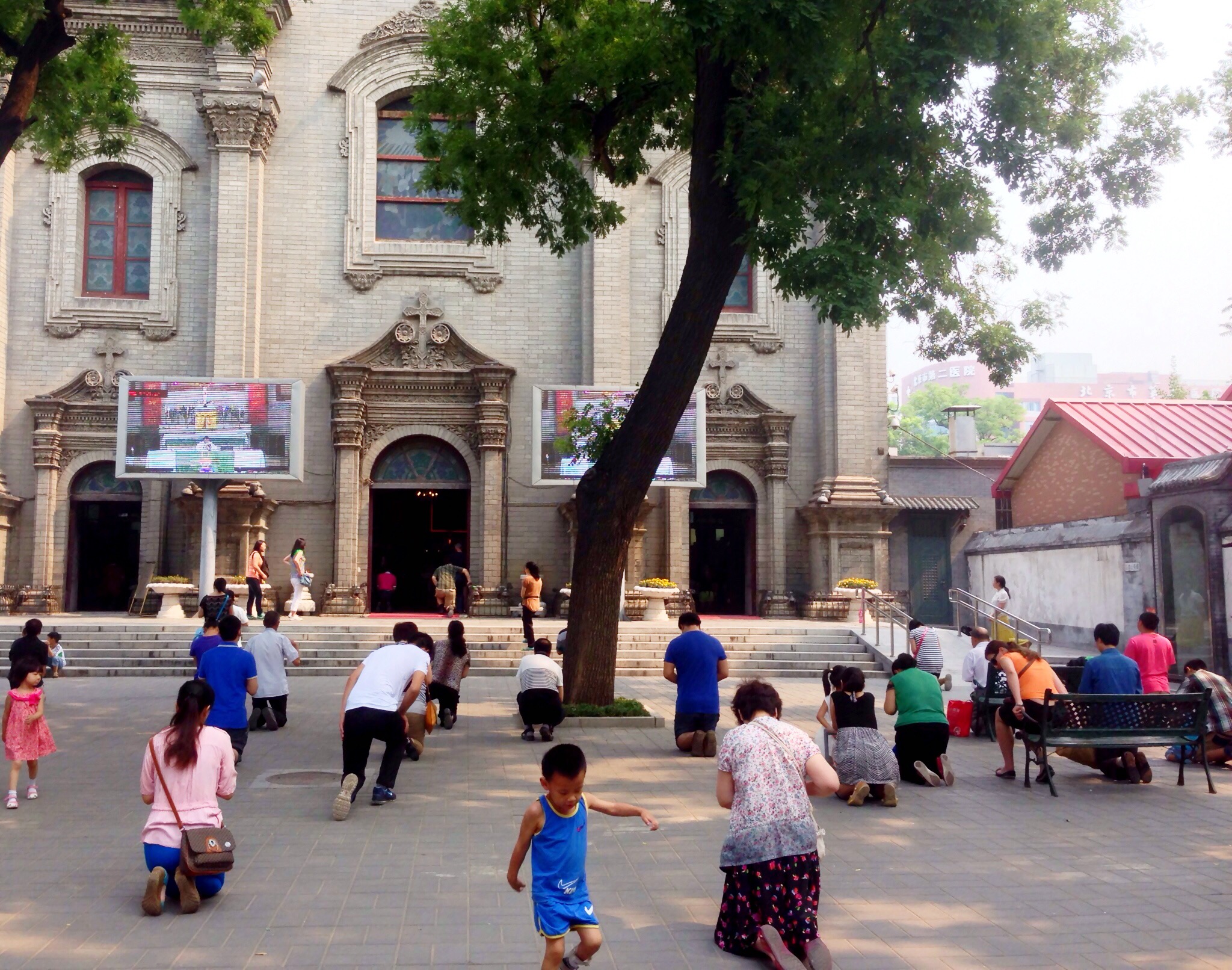
Temples and churches are full of young people asking the most basic questions and even Chinese propagandists are talking of the Chinese Dream – something deeper than ideology or practical economic gain. 

Christian history in China is bound up with particularly cruel violence and conflict: the Opium Wars, the Boxer Rebellion, and the Taiping Rebellion all shaped the way Christians are viewed in China. After the second Opium War, the Summer Palace was burned and looted. Cultural treasures were hauled off from across Beijing by a force of British and French troops. The great French novelist Victor Hugo, writing to a friend, was unsparing in his report: “All the treasures of all our cathedrals put together could not equal this formidable and splendid museum of the Orient. It contained not only masterpieces of art, but masses of jewelry. What a great exploit, what a windfall! One plundered, the other burned. And back they came to Europe, arm in arm, laughing away. Such is the story of the two bandits—before history, one of the two bandits will be called France; the other will be called England. ”

The complex feelings many Americans have toward Islam now because of 9/11 resemble the emotions that some Chinese have about Christians. For the Chinese, the events of the 1860s are present in their collective memory in much the way that Americans recall the Civil War.

Yet Christianity thrives in China. “By my calculations,” writes one Chinese scholar of religion, “China is destined to become the largest Christian country in the world very soon” (Fenggang Yang, Religion in China: Survival and Revival under Communist Rule). “It is going to be less than a generation,” Yang writes, “Not many people are prepared for this dramatic change.”


Chinese Christians kneeling outside South Cathedral during a standing room only mass.

 
I truly believe that a similar, if less ideologically orchestrated, shift is underway in the United States. We are witnessing in a generation the erasure of a host of assumptions about what is or is not essential to our identity. Assumptions about racial and gender identity are superficial manifestations of the unseating of cultural norms and conventions. The place of religion in our society is changing as well – its norms and conventions are being undone. Fundamental shifts are happening at a pace that is jarring because it is happening at the new speed of communication – change is happening at the pace of rapid-fire text messaging rather than that of lovingly crafted letters.

A cultural revolution is underway here that is being powered not by a centralized authority but by our collective acquiescence to technological and consumerist desires.  The impact, however, will be long felt and devastating.  There are pockets of resistance and a general sense of unease yet I suspect that the harm will be done before we realize it has happened.  Look at the way education is being treated now as a commodity and students as consuming customers for some insight into what is happening broadly in our culture.

In some ways the change is barbaric in its pace and intensity. When the walls of Rome fell I wonder if those watching saw it as simply one more incursion in a series of them? I doubt there was there a decisive moment when they said, “Oh, we’re in the Dark Ages now.” I tend to think that little by little dramatic changes in succession are lost in a wave of significance and insignificance alike. There’s a shifting of the terrain and you look about and realize that the world moved as you glanced away.

The world is moving around us.  There is no shortage of blog posts, books, and essays on what manner of post-something society in which we now find ourselves.  Yet the fundamental search for truth and identity remains fixed.  We are a people who seek pattern and meaning even as our sources of stable authority and measures of validity change.  We still search for fixed points though even as we distrust meta-narratives.
One noticeable thing in Buddhist temples in China is the discomfort with proper ways to show respect in religious places. Some Chinese enter them knowing exactly what to do – they bow and offer incense and prostrate in precisely the right ways. These are older folks who learned these things in a way that was deeper than memory and outlasted the petty virulence of the Red Guards of the 60s.  Custom and meaning are inhabited in a way that lasts beyond change and revolution.

Younger Chinese come in with less certainty but more earnestness – they arrive hoping to find something there. They are not sure what to do, they bow and look out of the corner of their eyes and wonder if they’re doing it right. They offer incense but aren’t sure how much to offer. They prostrate but can’t quite figure out how many times is the right number of times. Yet they are coming. They are coming because they know there is more in a culture that longs for more. It’s counter-cultural and it’s counter-intuitive and yet it’s happening across China.

Unfolding around us in the United States is a great leveling – a cultural revolution.  Things which had been raised up are being cast down and yet I truly believe that all things are being brought to their perfection. We are being called to offer something ancient to a culture that is losing its accumulated and inherited sense of depth, beauty, and meaning. Fascination with self, celebrity, and status are going to wear thin though and we are going to look up from screens.  We are going to look into the mirror and ask, “Is this all there is?”

It’s happening now – it’s happening all around us. People are nervously coming into our churches, unsure how to act, uncertain as to why they are there, and yet they know there is more. In so many places we are a Church built for the generations of the certain – built for those who know the stories yet who disagree on the moral or the authorship or the details.

Many of our churches are places that reinforce the story as we like to tell it – massaging details for those who found the story lacking punch or promise at another purveyor. Yet the generation that is coming will not have heard it at all. They won’t come with preconceptions or the like – they’ll come with faint stirrings or with dreadful certainty that there is more. Are we equipped and ready to tell the story wholly anew?

Can we be the place that stands with faith and hope in the desert as the oasis when the thirst sets in?  What looks like collapse now for the Church is not really collapse – it is a return to nomadic faith – a faith that preaches to those outside the walls who find that living within them comes at too great a price. We are being given the chance to drink and offer living water as hosts at the well. 

The Church’s stability of the last fifty years has been bought at a high price as we have too often leased integrity for political collusion and social comfort. Our home won’t be the security of civilization much longer for the civilized world will have little use for us. An empire of distraction can’t really abide a source of truth.

As surely though as young Chinese are finding their way back after the leveling of Maoist excess and the apparent triumph of economic determinism – so too will we be asked to explain who we are and why we exist. We will be asked about our great promise – and we can really only have one answer.

We are the Body of Christ living, loving, and learning in such a way that people see more in us. I believe that is the moment for which we are being readied. We are being prepared for a time of wandering, a time of gathering, a time of story telling when we will gather not reflecting on where we were, where we once called home, but relishing the journey together as Jerusalem beckons again. 

 Along the way, people will come. They will hear songs of faith and see acts of compassion and they will come. They will see miracles and simple signs of love that will be remarkable for they will be real and not cropped on screens and filtered.  They’ll see our imperfection and our hurt and our questioning and they’ll come because they will hurt, and question, and be tired of Instagrammed perfection. 

They’ll be sure there’s more and we will be wise, in our camps outside the walls, to receive them with open arms for they will change us and they will be our future and hope for they will call us to share Christ anew.

Robert

Share this:

  • Share on X (Opens in new window) X
  • Share on Facebook (Opens in new window) Facebook
  • Share on Reddit (Opens in new window) Reddit
  • Share on Tumblr (Opens in new window) Tumblr
  • Email a link to a friend (Opens in new window) Email
Like Loading...

Current

  • The Society of Catholic Priests of the Episcopal Church An Anglican society devoted to catholic spirituality welcoming all priests, deacons, seminarians, and religious as members.
  • Saint Philip's in the Hills, Tucson St. Philip’s is a large, active parish known not only for its worship, music, and art, but also for its inclusiveness, educational programs, and its outreach to the community.

Links

  • Saint Hilda's House A residential spiritual formation and service program for recent undergrads.
  • Christ Church New Haven An engaged urban parish in the Anglo-Catholic tradition.
  • Saint John's Cathedral, Denver Saint John’s Cathedral continues its rich Anglican tradition of historic ministry in downtown Denver along with the tradition of forward-looking, public ministry on the frontier.

Recent Publications

  • Yearning: Young Adults, Authentic Transformation, and the Church A recent book by Robert on young adults ministry and the future of the Church. It features contributions from 22 young adults with whom he was privileged to work in New Haven along with his own reflections in addition to three guest essays.

Archived Posts

Recent Entries

  • We’ve Voted: What’s Next? November 4, 2020
  • Dying at the Border of Truth and Beauty: Stories we Need to Hear December 4, 2018
  • A Justice for our Time? Reject Judge Kavanaugh. September 27, 2018
  • The Trump Delusion: What We’re Begging for is a Renewed Church not a New Prayer Book July 9, 2018
  • You can be right or you can be in relationship: You don’t get to choose both July 7, 2018
  • Peace Between the Outrages June 18, 2018
  • The Many Problems with Bishop Michael Curry’s Royal Wedding Sermon May 20, 2018
  • The Torture of Our Souls May 15, 2018
  • A Catholic Future: Universal Discomfort March 11, 2018
  • Priesthood is a Pack Activity January 14, 2018
  • The Women October 17, 2017
  • Story by Story: from Generation to Generation October 16, 2017
  • This Very Night: A Sermon for Maundy Thursday April 14, 2017
  • Midnight Evangelism July 19, 2016
  • Is it Nothing? July 8, 2016
  • A Corpus Christi Moment: Making a Home for the Body June 2, 2016
  • Wonderfully Made: Being Pro-Life and Pro-LGBT April 13, 2016
  • Communion? The Fracturing of Shared Reality April 12, 2016
  • Refrain from Anger: On Anglican Bigotry January 19, 2016
  • Behold, Your Son: Loss, Love, and Family January 6, 2016
  • It Couldn’t Possible Matter, but It Does: The Superficial and the Silly in Liturgical Life December 8, 2015
  • Waiting on God: Advent and Violence December 6, 2015
  • We Believe? On the Limits of Inclusion September 9, 2015
  • The Gift of Joy and Wonder August 26, 2015
  • Considering Abortion: Dialogue and Dignity in the Episcopal Church July 14, 2015
  • One Lesson from China: Belief in a Post-Something Society July 9, 2015
  • Of Papal Encyclicals and Charleston: Mutual Responsibility and the Body June 19, 2015
  • A Message Signed with Blood: A Sermon on the Martyrdom of 21 Christians in Libya March 3, 2015
  • A New Tabernacle: A Home for Homeless and the Host February 23, 2015
  • Must All Episcopal Bishops be Elected? A Modest Proposal January 29, 2015
  • Liturgy: It’s not the Work of the People January 22, 2015
  • An Alcohol Free Lent: A Season of Repentance and Reflection January 14, 2015
  • A Sermon for the Feast of All Saints 2014 November 3, 2014
  • How an Atheist Became a Priest: The Persuasiveness of Simple Things October 12, 2014
  • The Eucharistic Heart of Christian Leaders October 2, 2014
  • Appreciating the Faculty of General Seminary September 30, 2014
  • And There Was War: Remembering General Seminary at Michaelmas September 30, 2014
  • Prayerfully Holding the Center: Leadership in a Changing Church September 29, 2014
  • Why Anglicanism? Catholic Evangelism and Evangelical Catholicism September 11, 2014
  • Why the Church? August 22, 2014
  • It Couldn’t Possibly Matter: On Righteous Dismissiveness, Frivolousness, and Tradition August 21, 2014
  • Somewhere, Somehow: The Geography of Nowhere, Mason Jars, and the Church August 19, 2014
  • The Future Work of the Episcopal Church: Part I July 18, 2014
  • The Diaconate and Lay Religious Orders: The Shape of Future Ministry July 16, 2014
  • Strange Language: Jargon, Tradition, and Essence July 12, 2014
  • Tribal Jargon: A Case for Strange Language in the Church July 10, 2014
  • Faithful Women and the Presence of Christ June 24, 2014
  • The Depressing Regularity of Black Masses May 25, 2014
  • Cassock Albs are Destroying the Church May 21, 2014
  • The Seven Last Words: A Sermon for Easter Sunday April 23, 2014

Enter your email address to follow this blog and receive notifications of new posts by email.

Most Read Posts

  • The Lord's Descent into Hell: A reading from an ancient homily for Holy Saturday
  • The Seven Last Words: A Sermon for Easter Sunday
  • A Message Signed with Blood: A Sermon on the Martyrdom of 21 Christians in Libya
  • Refrain from Anger: On Anglican Bigotry
  • High Church? Low Church? Broad Church? On the Insufficiency of Labels
  • The Diaconate and Lay Religious Orders: The Shape of Future Ministry
  • A Sermon for the Feast of All Saints 2014
  • A New Tabernacle: A Home for Homeless and the Host
Follow A Desert Father on WordPress.com

Blog at WordPress.com.

Privacy & Cookies: This site uses cookies. By continuing to use this website, you agree to their use.
To find out more, including how to control cookies, see here: Cookie Policy
  • Subscribe Subscribed
    • A Desert Father
    • Join 316 other subscribers
    • Already have a WordPress.com account? Log in now.
    • A Desert Father
    • Subscribe Subscribed
    • Sign up
    • Log in
    • Report this content
    • View site in Reader
    • Manage subscriptions
    • Collapse this bar
%d