On the Eucharistic Sacrifice

For those that are readers, this essay represents a small shift in the blog.  I am going to endeavor over the next few posts to delve into some sources from our tradition, at some length, to explore core elements of our doctrinal and theological inheritance as Anglicans.  I think one of the great challenges of the Church right now is that we have overlooked the importance of sound theology and it would be a good thing for there to be a few places where the riches of our tradition were being explored and mined for enduring truths.

This does mean that I will post with less frequency and probably with less intensity about the issues of the day – but I hope these next few posts (which will be somewhat longer) will provide some new avenues for discussion and engagement with our tradition.

One of the real shocks in the recent contretemps over Baptism and Communion was the paucity of much of the Eucharistic theology of the Church.  The position papers that were put together by various dioceses and working groups were almost scandalous in their utter abandonment of anything that resembled the Eucharistic theology that we have inherited from both the Reformed and Catholic branches of the Church.

One of the chief oversights in much of the discussion was the nature of the Eucharistic sacrifice.  I heard lots and lots of meal language, fellowship chatter, and radical welcome talk, but I heard perilously little about the nature of the Eucharist itself – that it has, at its heart, a sacrificial character that is participated in by those who receive.  We take part both in the sacrifice and in being offered as one Body.
I remembered a solid book I read by Anglican theologian Darwell Stone called, “The Eucharistic Sacrifice.” It is actually a collection of sermons from 1919 that examine the nature of Christ’s sacrifice and our union with Christ in that self-offering.


“The Eucharist is the presentation of the body and blood, the human life, of our Lord to God the Father by the Church. … The consecrated Sacrament is the body and blood of the Lord. He is present, and therefore we offer Him in sacrifice to the Father. Moreover this sacred presence explains the gift of God to ourselves. The Lord is in His Sacrament, and therefore He is not only offered in sacrifice to the Father, He is also in our Communion bestowed upon us. Thus, both for the sacrifice to the Father and for the gift to Christians there is need of the truth that at the consecration the bread and the wine are made to be the body and blood of Christ.”


Stone vigorously defends the Real Presence of Christ in the elements on the altar. The understanding of the Eucharist as sacrifice rests, for Stone, on Thomistic conceptions of matter, form, and their relation to the spiritual. Stone begins his work with an examination of sacrifice in Jewish, Pagan, and Christian traditions.


Stone states, “There are many resemblances between sacrificial ideas in the Old Testament and those in the New Testament, between those of pagans and those of early Christians.” However, those resemblances are mitigated by the nature of those sacrifices and their adequacy and efficacy over time and across humanity. Stone writes, “In sharp contrast [to Jewish writers] the Christian writers emphasize that the sacrifices of the Christian religion are spiritual. They are ‘spiritual sacrifices’ which St. Peter says that the Christian Church is to offer up.” The Christian offering and sacrifice was one that was not a carnal one but one of the spirit. All Christians are called to offer up this sacrifice. Christians, like the Jews, have a priestly caste “through whom the sacrificial functions of the society can be performed.” Christians and Jews, despite the difference in the nature of their respective sacrifices are unified by their election as “as sacrificial people with a special vocation from God which calls to sacrifice.”


There are marked similarities between the intent and exchange involved in Jewish sacrifice and the atonement offered through Christ’s sacrifice. In Jewish sacrifice, Stone identifies three fundamentals. He claims,


First, the sacrifice was a gift from man to God. As a gift, it was an acknowledgement of God’s power and supremacy, of the duty owed by the creature to the Creator. Secondly, it was a means of propitiation. The blood of the slain victim, itself the symbol of life, was offered to God as a means of pleading for the forgiveness of sins…Thirdly, the Jewish sacrifices were a means of communion between God and man.


Stone makes a swift transition to articulating the created kinship between God and man. Stone writes, “The truth, ‘God created man in His own image, in the image of God created He him,’ lies behind all that is possible of human intercourse with the divine.” Stone clearly makes the allusion between the Jewish sacrificial exchange and the Eucharist. For example, he writes, “In sacrifice the worshippers took part in a sacred meal which they were regarded as sharing with Almighty God Himself. In it there was access to God. In it the altar of sacrifice was also the table of the Lord. In it the food was the bread of God.” The sacrifice of Jews was “gift, propitiation, and communion.”


Sacrifice and the sacrificial teaching of the New Testament in particular is fulfilled in the sacrificial offering of Christ upon the cross for the atonement of the whole of humanity. Stone writes,


The sacrificial teaching of the New Testament reaches its height in the sacrifice of Christ Himself. Our Lord’s earthly life, His death, His resurrection, His ascension, His heavenly life, are seen to include the aspects of sacrifice gathered from the Old Testament, gift, propitiation, communion. In Him are the dedication to God of a perfect human life, the means of divine forgiveness for man, the means of communion between man and God. He describes Himself as a sacrifice on our behalf.


Christ is identified with a number of titles which indicate His sacrificial offering. He is acknowledged as Lamb of God which taketh away the sins of the world, passover, and propitiation for sins. Stone cites these and states, “In the Old Testament victim, the blood was the symbol of life, not of death. It was when the blood of the slain victim was poured out before God that the crucial moment in the propitiation was reached.” Christ, with His blood, redeemed humanity in the ultimate expression of human unity with god and forgiveness in God. Christ’s perfectly human blood “the symbol and essence of His whole human life” fulfilled the whole of the offering of atonement.


The vital element of the sacrifice of Christ was the surrender to God’s will. God’s universal salvific intent was manifested in the oblation of Christ. Christ’s suffering and death give meaning to sacrifice and suffering across the ages. Stone writes,


In the Lord Himself is the central sacrificial life of the universe. There have been pictures of it all the world over. The sufferings of the brute creation, the cries of women and children, the agonies of men, the dedication of will in life and in death, the rites, sometimes touching, sometimes repulsive, of heathen religions, in particular the ordered system of the Levitical law, all of these have in their different ways pointed on to the sacrifice of the cross, to the sacrifice presented in heaven; and in the light of Christ alone can their meaning ever be seen.


It is in this passage that Stone begins to make clear the link between the Incarnation and the physicality of Christ as perfect man and the sacrificial nature of the Eucharist. For the sacrifice of the Eucharist to make sense and for the suffering of the world to have meaning Christ must have lived and died as man. Stone states that the life of Christ is “the centre and strength of all Christian life and worship.” Stone declares, “As He is, so is the Church; as He is, so is the Christian; in His offering He offers those who are His.” The Church and the Christian find in Christ their anthropology and pattern. We observe the call to sacrifice and obedience to God. The fulfillment of life in God is represented as sacrifice. Stone states, “If we shall find that the Eucharist is the sacrifice of the Christian Church, we shall find a truth which is in harmony with the whole current of the Christian faith.”


The sacrifice of Christ points toward our unity with God. The harmony restored by the death and resurrection of Christ Jesus is indicated in other portions of the work of God and Christ. Stone claims that three aspects of God’s ongoing work indicate this divine-human unity. First is, “the distinctive character of man through creation whereby he possesses personality which enables him to be in communion with God.” Second, is the Incarnation in which “the relations between God and man obtain a new character” in which “there is a new use of that which is material.” Third, we have the Sacraments through which there is “actual union between Christians and our Lord’s incarnate life embodied in the life of His body.” All of these additionally point toward the work of the Holy Ghost. Stone writes, “Between His death and the life of the Church were his resurrection and ascension and the outpouring of the Holy Ghost.”


It is in the action of the Holy Ghost that Christians are brought into unity with Christ. We become members of the one body. Stone cites S. Paul in claiming “the Eucharistic gift is a participation in the body and the blood of Christ.” The bodies of individual Christians, by their baptism and commitment to new life, become a vehicle in “the economy of grace.” The Christian, by their unity with Christ in the Holy Ghost become filled with a potential for spiritual refreshment and reinvigoration in Him. They are made alike unto Christ, transitioning from suffering and humiliation to glory alike to the Lord Christ’s. Stone states, “It is through the operation of the Holy Ghost that in Baptism, the gate of all other Sacraments, our bodies are made the means through which we receive spiritual grace.”


The unity that often seems so elusive between our own soul and body, between the will of God and our own will, is brought about in the indwelling of the Holy Ghost and in our unity with Christ in the Sacraments. The life of prayerful obedience patterned in the life of Christ direct us toward new life and humble glory in and with Christ. Stone claims, “In our spiritual actions of faith and prayer we use our bodily brain as the instrument of spirit; in all kinds of actions which are instinct with spiritual purposes the spirit uses the body…” The body is the site of humiliation and sin and yet is the vehicle for grace and new glory. In Christ we see the pattern of shame and humiliation on the walk to Golgotha transformed into the redemptive might of the resurrection and ascension. As we partake in the divine nature of Christ, we make this journey from humiliation and dessication to glorification in the body and blood of Christ. Stone writes, “Christians actually receive the Holy Ghost , and through His operation are brought into actual union with the deity of Christ by means of His human nature, body, and soul.” It is in our Sacramental participation that we move ever toward unity in and with God. The Eucharist, however, is the apex of our Sacramental participation. Stone claims,


In the Eucharist the Holy Ghost acts by His divine power on the risen body of Christ in heaven and on the earthly elements which have been offered on the altar, and he transforms those elements into the body and blood of Christ. This divine action postulates the abiding existence of Christ’s human body; it assumes the spiritual state, unhampered by ordinary laws, of the body of Christ, through His resurrection and ascension; it utilizes that union of body and soul which makes it possible for each to be the servant of the other in spiritual life.


Our Sacramental life in Christ prepares us to live in unity with God and one another as we are called to a pattern of sacrificial and cruciform living. We are drawn ever nearer to God and to one another.


This process depends, in part, on our own intention with regard to receiving the body and blood of Christ. The body of Christ is given unto us when we make our communions. However, our own spiritual preparation in and with the Holy Ghost must be one which allows the body and blood to make their presence felt in and through us. Stone states, “our moral and spiritual benefit depends on the will with which we offer, the will with which we receive.” The sacrifice of Christ upon the cross and our unity in His body and blood are an example of how the evil and the good can co-dwell in an instant. The betrayal of Christ, his passion and crucifixion, are all transformed in glory. We too can be sites of vice or victory. Stone writes, “The Lord is there present to pardon and strengthen and bless. But to receive His blessing, our good will must go out to meet His.” The Eucharist challenges us to remember the ever-offered grace of God as well as the weight of the whole of man’s free will.


In Christ all other incomplete sacrifices and attempted propitiations have been made complete. Stone asserts, “From His supreme sacrifice Christian life and Christian worship derive their nature. The more they are like Him, the more are they full of sacrifice. The Eucharist is at the heart of Christian life, and is the climax of earthly worship.” In the Last Supper, the disciples who are with Jesus are given a foretaste of his sacrifice as each word he speaks is freighted with portent. Even in this meal, Stone states, “The things which He used in the new rite were to Jewish minds themselves sacrificial.” The scene in the Upper Room was loaded with sacrificial meaning and import. In fact, Stone claims, “The term, ‘poured out’ in the words ‘ this is My blood of the covenant, which is poured out for many unto remission of sins’ was the very phrase which described the climax in the sacrifice of the Jews.” The description of the food as Christ’s own body and blood by Christ is proof for Stone that “the consecrated Sacrament is the Lord Himself. That which is presented to the Father when the offering is made is the Lord’s body, the Lord’s blood, His very life.”


Our participation in a sacrificial offering is evidenced by our use of the terms priest and altar. For Stone, these usages are so integral to our conception of Christian worship that they hardly bear comment. He states, “They come to men’s minds naturally as the appropriate words; and when we are using appropriate language about anything, we do not spend much time in explaining it.” However Stone proceeds to cite numerous church fathers as evidence for his clear assertion that the Eucharist must be understood as sacrifice in order to have theological meaning. He concludes this section by simply stating, “The Eucharist then is the Church’s sacrifice. In it the Church presents to the Father as a sacrificial offering the life of the Lord. It is His Body, it is His Blood, it is Himself. As the offering of Him, it is the offering of all that He has, of all that He is, of all that He has been, of all that He ever can be.” Along with Christ, because of the gift of divine-human unity, we are also afforded the chance to offer ourselves, our souls, and our bodies and “thus taking our part in the great offering, we are enabled to pray for our own needs and the needs of all the Church. Into the great stream of the sacrifice we pour the joys and griefs and desires of mankind.”


Stone cites John Henry Newman offering the quote, “’There are little children there, and old men, and simple labourers, and students in seminaries, priests preparing for Mass, priests making their thanksgiving; there are innocent maidens, and there are penitent sinners; but out of these many minds rises one Eucharistic hymn, and the great Action is the measure and scope of it.’” Along with the body of the Lord, the Church, in unity with Christ, offers all of that which makes it human, all of that which is ennobled by the Incarnation and also that which is stained by straying free will. It offers its all to Him that was, is, and ever shall be. It sacrifices itself making its own offering which is an offering that is of a piece with the perfect offering of Christ through the work of the Trinity. Stone claims, “This then is the central thought of the Eucharistic sacrifice. In it the Church presents to God the father the merits of Christ, the life of Christ, the death of Christ, the resurrection of Christ, Christ Himself, in pleading for all manner of needs.”


The offering of Christ and our unity with Him in the Sacraments and especially in the Eucharist rely on Christ’s presence made manifest in the consecration. Stone, on pages 29-32 makes numerous references to Scripture which demonstrate with force and vigor that Christ is present upon the altar and that those who receive Him “drinketh judgment.” Coupled with the New Testament evidence we also have the word and witness of holy tradition. Stone says, of this tradition, “there is a great main stream of testimony concerning Eucharistic belief which, viewed in detail or viewed as a whole, is extraordinarily impressive.” Stone cites S. Athanasius who stated, “’But when the great and marvelous prayers are completed, then the bread becomes the body, and the cup the blood, of our Lord Jesus Christ.’” This simple formulation is at the heart of the witness of holy tradition.


That tradition is consonant with manifold aspects of Christian doctrine and faith. Stone states that S. Athanasius’s simple construction is in harmony with the Incarnation insofar as “the hidden presence of God made Man in the holy Sacrament is that abiding outcome of the Incarnation wherein we are to rest until the vision of His glory is unveiled.” The material are made vehicles for spiritual grace via the Incarnation. The life of Christ was “real and complete” but also miraculous. The Sacrament of the Eucharist, in the same way, takes that which is real and brings about a marvel. The Eucharistic presence reveals and is indicative of the operation of the Holy Ghost in the world. Stone states, “The Lord’s mortal human life from its first beginning in the Virgin’s womb to the close of its mortality on the cross was empowered by the Holy Ghost. That strength of the Holy Ghost in Him did not cease with His death but abides forevermore.”


Stone delves into historical and theological questions surround the Eucharist. He begins with a quick note on Archbishop Cranmer’s formulation of the real presence which Stone says “recognizes some great truths” while being “inadequate.” Stone goes on to discuss the theories of Zwingli, virtualism, and receptionism. Of Zwingli’s conception of the Eucharist, Stone writes, “Before consecration they are bread and wine; and after consecration they are nothing more. Nor are they the means of conveying any specific gift.” The Eucharistic gifts are merely signifiers of a greater purpose whose “excellence” rests upon perceived symbolism. Virtualism, Stone describes as meaning that those who receive the Sacrament receive the “virtue of Christ’s body, although the Sacrament is nothin more than bread and wine.” Finally, Receptionism, Stone states, is the notion that “though the consecrated bread and wine remain bread and wine and are nothing more, yet faithful communicants at the time of receiving the Sacrament receive also the body and blood of Christ.”


All of these has, according to Stone, some spiritual value for they focus the mind and heart of the communicant on the nature and work of Christ and fix the memory upon the Lord. However, Stone iterates that opinions such as those of Zwingli and of Cranmer “must be set aside if the central truth of the Eucharist is to be maintained.” Stone goes on to argue that there have always been, across Christendom, disagreements and conversations regarding the precise nature of various elements of the Eucharist. He cites disagreements over issues of agency in the celebration of the Mass, the precise moment of consecration, and the method of the presence of Christ in the Sacrament as examples of points upon which there is not universal agreement. However, these differences of explanation and interpretation…leave that central truth unimpaired.” Stone advises those who would get caught up in these sorts of discussions that “it is our wisdom to fix our thought chiefly on what I have called again and again the central truth, the fact of the real presence on the altar in the Sacrament of our Lord and God.”


From Stone’s central concern, that the Eucharist is sacrificial and that Christ is present in the Sacrament, he draws some practical and devotional conclusions. First, the Eucharist is the central act of Christian worship and life. Sundays and other high festivals should not pass without one receiving the Eucharist according to Stone. Stone argues that the Eucharist is “the chief moment of prayer, into which are gathered hopes and fears, yearnings and entreaties, intercessions for others, supplications for ourselves. It is the service of principal dignity.” Out of this service of prayer, hope and dignity, the believer ought seek to “live a Eucharistic life which ever looks back to the Communion last received and forward to that which is to come. From the altar they take with them the Lord Himself to be their Companion in pain and in delight, in effort and in rest, in the bright hours of youth, in the steadier glow of middle life, in the waiting of old age.” By degrees of divine presence, the divinity is unveiled to us. Therefore, it is “with special adoration we bow before Him when the consecration makes the earthly elements to be the veils of His being…” An especial reverence is to be reserved for the Eucharist when the Lord is present and the Sacrament should be “continuously reserved in church” for the benefit of the faithful.


In the Eucharist, we are to be ever joyful, according to Stone. This is for the simple fact that Christ has made man free. Stone states of the early Christian communities, “Christ had set Christians free; and the freedom included the power to conquer sin and live in holiness.” This freedom combined with the ongoing unity with God and Christ in the Eucharist were sources of profound celebration for early Christians and remain our gladsome inheritance. No matter the persecution, degradation, or failings of Christians, we know that we have a unity with Christ in the Sacrament that cannot be shattered.


Robert+
 

Aside

Giving Thanks for a Nearly Perfect Day

Every once in a while you have one of those almost perfect days. Sure, there are days of exceeding joy that come along when some great event changes our days – a wedding, the birth of a child, or the like. But when I think of perfect I think not in terms of some singularly excellent particular event. I think of a day when so much comes together in a way that shows something of the love and Presence of God in our everyday lives.

So what made this an almost perfect day? It began with morning prayer – beginning the day saying “Lord open Thou our lips.” Today, we celebrated the Feast of S. Michael and All Angels giving thanks for the ministry and presence of the angelic. At morning prayer we heard,

Where wast thou when I laid the foundations of the earth? declare, if thou hast understanding. Who hath laid the measures thereof, if thou knowest? or who hath stretched the line upon it? Whereupon are the foundations thereof fastened? or who laid the corner stone thereof; When the morning stars sang together, and all the sons of God shouted for joy?

We then moved into saying the first canticle, The Song of Zechariah, hearing the charge and saying together as we do most mornings,

thou shalt go before the face of the Lord to prepare his ways;
To give knowledge of salvation unto his people
for the remission of their sins

We said the Te Deum together for the second canticle, offering praise and thanks along with the company of angels,

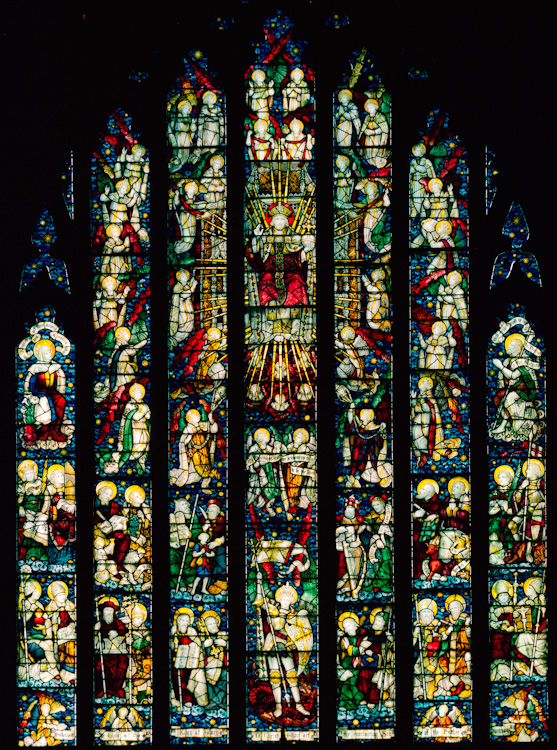
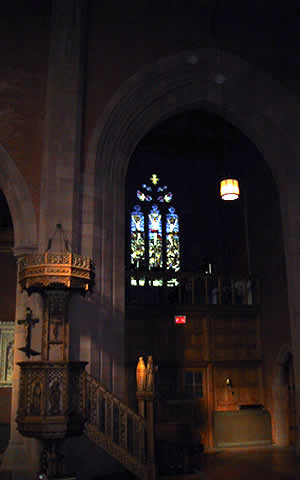
The Te Deum window at Christ Church, New Haven

To thee all Angels cry aloud,
the Heavens and all the Powers therein.
To thee Cherubim and Seraphim continually do cry:
Holy, holy, holy, Lord God of Sabaoth;
Heaven and earth are full of the majesty of thy glory.
The glorious company of the apostles praise thee.
The goodly fellowship of the prophets praise thee.
The noble army of martyrs praise thee.
The holy Church throughout all the world
doth acknowledge thee,
the Father, of an infinite majesty,
thine adorable, true, and only Son,
also the Holy Ghost the Comforter.

Can there be a finer way to begin any of our days than to hear of the miracle of creation, remember our charge to go before the Lord, and offering praise in the Church’s song of triumphant joy? Worship built to a loftier scale during the 11:00 Solemn Mass with Procession and Sung Te Deum but that 7:30 said morning prayer, as it so often does, remains with me through the day. Doing those grand services only seems to make sense in the context of a fuller life of prayer and thanksgiving – they need to be situated within the more humble work of offering praise day in and day out in order to have true meaning and depth.

Solemn Mass was simply a joy. From a procession done with banners aloft and thuribles swinging in full circles while singing hymns that stirred the heart, to an epistle that began “and there was war in Heaven,” to a sermon of complexity and depth that gave new insight into the nature of the angelic, to a Monteverdi anthem that brought tears in its beauty, to a sung Te Deum with double thuribles swung with zeal, there was much to lift the soul to a higher place – and to draw us nearer to the ineffable mystery we celebrate when speaking of angels.

After Mass, I had lunch with my wife and a dear friend. It was a delicious meal made all the better by a martini (a real martini made with Hendrick’s gin and not the mongrel version made with vodka)!

Then came a nap – a fixture of most Sundays – which my dog enjoyed with me.

Then Evensong and Benediction of the Blessed Sacrament. Evensong began with a Bairstow anthem and continued to build in its beauty as the altar was censed during the Magnificat as the choir sang, “My soul doth magnify the Lord and my Spirit hath rejoiced in God my Saviour.” Then we moved into Benediction (which I have written about before) which offered a chance to simply be in the Presence of the Lord.

We sang together, “Let us forever adore the most Holy Sacrament” and said among my favorite acts of praise and adoration, the Divine Praises.

Blessed be God

Blessed be the holy and undivided Trinity

Blessed be God the Father, maker of heaven and earth

Blessed be Jesus Christ, true God and true Man

Blessed be Jesus Christ in his death and resurrection

Blessed be Jesus Christ on his throne of glory

Blessed be Jesus Christ in the Sacrament of his body and blood

Blessed be God the Holy Spirit, the Lord and giver of life.

Blessed be God in the Virgin Mary, Mother of God.

Blessed be God in Joseph, guardian of the Incarnate Word

Blessed be God in all the angels and saints

Blessed be God.

It is a constant reminder that God is present in manifold ways all about us in perfect days and less than perfect ones – Blessed be God who gives us all our days.

Robert+

Of course this does not include mention of the squirrel that got loose on the High Altar during morning prayer which the Rector had to chase from the church. Nor does it include the thurible which burst into a giant ball of flames during the Te Deum. I just can’t decide whether these brought the day closer to perfect or not.

The Church which is His Body: On Restructuring, the Episcopate, and the Sacraments

I am glad to be back from vacation and sufficiently recovered from the beginning of our program year to resume writing a bit.

In a meeting some time ago, I was asked what traits I thought would behoove the Church to look for in potential new ordinands. Rather than entrepreneurial, forward-thinking, flexible, or the many other qualities that are desirable in any new employee, I think the Church is best served by finding men and women of the Altar – men and women who see the whole of their ministry offered in the life-giving exchange of the Eucharist.

I pointed out that there are many ways one can serve. There are many ways one can care for people. There are many ways to do social work, therapy, social service, and the many other good and caring ways in which we minister to the hurting and the lost. A priest though has one role, one function, to offer the Sacraments. All of our other roles – teaching, healing, preaching, and more flow from the Altar.  More broadly this is the whole ministry of the Church, which is His Body – we offer the means for men and women to find themselves in the Presence of the Holy One.

The response of a colleague was telling – she said, “well you are a sacramental priest – so that makes sense for you. We need to be thinking of other ways to be priests too.” I could not disagree more.

The Church is only the Church insofar as it offers the Sacraments with meek heart and due reverence. It seems to me that in the conversations about restructuring the Church, or a missional Church, or the many other ways we can imagine the Church changing that we are losing the simple fact that we first and foremost offer the Sacraments. If one visits the Episcopal Church’s website and clicks on “What We Do” you will not find the Sacraments. They are certainly listed under “What we Believe” but they are not just what we believe – they are what we do, who we are, how we are meant to be, and what we are called to be more of.

We are initiated in baptism, fed in the Eucharist, express our devotion in confirmation, find forgiveness in confession, seek healing in anointing, embrace love in marriage, and some seek new forms of service in ordination. The sacraments walk us through the life cycle, drawing us to God and back to God and home to God. They are the foundation of ministry and unify the faithful in grace. The administration of the Sacraments cannot be unwoven from our pastoral function, nor from our teaching function, nor from social justice for it is through them that we are healed, united, and learn of God’s mercies.

In our conversations about the life of the Church, I think we would do well to think of the bishops’ office not as an administrative or managerial one but again as a Sacramental one.  We would be well served by ordering our life along the lines of Eucharistic Servanthood.

The Bishop lies at the center of our Eucharistic life and welcomes us into the apostolic band through the laying on of hands. The Church might benefit from an increased focus on our unity through the Sacraments with the bishops rather than viewing them through a power-politics informed adversarial lens (as seemed to happen too often at General Convention). Moreover, the bishops themselves would benefit from understanding their role through the traditional lens of Sacramental leadership rather than that of managerial acumen. Our priestly ministry is an extension of the bishop’s. Our Altars are extensions of the bishop’s Altar.

The elevation of elected bishops is described by Hippolytus. He writes “All shall keep silence, praying in their hearts for the descent of the Spirit; after which one of the bishops present, being asked by all, shall lay his hand on him who is being ordained bishop and pray…” Obviously, we have a reference to what we would now understand as the laying on of hands and the succession of bishops. The role of the bishop is described in sacrificial, Eucharistic terms and his or her role and that of the rest of the church order are ordained by God; “You gave the ordinances in the Church through the word of your grace; you foreordained from the beginning a race of righteous men from Abraham, you appointed princes and priests, and did not leave your sanctuary without a ministry.”  The bishop is the center of the sacramental life of their diocese with the priests assisting them in the administration of those sacraments. Our unity is found in this sacramental charge. Like priests, the bishop’s identity is rooted in the Sacramental life of the Body.

God is enjoined to help his new bishop “…to feed your holy flock and to exercise the high-priesthood before you blamelessly, serving night and day; to propitiate your countenance unceasingly, and to offer to you the gifts of your holy Church; and by the spirit of high-priesthood to have the power to forgive sins…” The central role of the bishop, in Hippolytus’ work, is as a Eucharistic servant through whose auspices the Eucharistic unity of the church is promoted and preserved. Our role as priests is to stand in unity with and for the bishop as pastor of congregations under his or her leadership, strengthening and empowering a spirit of mutuality, ever-sharing in joys and sorrows.

The simplest lines of this service of consecration offer insight as to Hippolytan unity. “Then the deacons shall present the offering to him; and he, laying his hands on it with all his presbytery shall give thanks…” Hippolytus writes. The offering is physically presented unto the new bishop and he, with all his priests, gives thanks. This act of the Eucharist is the very first action of the newly seated bishop. Once thanks has been given the bishop declares the power of Christus Victor who “destroyed death” and was able to “break the bonds of the devil.”

After this declaration, at the beginning of the service, the new bishop gives thanks that “you [the congregants] have held us worthy to stand before you and minister to you.” This passage is powerful in that it announces thanks and demonstrates humility at the beginning of the Eucharist for the trust of the congregants in the newly consecrated bishop. Surely this act of humility, as part of the Eucharist, demonstrates unity and reciprocity of service and obedience in the Hippolytan vision. Moreover it clearly indicates shared responsibility for the life of the community and reminds us that our ministry comes from our shared adoration of Christ in the sacraments as the whole church.

In the work of Cyprian, we find a different conception of church unity. Unity, for Cyprian, is a matter of protecting the ecclesiology of the church. Where unity for Hippolytus rests on baptism and the Eucharistic celebration, Cyprian states “…in order to make unity manifest, he arranged by his own authority that this unity should, from the start, take its beginning from one man.” Cyprian goes on to ask, “Can one who does not keep this unity of the Church believe that he keeps the faith?”  

As priests, we share in the work of promoting unity. Moreover, we also strive to claim authority while at the same time sharing it. Our authority is not derived from hierarchy but from a form of democratic centralism that rests with the community of believers living missional lives inspired by the work of the Holy Spirit and united in the Sacraments. This is a Church that in its unity can spread “far and wide” yet remain as the sun with “many rays but one light.” 

The glory of the unified church is “the light everywhere diffused in one light” while the unity of the church is “unbroken.” Cyprian states that Christ commanded love and unity and asks “But what sort of unity, what sort of love, is preserved or contemplated by the mad fury of discord that rends the Church, destroys faith, disturbs peace, scatters charity, profanes religion?” As a Sacramental Body, we are to do the difficult work of preserving the unity of the Church not for the sake of the church but for the sake of His Body.

This is not to make an idol of church unity but a call to struggle to make the Church a symbol of Christ’s love and God’s saving will. Cyprian’s vision of the Church can be summed up in the exhortation “There is one God and one Christ and one Church and one faith and one people fastened together into a solid corporate unity by the glue of concord. The unity cannot be rent, nor can the one body be divided by breaking up its structure; it cannot be broken into fragments by tearing and mangling the flesh.” It is unity held fast in God’s love.

The love of one another is the response to God’s love for us in Christ and in creation. It is the love of Christ poured out on the cross that provides our model for prayer and engagement in the world. That love is modeled for us not only in Christ, but in the work of the saints as well who by their offering of themselves demonstrate the indiscriminate love of the cross. They represent the church at her best – they are the Church we are called to be.

This kind of love is found in the Eucharistic life of the Church. Is there any act more radically democratic – calling us to shared self-giving – than the Eucharist? It is a point at which all take part in the divine and all people know that God loved them enough to make the sacrifice and to restore humanity in the fullness of time when we will share “a feast of rich food and a feast of well-aged wines.” (Is. 25.6) It is a point at which we truly experience creatio simpliciter and gain a sense of the preciousness of our inheritance in the abundance of God and Christ.

In those moments, in fervent prayer together, we are provided a glimpse of the Christian defiance of the viciousness of the status quo. How can we, looking to the Lord present while being “transformed into the same image” (II Cor. 3.18), not recognize that the pain of others pierces God? If God abides in us and we are to abide in that love (John 15.4a, 9), then hardness of heart and blindness to suffering are profound sins against the indwelling God and we are called to offer solace and comfort – to offer word of God’s Presence. We stand in persona Christi and in persona ecclesiae together with those in distress.

At the altar rail, we are transformed in joy and judgment into the Church. Our joy is unity and we are judged as we are called to ever more loving service. We share with all believers in a line of priests, prophets, martyrs, and saints. We share in the councils and witness of the church and take up the call of Christ to share in living Sacramental witness to God’s redeeming love.

Jesus is so Lucky to Have Us: Of Justice, Doctrine, and Worship in the Church

This post is a bit longer than most – I suppose that since I am heading off for a month of vacation I felt a bit verbose.

One of the things I have been struck by in the conversations about General Convention and the Episcopal Church is the energy we spend on what we think about being the Body rather than what we do that makes us the Body. I would argue that the works of justice that we advocate for are part of our life as the Body. I would also argue that a firmness in doctrine is also required to bind us together as the Body. Neither justice nor the quest to articulate our relationship to the Triune God are indifferent matters. We seem eager to create ghettos – to carve out homogeneous and pure bodies within the Body who are doing it just right with our own slang and in-talk. Jesus is so lucky to have us.

I have found that this exercise has emphasized that which we have always struggled with as Anglicans – uniformity of belief. Throughout our history we have navigated the Catholic and Reformed strains and struggled with the melding of politics and religion. Through all of this, we have maintained our identity through common worship. We have prayed together, broken bread together, and listened to one another with a common language, with a common prayer.

It may sound nonsensical or naive but I truly think the most crucial task for the Church is not growth, justice, discipleship, survival, nor restructuring. The most crucial task facing the Church is worship. We must strive anew for a way of being the Body together. The world’s, and the Church’s, desperate need now is for that expanded awareness of the presence of God – the enlarging of the Eucharistic action to encompass relationships that desperately need healing, hearts that are broken, hopes that are shattered, memories that are fraught with pain, and even nations that seem lost.

The Incarnation has sanctified the whole of creation. Adoring God made known to us in the flesh of man opens us to sharing in his love for all of humanity. One part of the Eucharistic action is that we are made one with Christ – not so that we are made ever more privately holy – but so that we can approach the world around us as ever more blessed – ever more worthy of love and thanksgiving because it is beloved of God.

“Do this in remembrance” was not a command given so that we would remember any one earthly event. “Do this in remembrance” is commanded that we might know where our true hope and glory lie.

Through the Sacraments, prayer, thanksgiving, and adoration we are drawn ever more to the source of our peace – that place where we can dwell and know that we are the beloved of God. Where we are held by the Good Shepherd – are branches of the vine – may drink of the Living Water – dwell within the refuge – be protected by a mighty warrior whose name is Yahweh. In all of these images, God longs to be with us and protect us, for all eternity, in a way that no one image can capture. It is this God that we come before in praise and thanksgiving.

Ultimately our hope and our salvation and our joy are not found in the worries of the day – nor even in the answers we find to those everyday worries. Our joy comes when we can surrender and know the hope of things eternal – when we see the totality of our life as the Body as bound to the eternity of God.

The liturgy is the expression of the Body’s questing for unity with the Divine in the person of Jesus Christ. In its use of pattern, connection, arrangement, movement, and varying celebrations of more and less significance. Its mirror of life is natural for it reflects the lived and living experience of a Body. Gregory Dix cites S. Augustine in writing, “The spiritual benefit which is there understood is unity, that being joined to His Body and made His members we may be what we receive.” We receive not simply the sacramental grace of the Body and Blood but become that Body. Moreover, we become a constitutive part of the passion narrative as we take on the form and incorporate the meaning of offering and sacrifice. Meaning and order are mediated by the reality we take in at the Eucharist so that we become not so much pattern-seeking but become part of the very pattern of the divine order – we become the Body.

The individual is ill-equipped to search for meaning or form in isolation. I would broaden this to individual parishes, denominations, and Churches. We need one another. The liturgical enactment of the community mediates the ebbs and flows of personal perception of and receptivity to divine love. The action of the Eucharist is not simply a recitation or re-creation of history but a process of creation of new living meaning within the Body of the faithful. The ebbs and flows of individual perception are moderated and mediated in the corporate action of worship. Gregory Dix claims, “As the anamnesis of the passion, the eucharist is perpetually creative of the church, which is the fruit of that passion.” New meaning is found and incorporated as the community enacts the liturgy together so that the individual is not left adrift in wonderment, but is drawn ever deeper into the realization of divine promise – we are woven into the pattern.

Our participation in the life of the Holy brings about a kind of cognitive dissonance in which we recognize that our imperfections and those of the world around us may be brought into greater harmony with the divine. Moreover, we gain a sensitivity to those things which are out of balance in ourselves and the world around us as we are exposed to patterns of holiness and divine love. The individual can fail in apprehension when they discern the essence of Holy Communion either to be too individual an affair or too global. Without understanding the convicting power of the Sacrament, they are not truly coming into the realization of the divine order that is promised nor the sacrifice that is called for.

The call to properly discern is part of the mission of the Church at large and is essential to the edification of its members. Dix states, “the idea of the Holy Communion as a purely personal affair, which concerns only those persons who feel helped by such things…is nothing less than the atomizing of the Body of Christ.” Worship can never be a personal affair, nor can true religion. Worship which loses sight of the totality of creation, of our relationships, of the world around us, ceases to be worship and becomes another form of individual therapy. We are called to worship, to the work of adoration, which is necessarily not an act of self-regard but of oblation and self-giving. The model for this oblation is, of course, Christ and we enter into that oblation as a community which discerns the Body and seeks its restoration.

This oblation of self is taught in the unfolding of the Eucharist. In the actions of offering and breaking, we see the model of self-giving enacted and re-enacted and we are provided the grace of the Sacrament so as to be empowered to do likewise and to be so offered and willing to offer. This experience is brought about by an encounter with the Christ of heaven and earth. The Christian, with this model of self-offering, enters the memorial action that has been repeated across time and space and makes his or herself one with the sacrifice once offered and passes into the loving and guiding hand of God.

It is the perpetual dying of the person and the perpetual new life in Christ that is made possible by the action of the Spirit and in the memory and action of the community. This new experience of life and potential are mediated by Christ for he is the center of the action and memory of the community.

Any human advancement that is made by the Church must be an advance in our understanding of the life and death of Christ. This revelation of our life in and with Christ not only calls us to ever-offer that which we are to that which we may be, but also, paradoxically, affirms the value of humans to God. As objects of divine love, we are called to closer and deeper relationship to God through Christ. The men and women of the Church are an offering that is acceptable in the sight of God. It is in the striving to be worthy of offering and the yearning for holiness that the nexus of the divine-human relationship is found – in that moment when our sacrifice is joined to Christ’s.

If we celebrate the mystery of the Incarnation in the Mass – how do we look upon God’s children with anything less than love and adoration?

If we adore the Body of Christ – how do we then condone torture done in our name?

If we participate in the memorial of Christ’s sacrifice – how do we allow so many around us to be sacrificed to the zeal of nations or plots of terror?

If we glory in the Resurrection – how do we condemn others to the grave in our hearts?

If we ask for forgiveness for thoughts, words, and deeds – how do we then turn our minds to hate?

If we anticipate his coming again with power and glory – how do we allow the use of power to be glorified?

If we present an offering and sacrifice to God for his use – how do we allow our wealth to be used to degrade those around us?

If we anticipate that heavenly country – how do we allow the one around us to be lost to anger and despair?

If we know, are drawn to, are called by Christ made present on the altar – how can we surrender to despair?

In other words, worship feeds justice. Justice flows naturally from true adoration.  The Church, to be the Church, must offer both with passion and joy.

Robert+


Updates on General Convention and follow up on a New Oxford Movement

This post has a couple of updates on items of note I have written about recently…

An Endorsement

Fr David Simmons has put out a great endorsement of the Revd Frank Logue for President of the House of Deputies whom he has known for 14 years. He writes, “Frank offers a formidable intellect, a pastoral heart, a listening ear and a real can-do spirit to the House. Considering the challenges that are being laid down by the Committee on Structure, I believe Frank is eminently qualified to lead the house during this time of great transition.”

On Progress

Dr Derek Olsen put up a post today about the movement at General Convention.  He especially focuses on Holy Women, Holy Men and Communion Regardless of Baptism.  Of the second he writes, “Nobody wants to see a communion rail lock-down; that’s just silly. What needs to be avoided, though, is any sense that Baptism is somehow optional. If we invite any and all to the Eucharist then we have precisely made Baptism optional. That’s not a pastoral practice, that’s deliberately turning our backs on the theology of the Prayer Book and the consistent witness of the Church up until the late 20th century.”

He adds, “What I would love to see in any discussion of pastoral discretion with regard to CWOB is the word ‘individual.’ The message that the resolution would send, then, is to say that pastoral discretion may be warranted in specific individual and unusual circumstances. A general call to any and all is not pastoral—nor is it evangelism; rather, it salves the consciences of those who want to see themselves as inclusive, but who don’t want to do the work of setting healthy boundaries and inviting all comers within those boundaries through the proper protocols (i.e., Baptism with water in the name of the Triune God).”

Church Structure Updates

Fr David Sibley posted a draft of the omnibus resolution on church structure.  This sounds dull but represents potential for a renewed focus on evangelism, mission, and ministry.  Of particular note is this, that the gathering to consider structure “shall include from each diocese a bishop, a lay deputy, a clergy deputy, and a person under 40.” Thanks to those such as the Revd Canon Amy Real Coultas, the Church will include these younger voices in any deliberations about our future structure.

On a New Oxford Movement

Not long ago, I put together a piece on the need for a New Oxford Movement.  It has gotten some great responses and we have begun generating ideas for how to bring this to life.  Among the responses is one that I thought particularly worth noting as the author raises several great points to consider.  Perhaps my favorite section is this, 

‎”What I’m specifically reacting against here is whatever the hell it is that makes people think that when I say “anglo-catholic” what I really mean is that I like smells and bells. On the one hand it’s a reduction of “catholic” to subjective aesthetic preference — “Oh, you just like high liturgy” — and it’s not even connected to theology or ecclesiology on the other. And anglo-catholics buy right into this with so many petty discussions about the intricacies of liturgy and robes and how many times to shake a thurible. Not that high liturgy is bad, obviously, or that low church is actually praiseworthy, but it’s such an incredibly narrow vision of the catholic. Also think of certain austere monastic orders that live a simple life and perform simple prayers and liturgies. We would never suggest they “aren’t catholic.”

It is well worth the full read and comment!

Robert+

Things Looking up from General Convention: Of Nominations, Resolutions, and Movements

I have been trying to follow without following too closely the discussions at General Convention.  I generally apply the same measured interest in considering these sorts of things that C.S. Lewis offered about demons.  He said there are two strains that are dangerous, “One is to disbelieve in their existence. The other is to believe, and to feel an excessive and unhealthy interest in them.”

However, I have to say that there have been some healthy and encouraging developments in this convention thusfar.

First, we have an opportunity to elect someone as President of the House of Deputies that, I believe, has some experience that makes him a very attractive candidate.  The Revd Frank Logue announced that he will accept nomination to run for the post.  I love the idea of having someone with church planting experience in our leadership.  At a time when our focus is too often on failure and decay, Frank has planted a successful and thriving congregation, King of Peace.  Not long ago I wrote on how understanding the Episcopal Church as needing replanting could be beneficial to our dialogue and mission.  This is an opportunity to elect a leader that brings that real life experience to bear as we face daunting challenges and questions.  He seems forward looking, grounded, and capable.

The other development I was heartened by was the rejection the call to change our Church’s canons to allow Communion without Baptism.  Now that the wider Church has spoken on this, I am sure we can expect a wave of parishes and priests to change their practice so as to obey the doctrine, discipline, and worship of the Episcopal Church.  Or not.  Regardless, I think it is a vital affirmation of both the Reformed and Catholic strains of our heritage and a demonstration that we remain marked by our baptisms as heirs of the Kingdom.  By this vote we can continue to teach, as a Church, that Baptism is not suggested or encouraged but is vital to our life in Christ – a life nourished ever after by the Eucharist.

Other developments are of interest.  For example, the call to sell 815 Second Avenue as our Church headquarters is one that will stir lots of conversation about how we serve God’s mission in the future at the general Church level.  I continue to wonder if sharing the space in Chicago that the ELCA uses as its headquarters makes sense as we seek new ways to live into our Full Communion relationship.  Holy Women, Holy Men will continue to be revised and used on a trial basis.  The issues with it are manifold and I hope they can be ironed out over time.

Finally, of interest to me, has been the proposal of a resolution to require that any new body created to look at restructuring the Church should have no fewer than 1/3 of its membership comprised of those under 40 years of age.  I think this is a hugely important step for the Church.  As we are talking about creating the Church of the future, those voices are critical to understanding the faith lives of those we seek to draw to Christ.  The overall tenor of the convention seems to be marked by a commitment to change and new life and a recognition that we need to get creative and draw on new voices.

There are other signs that are less encouraging (the shift in our understanding of Confirmation, the generally anti-clerical tone of some of the deliberations, and of course very real budget woes) and yet I remain hopeful that we are reaching a moment in the life of the Church in which we seek not just survival but to thrive by blending that which is richest in our tradition with innovation and flexibility.  A sign of this might be the Acts 8 movement.  As I listened to some of its participants talk about their dreams for the Church, I was encouraged.  Now the task is to not simply dream but to make sure we awake and bring those dreams to life.

Robert+

A Short Post Worth the Reading from a Young Deputy to General Convention

There has been much coming out of General Convention.  I was, frankly, deeply frustrated by the opening address of the President of the House of Deputies.  As the Church struggles to renew its common life she seems to be too taken with the language and meme of perpetual revolution.  Rather than taking the opportunity to help us find new and shared hope she articulated a divisive view of the Church and a dated understanding of the nature of power and relationship.

One of the deputies to Convention, Steve Pankey, shared the following reflection that I think summarizes much of the difficulty in the current discourse.

The 77th General Convention started to rev up yesterday.  Legislative Committees had several hours worth of meetings, deputies and bishops were oriented, and the Presiding Bishop and the President of the House of Deputies both offered opening remarks.  During the PHoD’s speech, I began to realize the fullness of our problem.  I tweeted “I’m realizing that the PHoD and I live in two different worlds. Her’s informs mine, but the foundations are fundamentally different.”

She, and many like her, had their lives profoundly shaped by the struggle for equality in the 1960s and 70s.  Out of those struggles, many boomers developed two very strong identities (broad brush warning).  Some are fighters: they continue to seek out problems that are in need of solutions, especially in areas of equality.  Others are guilt carriers: they continue to emote the guilt that comes with realizing one’s privilege at the expense of millions who carried the full burden it took to create that privilege.  Some, I’m guessing the PHoD falls into this category, carry both identities with in them.

I grew up in the excesses of the 1980s and 90s.  Bubble economies, the rise of hip-hop, and the beginnings of digital communities have lead many in my generation to feel disconnected from the guilt-ridden fighting that has come to define so much of the rhetoric in our current debate.  Sure, my world was cushy because of the world that two generations before me struggled to create, but my fundamental identity is not based in social change.  And while I very much appreciate the hard work done by the generations that came before, I’m wondering how long guilt, shame, and partisanship has to rule our discourse?  As I looked at the dais yesterday during orientation, as I realized that the leading candidate to replace the current PHoD and the leading VP candidate were two of the four bodies up there throughout.  I’m thinking that we’ve got at least three more years in this transition.

The Old Testament lesson for Sunday tells us that David was 30 years old when the elders anointed him King over Israel.  Youthful leadership is not something that is without precedent.  It has been lamented all over the internet that there aren’t enough younger people present in the councils of the Church, and I agree.  The problem is that we have made leadership roles all but impossible for those who still have to work a day-to-day job to make ends meet.  How can we bring more voices to the table?  How can we make sure that one group’s experience doesn’t define our fundamental identity?  How can we enjoy the fullness of who we are, the truth that exists within every believer?  I don’t have the answers at this point, but I’m certain they are out there.

Perhaps a starting place is forgiveness.

I offer you the Prayer for the Mission of The Church (BCP, 816-7)Everliving God, whose will it is that all should come to you through your Son Jesus Christ: Inspire our witness to him, that all may know the power of his forgiveness and the hope of his resurrection; who lives and reigns with you and the Holy Spirit, one God, now and for ever. Amen.

Find the original here.

Robert+

Liberal Protestantism and the Discomfort with Difference

Since the Reformers, there has been an impulse within Western Christianity to erase particular marks of sacred time and space. The desire ranges from a fierce iconoclasm that sees idolatrous popery as the bane of true religion to a polite bourgeois discomfort with physicality or difference. In contemporary American religion there is also the particularity of our inherited discomfort with anything that resembles hierarchy or appears undemocratic.

Within the Episcopal Church we see these impulses in a variety of places. Watch the distrust of the House of Deputies for the bishops of the Church and you can see that democratic impulse alive and well. Read the justification for Holy Women, Holy Men – everybody is affirmed and the concept of sainthood is redefined as setting a good example. Listen to the debates over Communion and Baptism and you can also hear the discomfort with difference as there seems to be incredulity that we should set any bar, let alone a high one, to participation in sacred mysteries.

This is the point – for many there is no such thing as a sacred mystery anymore. The notion that particular people, places, moments, or things can be set aside as blessed (as different) is increasingly deemed retrograde.

The danger of this sort of liberal Protestantism is that when we cease to see particular moments as communicating something of the divine then we will, eventually and I believe inevitably, cease to see that movement anywhere.

There is a commendable impulse that underlies much of this – the desire to see all of life as sacred and all people as blessed and valued by God. It is and they are! Absolutely!

Yet, we also believe that God is doing something new with people in Baptism. Even if your understanding of the Fall is a muted one there is still some bit of redeeming grace that we expect in that moment. In the Eucharistic feast we expect that God is coming among us is some special way even if Real Presence is a step too far for some.

God does something unique with the common in particular moments. These moments are the means by which we have sure and certain hope – they are the means given to us by Christ for the sanctification of humanity. After them, we are different. We are changed as we become a new creation. We are set aside as we are no longer that which we were.

The concept of holiness necessarily requires a sense of and belief in difference. The Church invites people to a different life – a renewed existence in the Body. The Sacramental life of the Church is the means by which we see and know that God makes use of the simplest of elements to transform our very being. If we can’t articulate this simple fact, that God changes things, then we are left in a profoundly disconcerting theological place for we are left with human device and the limits of reason as the sole measure of God’s action in the world.

Current trends in the Church point toward a revolution of profound and disturbing significance. We no longer seem able or willing to say how it is that God transforms us as individuals and as a Body because we are uncomfortable with difference. The underlying message of the Diocese of Eastern Oregon’s proposal to endorse Communion without Baptism was first that we have failed to bring new people to the Church and second that the failure really isn’t that important because people are fine as they are and not in need of Baptism.

The message of the Church cannot only be “you’re fine as you are.” This kind of undifferentiated affirmation results not in an inclusive community but in a community without an understanding of its own purpose, message, identity, or goal.

I am not advocating that we return to fire and brimstone or rest our teaching on moralizing about private lives but I do think we need to be honest that God is calling us to be different, to change, to be transformed. Christ’s message was not one of affirmation alone but an invitation to die. It was an invitation not to live today as we did yesterday but to know our old selves as dead. This was the invitation of Baptism. This was the difference.

The Church comes together to celebrate Sacred Mysteries. It exists to say the Mass together and share in the sacrifice of praise and thanksgiving – in Communion with Christ. It exists to baptize new believers into the Body. It exists to be a Body of reconciliation and forgiveness. It exists to call people into union with one another in Christ. It exists to heal and to offer hope for the life to come.

The Church exists to change us and all those around us in sacred moments by sacred mystery. It exists to make us different – to make us one in Christ.

That difference is expressed in our liturgical seasons, in our rites and Sacraments, in our service in our communities, in our work of love and reconciliation, in our life of prayer, and in our self-sacrifice. A Church which denies difference denies its own calling and fails in its essential witness to bring others to consecrated life.

Understanding ourselves as changed and transformed is not hubris – it is an act of profound humility that recognizes that it is not we ourselves who bear witness to God but Christ living through us.

Just as the common becomes holy on the altar, we creatures become holy at the altar rail. We become another part of the feeding of God’s people even as we are fed. Each Baptism and Communion is part of the striving toward the Kingdom of God, the yearning that echoes in time and memory, and promises that human frailties and fractions can be bound up in the laboring grace of the divine and consecrated to God’s use.

This is the difference.

Baptism prepares us to be servants of God in the world as we are bound together in grace and sustained in love. We receive this grace and become agents of God’s reconciliation in our communities. The peace we receive from Christ is one that is grounded in overflowing abundance even as it demands that we offer all as we serve and thus find perfect freedom.

In Baptism we are different. We are changed. Thanks be to God.

Robert+

I Wish the Church was More Like a Museum

Yesterday, my wife and a friend of ours headed into New York to visit the Chinese consulate. If you have not experienced the efficiency, warmth, and clarity of dealing with the Chinese bureaucracy then you are the richer for it. However, shocking to us, the consulate seems to have reformed itself a bit. Rather than the 8 or more hours it can take simply to get to the window (and then be rejected for a visa) we were in and out (and approved) in about an hour.

This good turn left us with a whole day in New York!

So we decided to head off to the Metropolitan Museum. I was particularly excited about the Byzantium and Islam exhibit, the Chinese printing exhibit, and my favorite, the Arms and Armor exhibit. Also not to be missed is the relatively new Greek and Roman antiquities wing.

I have heard, more than a few times, deriders of one part of the church or another say something along the lines, “The church is not a museum” or more often “We need to act like a church and not a museum” or “We can either get involved or just become a museum.”

Each comparison to the museum is, as you may have noticed, to demonstrate the stagnant nature of the museum in contrast to the speaker’s own vibrant, effervescent vision of the Church.

I actually find myself wishing that the Church was more like a good museum. Museums are places that generate excitement in us but may, on occasion, also inspire dread. They can bring us into contact with some of the most important elements of our history and identity even as they sometimes present those vital pieces, moments, or times as if they were forgettable or lost in the rush of time.

The trick in the museum is to present an object so that it communicates with us – so that it is not simply an object of studied and indifferent origin but is in conversation with us. This conversation forms us. It creates in us an understanding that this piece before us is part of us. Our conversation and engagement with it continues to craft some part of us.

Great museums do something great churches can do – they tell us who we are. Moreover, with training and study, they can form us for the future. To the untrained eye there is something that immediately attracts even while always revealing some new complexities and patterns that reward careful study and meditation.

Yet we too are afflicted with the question of value. Why do we matter? Who will notice if we are not around? I would contend that we matter because we answer the deepest need of human existence. However in a culture that is beset with consumptive utility, the ability to consume and be consumed, as its driving force, churches and museums alike will be called to answer for themselves and for their usefulness. Yet we answer those questions that we are trained to forget even exist.

The question “Who are we?” is up for grabs in a culture that sells identity. A culture with no sense of who it is is malleable, formless, and ultimately forgettable for it will have left nothing that can be seen, known, or is even, in the truest sense, present. Such a culture will be at the whims of those forces which always step into the void. Whether shameless corporate manipulation or political peddling some other narrative will drive the creation of identity to the point at which any sense of truth, beauty, or dignity is simply manufactured in the most profitable or politically expedient way.

Museums and the Church offer a counter-cultural understanding of the world. They invite us into a scope of history and meaning in which the full flourishing of humanity is pursued. They are an encounter with those things which are most essential to remember and most easy to forget. Their “usefulness” only extends so far as their understanding of their central story and mission.

Not every museum offers this. Neither does every church.

The Church has, in many ways, a similar charge as a museum. We communicate identity, curate elements of tradition, lead people through a journey, connect people across cultures and time, offer an entry way for the novice, connect themes and ideas across fields, and offer historical examples for the future. Beyond this, as the Church, we also offer a life-altering encounter with a living God whose power is always at work in the world.

Our role is descriptive as we share the story of the arc of salvation. It is also didactic as we offer the lessons of thousands of years of tradition and theological insight. It is also prescriptive as we offer an understanding of the Christian’s life and role in the world. It is also experiential as the Christian is drawn into the life of God by the working of the Sacraments and in the holiness of relationship.

Why does faith matter? Who is Jesus today and who has he been? How does the faith of centuries shape our faith today? Is there a God? How do we understand the afterlife? When a visitor walks into our churches they need to hear people dwelling with these very questions and finding, in the shape and life of the Church, a life-giving encounter with the Holy.

Even as they answer individual questions about particular objects of interest, museums also portray the sweep of history. They give you a sense that the particular dwells within the context of the whole. Docents carefully answer every question and guide people to a deeper understanding of the transitions between space, place, and time. Great museums and Churches are grounded in both the depth of history and tradition as well as the very real needs of the communities around them.

Great museums become voices and actors in their communities because they know how to engage the world around them as they tell a living story. the American Visionary Art Museum, has a mission simply to “expand the definition of a worthwhile life” by presenting and encouraging creativity in untraditional venues. The Denver Museum of Contemporary Art describes itself as an activator, content provider, and immediate research vehicle of culture in the making—a museum without a front door—a place for public engagement.

A judge with the Hague was interviewed about overseeing the trials for those that had committed atrocities in Sarajevo. He was asked how he kept his sanity and his faith in the face of such a relentless press of the worst of human barbarism related day after day. He said that he would frequently visit a nearby museum to look at the Vermeer paintings and be reminded of the stirring beauty that humanity was capable of.

Churches, at their best, offer this chance. We offer the chance for those beset by the cares, occupations, and struggles of this sometimes wearying life to find a place of rest, refreshment, and new meaning. They can be reminded of the beauty of God and the promise offered to each of us.

Each person that enters the space has something to offer to the whole understanding of the life of the Church. As in a museum, the curated meaning is not the only one. There are a host of challenging and enlivening insights that will come from those new to the exhibit. We also have to be ready as the Church not simply to expect visitors but to give them space to shape life and meaning along with us. So we are tasked with bringing forward and nurturing the tradition even as we are ever open to new interpretation and ideas some of which will stand the test of time and some of which will fade away.

Great museums allow for this sort of interchange. The fascinating thing about the arms and armor exhibit at the Metropolitan, for example, is its sense of movement. You feel in the midst of this history swirling about you and can imagine that hooves are pounding and pennants fluttering. You see in the exhibit a progression of history as well and understand the link between one piece and the next. You see the influences that one era has on another until you are, even without realizing it, seeing patterns that resound in our own time.

Yet, this does not happen on its own. There are not speakers playing whinnying horse noises or actors in olde English garb railing at the peasantry to stay out of the road. We bring something to the experience too that is vital.

Perhaps a lesson might be found in the sign at the entrance to the Gage Center, an historical house in New York which is a model for museums and the Church.:

Welcome to the Matilda Joslyn Gage Center where Matilda Joslyn Gage lived with her husband Henry and their four children and carried out her work for social justice from 1854-1898. Rules of the house: 1) Check your dogma at the door; 2) Think for yourself; Please dialogue with us about the challenging ideas you will find within these walls and together let us envision the world we want to create. Please feel free to take photographs, pick up books, play with the toys, sit on the furniture, and most of all write on the walls!

Oh that the Church could be more like a museum.

Robert+

“There is No Try” or The Lessons of Star Wars for the Church

Note: I promise I shall return to less fluffy pieces soon!  After a week mixing the sad and the frustrating it seemed an occasion for a bit of a lighter take.

Someone once told me that church geeks, the kind that become clergy for example, are the biggest geeks – they are the geeks that the Dungeons and Dragons kids make fun of.  It’s more than a little true.

One of the best comments I ever saw on a blog was about the Sarum Rite, the commenter said that attempting to recreate the Sarum Rite was like trying to master the rules of Advanced D&D.  In other words, it requires an obsessive attention to detail that only a fellow lover of such obscura will appreciate (and much of the world will find it baffling that so much energy is devoted to the pursuit).

Well, I have always had an appreciation of all things geeky.  I suppose it began with Star Wars – I was the kid that was thrilled with the Grand Moff Tarkin action figure.

I started thinking today about how two of my interests (read geeky obsessions) come together.  What are the lessons of Star Wars for the Church?  What can Yoda, Vader, Tarkin, and more tell us about how to change and adapt?  What are the lessons of the Rebellion’s victory and the Empire’s fall?

1. Meesa wants more: Dumbing things down just doesn’t work.

The complexity of the galactic struggle of the first three Star Wars movies was nearly obliterated by the annoyance that was Jar-Jar.  Those coming back to Star Wars and those new to it were not looking for a bizarre novelty – they were coming back to see Vader and Yoda.  Our great gift as the Church is that we are not the home of grating attempts at entertaining humor.  We have a tried and true core that need not be tarted up with CGI buffoonery.

2. “Named your fear must be before banish it you can.”

Yoda gets it right.  There are lots of things we fear as a Church right now.  The culture is changing.  The church is changing.  Atheism is on the rise.  We are becoming irrelevant.  We are too rigid.  We are too loose.  The Prayer Book is holding us back.  Abandoning the Prayer Book is killing us.  In other words – there is fear in abundance.  Fine.  Name it.  Get it out in the open so we can get on with the work of visioning our future.  We have to be willing to say with honesty those things that are most troubling and feel most threatening.  Only then can we begin to metabolize the fear and let it become a new source of energy.  The rebel culture was one of optimism and hope as opposed to their foe which was motivated by fear and anger.

3. Fear cannot be the motivator.

Yoda knows, fear and anger lead to the dark side.  Yet our own fears cannot be what drives us – we have to trust that God is leading us and the Holy Spirit are present even, and especially, amid our anxieties.  Fear cannot be the means we use to motivate others either.  “Do this or we’ll die” is not exactly the most salient vision statement.  After all, how much did Imperial performance improve after Vader’s serial force chokings of admirals?  Not much.  We have to find our common vision, our common identity, as Anglican Christians.  It was not fear that made Han a hero and a farm boy a Jedi – it was a belief in something greater than fear and larger than themselves.

4. Bigger is not better. 

When those AT-ATs came across the frozen waste of Hoth, they must have been a terror to behold.  Yet out come the rebel ships throwing cables around their legs and down they went.  Death Star? Ditto.  In other words, those big imposing structures and mechanisms we have put together just will not get the job done in this new era.  They are the way and tools of the past.  We have to be willing to take those things apart and build a newer, faster, more nimble force.

5. Agility is the key.

As those larger structures collapse under their own weight or through our own re-working, we have to be agile and responsive.  The culture is moving too fast around us for us to believe that bloated structures built around triennial gatherings will ever respond to the deep needs all around us.  We are only relevant insofar as we are equipped and ready to respond to the communities we are part of.  At every level we have to be moving quickly and anticipating rather than just reacting.  Insulated centralized structures will always be a step behind a networked but creatively trained and mobile forces with a shared hope.

6. Mentoring not just training

How do you think stormtroopers were trained?  I don’t imagine that their drills stressed creativity or new thinking.  The rebels, on the other hand, probably had a formal training program that was a mess.  They were ragtag and their equipment was often shabby – and yet they managed to pull it off.  Bringing up new leaders in the church, both lay and ordained, requires not just rote training in the fundamentals but also careful mentoring and apprenticeship.  Yet, there are basic building blocks that must be learned.   Look at Yoda’s training of Luke.  He trains him in the basics of the force, the core elements, but also mentors and helps him see what was possible.

6. Relationships not structures win out

It was the relationship and love between Han, Leia, Luke, Chewbacca, and more that gave the rebels strength and courage.  The Church is a Body of relationships – relationships rooted in the love of God.  It is not a system of obedience that will renew us but a revivified understanding that each of our lives is intertwined in dangerous ways with one another’s.  It is dangerous because it is a threat to our sense of pride, individualism, and self-sufficiency.  We are together, as the Church, only because of the life we share in the Sacraments.  Our bishops are leaders because they form the heart of our Sacramental life as a diocese.  Our priests are priests only because they were first baptized and called to offer the Sacraments on behalf of the bishops.  We have a priesthood of all believers that have been welcomed into the apostolic band through the laying on of hands at Confirmation.  It is this web of relationship that stretches beyond time and borders that binds us together and to Christ.  We are not a structure for the sake of structure – we are the Church because we share in the Body.

7. “Don’t tell me the odds.”

C-3P0 lets Han know that the odds of successfully navigating an asteroid field are approximately 3,720 to 1.  The odds seem against the Church these days.  We hear day after day that the decline is coming, the fall is imminent, the sun is setting on the Church.  Yet, we have gone through this all before.  There have been challenges again and again to the Church and yet it thrives not because of our own efforts but by the inspiration of the Holy Spirit.  The odds are there and the challenges are real and yet we would be sunk, indeed would have collapsed long ago, if odds were the only thing that guided the Church.  We are not a Body of odds nor a faith of mathematical determinism.

8. There is no try.

Yet, the odds are real and there is little time for us to just let the future happen.  We can’t spend our time theologizing our failure or decline – there are no excuses.  There is no try.  There is do or do not.  Our work is not to save the Church – it is to bring word of God’s salvation to the communities all around us.  With creativity, joy, and determination we are called to work, pray, and give for the spread of the Kingdom.  Offering our whole selves to this work is not easy and it is hardly glamorous but there is no try.  Luke: “I can’t believe it.” Yoda: “That is why you fail.” There is no try because we believe.

9. Learn from failure.

The Galactic Empire devoted years and an enormous amount of money and manpower to constructing the Death Star. After it was built, the base the size of a moon only successfully completed one mission before it was destroyed by the Rebels. And the Empire’s response? Build a bigger, newer Death Star.  There are no reasoned chats between Vader and Palpatine about the wisdom of this path.  Maybe there were creative ways to obliterate planets that they had not considered!  As I listen to the debates about structures in the wider church, I keep waiting for some leader or another to invite us to witness the awesome power of the new and improved House of Deputies.  “I find your lack of faith disturbing” he says as we wonder aloud about this grand new behemoth.  It was not the power of the structures, of the Death Star, that ultimately won but a shared vision of the future.

I am sure there are more lessons to be found – these are just some that jumped out.  Of course, there is always that most valuable of lessons, “Always let the wookie win.”

Robert+