It’s Time for a New Oxford Movement.

An American commented that the church [in the early 19thc.] had fallen from a position of power to the condition of “a victim, dressed for the slaughter.” It was a ghastly picture, he declared, “when skepticism was rampant, and an insufferably insolent individualism paraded itself on the platform; when the men most alive were the Evangelicals, amongst whom there was hardly on who combined scholarship. Intellect, and address in a considerable degree, nor one who represented the principles and system in the Book of Common Prayer.  Cited in John F. Nash’s “The Sacramental Church”

One of the challenges for Anglo Catholics in the 20th and 21st centuries is that we have won much.

Eucharist as the central act of worship? Check.

Confession in the Prayer Book? Check.

Holy Week services in the BCP? Check.

The Gloria at the beginning of the Mass and the Peace? Check and Check.

A faithful social consciousness restored? Check.

There is much that the Catholic movement within Anglicanism has “won.” Yet, now there seems to be a need for a new Oxford Movement within the Church.

Look at that quote above again. Skepticism rampant.  Individualism unchecked.  A quasi-evangelical Christianity as the dominant form of Christianity.  A lack of seriousness in theology and scholarship.  And a Prayer Book all too often ignored.

There is still much to do.  The worry of the day is not that we have the externals in order.  Our churches and clerics are also now adorned in ways which once would have caused scandal.  Candles, vestments, and more are part of the standard Episcopal Church.  The worry is that these things are the décor for a churchwide wake as we remember the good old days, are careful not to speak ill of wrongs that have contributed to the demise, and sing a song or two in fond farewell.

There has been much talk of restructuring the Church, this is good and proper, yet my fear is that we have no idea what we are building structures around.  There are other Christian pan-Protestant denominations about that hover at the gates of universalism.  There are social service agencies that can deliver needed services more efficiently than us.

We are facing not just a collapse of large parts of the Church, we are facing a collapse of leadership, nerve, and vision.

The answer is not Hymnal revision, new governance structures, Communing the UnBaptized, a Kalendar of Saints with non-Christians, guitar Masses, digital Prayer Books, more liturgies about the Earth, or many of the other countless ways many seem to think will lead us to the dawn of a kinder, gentler Church that will usher in the Kingdom.

We have to begin, now, to rediscover what it means to be an Anglican Christian.

A new Oxford Movement can do this.  There is a desperate need for a movement that takes seriously the issues of the day while committing to delving into the Tradition and carefully reading Scripture.  There is a need for a movement that is unabashed in its proclamation of Jesus Christ.  There is a need for a movement that sees social service not as a goal of the Church but as a means for us to be drawn closer to the mind of Christ.  There is a need for a movement that is grounded in disciplined prayer and lovingly offered worship.  There is a need for a movement that sees the Sacraments as the means by which we know the Incarnate Lord.  There is a need for a movement that is ready to move beyond zero-sum church politics to transform hearts and souls.

What could such a movement offer?

  1. A focus on the adoration of God.
  2. A focus on careful preparation to receive the Sacraments.
  3. A heightened awareness of Healing and Confession.
  4. An understanding of the Real Presence in our life together.
  5. A renewed focus on the disciplines of daily prayer for all believers.
  6. A focus on devotion to Our Lady and all the Saints.
  7. A view of the Church as extending through time and across boundaries.
  8. A commitment to forming young people in devotion to Christ.
  9. A commitment to justice work grounded in the Incarnation.
  10. A commitment to fostering a renewed sense of Anglican identity.

A new Oxford Movement offers distinct gifts for this time.

In a time when younger believers seem to be reaching for the transcendent and the mysterious we have an understanding of God that is rooted in more than tidy chats about Him.  We offer a way of coming into the Presence of the Holy One.  Worship is no didactic lecture on the merits of God but a chance to be in relationship with Him through His Son.

As many Christians are rightly offended by the degradation of the Earth and the plunder of its resources we have an understanding of the created order that revels in its most essential quality – it communicates something of God.  We use the most common elements to receive the grace of Christ.  God makes Himself known in the world all about us and we gather the best that creation as to offer in art, music, architecture, flowers, incense, and more as we worship.

We see in the Incarnation that embrace of the whole of humanity.  As we live and move in an evermore diverse and pluralistic society, understanding the nature of God as revealed in human flesh is more vital than ever.  For we see all of humanity bound up in the humanity of Jesus Christ.  The challenge is not to see Christ in every person for that leads to the exaltation of the individual – our challenge is to see every person in Christ so that their totality is caught up in the divine personhood of Jesus.

As we see suffering all about us in the world, our view of the Incarnation, Creation, and the Glory of God leads us to serve.  We have long understood that worship without service and service without worship are dead ends.  The liturgy is not simply blessing or encounter with the Holy, it is a divine imperative to go forth and transform lives in the world around us.  We do this not because it is the nice thing to do, we do this because we can do no other as we are transformed evermore into the likeness of Christ.

We have also always understood that it is the humanity and divinity of Jesus, in their fullness, that bring saving health.  Whether through Stations of the Cross or Benediction of the Blessed Sacrament, we seek to know Jesus more fully so that his story becomes ours and ours his as we are bound together in the love of God.  We are in a life-long journey of redemption living as we continue to turn from sin to newness of life.  As vague spiritualities and syncretistic propositions capture the devotion of too many, we offer a way of understanding the life of Christ who makes us whole.

As the Church struggles, we offer a view of the Church that is more than a voluntary society of well-intentioned men and women.  It is a Divine Society given to us by Christ as we have been made His Body.  The Church’s mission is God’s mission – the restoration of all with and in God.  The Church exists for this one purpose – for the same purpose as Christ was sent – to bring men and women to the knowledge and love of God.

That Church extends back in time and is not a passing thing.  In a culture obsessed with falsity and peddled images of self, we offer a Body that is real.  We offer a Church that is authentic and rooted in millennia of faith and prayer.  Moreover, we offer an Anglican Church that, for centuries, has straddled theological divides, wrestled with thorny issues of church-state relationship, and has been responsive to the needs of the day while maintaining the faith.

We are facing serious challenges as a Church, of this there is no doubt.  Yet all the restructuring we can achieve will be for naught if we have no sense of self, no reason for being the Church, and no hope of connecting with those outside our walls.

We offer hope in the face of the predations of fundamentalism and humanism.  On the one hand, fundamentalists define the faith in such a way as to make it a laughingstock in the face of human progress and scientific achievement.  Yet, equally destructive is the path of humanism which has given us liberal Protestantism.  Humanism and liberal Protestantism have stripped mystery, spirituality, and symbolism away to the point where we have no compelling reason for people to even come to our churches – let alone for us to go out and evangelize.

Each has taken its toll on Christianity.  There must be something else that the Church offers than knee-jerk reaction or hollow affirmation.

We offer, simply put, the sacred.  We offer the sense that God is calling us to be a holy and living sacrifice as we are brought into his redeeming love.  This happens in ways beyond understanding and can only be termed mystery.  We offer a sacred way of being that sees all of our lives as consecrated for God’s use so that our selves and souls and bodies are fed and we, in turn, go out into the world, rejoicing as we draw others to Christ.

Robert+

More about much of this will follow!
Responding to the Diocese of Eastern Oregon’s Position Paper on Communion Regardless of Baptism

The Episcopal Diocese of Eastern Oregon has released a supporting statement regarding its General Convention resolution (you can visit the General Convention page and scroll down to C040 to find it linked) calling for Communion regardless of Baptism.  The document is theologically problematic, culturally myopic, and logically flawed.

It begins,

As Christendom was waning, the Episcopal Church ratified a new identity in the 1979 Book of Common Prayer.  This new identity brought us to practice baptismal ministry and made the Eucharist the central part of our Sunday worship.  Now, after living this theology for over 30 years, we are faced with the growing practice of Open Table in the Episcopal Church.  The two are not unrelated.

Yet, baptismal ministry has been the core of the Church’s identity for 2000 years.  The Eucharist has been the central act of worship for large parts of Christianity since Christ said “Take, eat, this is my Body.” Somehow, over 2000 years, this has not been a source of tension.  This was the pattern in lean times of persecution and in the bloated years of full-blown Christendom and in every era in between.   Wax or wane Christianity has held, at its core, Baptism as entry into the life of Christ.

The challenge is not that we have a ministry of the baptized and Communion as our central act of worship – the challenge is that we have clergy ill-trained in Sacramental theology administering them.  We have laity that we have failed to form in Sacramental living.  We now have a wide body of our priests that do not believe anything much actually happens in the Sacraments.

Do you believe the Holy Spirit descends upon a person and transforms their very being in Baptism so that they are united with Christ?  Do you believe that Christ is truly present in the Body and Blood we receive at the Altar?  Are the Sacraments God’s action or ours?  I have heard far too many talking of Baptism as an entry rite rather than as transformation just as I have heard too many speak of Communion as a “meal” alone rather than the very Presence of Christ among us.

If you have a clergy addicted to modernism and reformation charged with carrying out the catholic Sacramental life of the Church then you will, indeed, have tension.  But the tension should not between upending the Sacraments or administering them faithfully as they have been across the centuries.  The tension should be between doing or not doing them.  You can choose other ways of ministry that do not involve undoing the historic Sacraments of the Church if you are not comfortable with the faith and order we have been welcomed into as both baptized and ordained leaders.

In a recent conversation with a clergy person about this issue, they mentioned an older person in their parish who was receiving Communion but had not been Baptized.  The priest said, “I just can’t see making him go through some ceremony.”

To open our boundaries to the beloved children of God means that we first must understand our relationship to God in a way that empowers us to be Christian ministers.

We already open our boundaries at the font.  In that action of washing and being made new in Christ we come to understand our relationship to God.  I cannot help but notice that up to this point, and through much of the document, the emphasis is on one person of the Trinity (I am assuming they are referring to the Father, but it is difficult to know).  Yet the Sacraments are about our union with Christ.  Communion and Baptism are not a vague encounter with a Divine Source –they are the receiving of the Son by the work of the Holy Spirit.

Creation is not the chief Sacrament.

The Sacraments exist for the sanctification of humanity because we are not just fine on our own.  We need the life-giving encounter with Christ to be fully alive as creatures of God.

This is the crux of the dilemma, in many ways.  Why baptize?  If people are fine as they are and not to be challenged to the life of transformed living in Christ, then the Sacraments are, indeed, irrelevant and can be toyed with to suit the perceived needs of the day.  The Catechism reads, “From the beginning, human beings have misused their freedom and made wrong choices” and we are rescued from that misused freedom (which includes walking apart from Christ) in Baptism.

We must, indeed, understand our relationship to God.  It is a relationship that is defined in the life, death, and resurrection of Jesus Christ.  If we do not see Christ as decisive in the salvation of the human family then our Sacraments do not really matter.  They are an indifferent thing if redemption is an indifferent matter.

At Baptism, our lives begin their irrepressible movement toward fulfillment in Christ.  Moving through that door, toward that fulfillment, is a synergistic interplay of our faith and God’s promise, the living of which, in and of itself, is an act of faith.  For it is the recognition that we can be more, that Christ offers more for us, of, and to us and calls us to nothing less.

We die in the water and are reborn in the spirit.  All of the historical understandings of baptism require the work of the cross for completion.  The washing away of sin is incomplete without the work of the cross.  If one downplays the notion of washing away sin in baptism and prefers to conceive of baptism as rebirth, that too requires the cross.  Baptism opens a door to the treasure house of grace and the true refuge of the sinner; and it wedges that door open for all time.

We are the Body of Christ and we choose to offer ourselves as sacrament to all the children of God.

This is a troubling theological statement.  We are, indeed, the Body of Christ – the Church.  The whole Church is the Body – the whole Church throughout time, across borders, transcending theologies, and beyond horizons.  The whole Church has Baptism as the core of its identity.  The Baptism of Christ is ours.  The Baptism of every saint is ours.  The Baptism of every sinner is ours.  Just as ours is theirs.  The Sacraments commanded by Christ are of the life of the entire Body of the Church.

The troubling thing about this entire section of the essay is its implication that somehow there is an entitlement to undo the Sacraments.  “We are the Body of Christ and choose…” Yes you are, but so are the countless souls gone before and that will come after.  So are those in Churches across Christianity that understand Baptism as the mark of Christian living and the entry into the life of Christ.

In other words, being members of a Catholic body of faith does not mean we get to say “We are the Body of Christ” with anything other than a full recognition that this does not entitle us but rather binds us to one another and to the faith once received.

The Catechism says of sin, “Sin has power over us because we lose our liberty when our relationship with God is distorted.” Seeing ourselves as the Body unmoored from the discernment and practice of the Church throughout the world is a distortion of our relationship with one another and with God for it makes of salvation by the water a thing to be played with rather than the heart of the Great Commission.

If this just read, “It is no longer convenient for us to maintain the faith and order of the Church throughout history, so we give up” I would be happier for that would be an honest summary of where things are.  We have given up and blame society for our inability and unwillingness to do the complicated and taxing work of discipleship, evangelism, and mission.

While we do declare the Church to be Christ’s Body, we also must be able to remind ourselves that it is a human institution, indeed our human endeavor to proclaim God’s profound and radical love for the whole world incarnate in Jesus Christ.

The Church is, indeed, a human institution and it can be captured by the winds of the day.  This is why the whole, the entirety, is vital for conversations such as these.  Across Churches and denominations, there is a wide understanding both within the Reformed and Catholic traditions that Baptism is the natural entry into the life of Christ.  This human institution has spent millennia listening to the voice of the Holy Spirit which has led to the Sacramental life we share.  We are indebted to those Christians across traditions and through the ages who have passed on this understanding to us.

I do not believe that the Church throughout the entirety of our history and across traditions has been failing to “proclaim God’s profound and radical love” because of its understanding of the link between Baptism and Communion.

Our new enlightenment must be something to behold for the priests martyred in South America, for those who were part of the Civil Rights movement, for those who advocated for better working conditions and wages in the slums, for those who throughout history have sought to stand in the path of the forces of depredation and exploitation.  Courage to stand in the face of a violent humanity and proclaim true love does not come from humanism with a godly patina.  That kind of courage flows from understanding the faith, the Church, and Christ Jesus as so decisive and upending that we can do no other.

A Church that wants to transform society cannot be shy about asking its members to be transformed.  A Church that wants to impart the strength to challenge the systems of oppression and violence better offer more than enlightened self-interest to feed its people.  Sacraments that don’t matter enough to wait, to ponder, to make a loving commitment to receive are not Sacraments that can fuel the Body.

This redemptive work cannot be done only by those within the system but must involve people outside the system.  Therefore, when people feel called to our Table we, as stewards of our Table, are called to welcome them so that we might work together towards redemption.

…as Christians, we more than anyone should know that the mystery of our Sacraments is beyond our ability to comprehend and, by implication, beyond our ability to contain.  Our location as Christians enables us to identify the Holy Spirit at work, not to own it.

The redemptive work is done.  It is not done by us.  It is not done by those outside the “system.” We do not work towards redemption.   

Christ has done the work of redeeming and we are baptized into that redeemed life.  The Catechism states, “Redemption is the act of God which sets us free from the power of evil, sin, and death.” It does not mention working toward it.  Furthermore, “By his obedience, even to suffering and death, Jesus made the offering which we could not make; in him we are freed from the power of sin and reconciled to God.” It is that sacrifice which we are bound to in the sacrifice of the Eucharist.  It is not just a meal – it is our offering to Christ to be joined to his own sacrifice and “We share in his victory when we are baptized into the New Covenant and become living members of Christ.”

The mystery of the Sacraments is, indeed, “beyond our ability to comprehend” and thus should not be undone because a small sect of Christians finds it inconvenient.  It sounds harsh to say sect, but we will divorce ourselves from both catholic and reformed practice and will be exactly that – a sect.

The Sacraments are a mystery beyond our grasp and we can only shepherd, with faith and attention, that mystery.  This is not ours to upend.  The Holy Spirit is not only at work in your corner of Christendom in ways you would like to perceive – it has been at work across the ages in the hearts and souls of the faithful.  The canons of the Church, the councils of the Church, the Catechism and faith of the Church – these too are expressions of the movement of the Spirit.

The grace and prayer of Baptism and Communion necessarily straddle time and space, for while the feeding and the washing take place within the margins of our awareness of space and time, they function in liminal excess, that place of nearness and distance from self and God where the tyranny of linearity is undone in the all encompassing will of grace that overshadows and conquers time, place, and distance.

The promise of Baptism is that the exchange between God and man takes place in the space of communal memory.  That space of memory is one that is not simply an individual exchange, but an exchange of the community in which it renegotiates and reimagines its history as it encounters the grace of God.  The call to unity is one that takes place outside of space alone.  Thus one person’s intentional participation in Baptism can have manifold and deep benefit for the community they are a part of for they are helping to reshape and renegotiate the place of memory of and with God.  Moreover one person’s, one diocese’s, or one priest’s decision to upend the tradition has an impact far beyond sight and space.

The interpretation of what is the movement of the Spirit cannot be held captive in a tyranny of the living alone.

Robert+

The final sections, on mission and ministry, deserve their own post and this one has gotten over long I think!

Re-Planting the Episcopal Church: What can the Church learn from Church Planting?

As we are working to re-plant a worshiping congregation in the Hill neighborhood of New Haven there are a number of realities that bear strong resemblance to the broader Church’s situation. Ascension Church in the Hill was a chapel of Trinity Church on the Green. It was a place to worship when the summer heat became to stifling too travel all the way into downtown New Haven. The congregants were well off and the neighborhood a middle class one.

The neighborhood changed – as all do. It became more working class and more diverse attracting large numbers of immigrants who worked in the industries all about New Haven. Gradually, the well-off congregants at Ascension moved away or found means to get to Trinity or points further to worship and Ascension was left to struggle along, searching for an identity amidst a changing neighborhood in which the church was not at home and was not equipped to change drastically enough to make itself a home for others.

Rather than adapt, over time, Ascension dwindled and, about ten years ago, shuttered its doors as an Episcopal worshiping community. We were not the only church that failed in the neighborhood nor were we the only church that failed the neighborhood. Every mainline church in the Hill closed and, most recently, several Roman Catholic parishes closed, leaving the neighborhood without a spiritual center or home.

For an historic Church that is declining rapidly in a culture that no longer knows what it means to be Christian let alone Episcopalian, it might be beneficial to think of the Episcopal Church not as a dying institution that is in need of resuscitation but as a Church that needs re-planting.

Church Planting

As we seek to re-plant the church in a neighborhood that desperately needs we have read through a pile of books on planting churches. Among them many resources, mostly from a very evangelical persuasion, we found a report from 2001 entitled, “New Church Development: A Research Report.” It was produced by the Episcopal Church for the Office of Congregational Ministries.

There are several key factors that the report identifies as crucial to the success of new church plants or as strong corollaries to successful evolution over time.

They are:

• Effective recruitment and training of lay leaders

• Shared vision and direction

• A younger minister who is good at starting groups from “scratch”

• A focus on reaching unchurched community residents

How might the wider Episcopal Church look at these as we think about how to re-plant ourselves? The report states, “’Who’ congregations are as defined by their community constituency and their leadership and ‘where’ they are going in terms of mission and vision are crucial for success in new church development.”

Recruiting and training leadership

The first point, the effective recruitment and training of lay leaders, is no mean feat. How do we identify and equip our congregation to live as baptized leaders in the Church? In the past, serving as a lector, reader, eucharistic minister, on the vestry, as treasurer, or as warden, or in any other leadership capacity was a sign of status and achievement. Now, how many of us struggle in parishes to find capable people willing to take on these critical roles?

The report says, “Not surprisingly, analysis of other factors related to characteristics of the founding pastors shows that those who are successful in planting strong new churches possess a clear sense of direction and are not merely people-pleasers. Successful pastors tend to be young to middle-aged and like their lay leaders they are personally involved in evangelism and outreach.”

Successful new pastors are evangelists and missionaries – our lay leaders must be as well. How do we equip lay leaders for this work of evangelism and outreach?

The report found, “leader training and experience in practical evangelism, outreach development, and conflict resolution (in that order) are most important for new church success.”

In other words, the focus of the training in successful church plants is all on the growth and evolution of the community as witnesses to the Gospel. The Episcopal Church could benefit mightily from rediscovering an emphasis on our work as evangelists focused on outreach skilled in resolving conflict. How much better would the Church look if our energies were centered on bringing word of God’s love to all around us and understanding that creating new community means that we must understand how to resolve conflict?

The formation of our leadership must begin with Christ. Teaching the story, learning to pray to and with him, and trusting in him are all at the root of effective Christian formation. Once this is begun, we can begin to train for evangelism and outreach. We need to see lay leadership within the context of Christian formation. The goal is not recruitment for the sake of perpetuating the institution, the goal must be first recruiting the person to a life of spiritual maturity and offering them a vision of the baptized life that strengthens them for leadership.

Asking someone with a prayer life that is not exactly lively to be in leadership is a disservice to their development as a Christian and to the Church’s witness to faithful leadership. I know more than one person who was brought into leadership and then, as the quotidian pressures of church life wore them down, were spiritually unprepared to handle the inevitable disappointments that come and dropped out of the Church altogether.

Our approach to lay leadership cannot be “more is good.” Our approach must be rooted in the deepening of the faith, a commitment to living the gospel, and an understanding that using their gifts in the service of the Church is part of stewardship. Moreover, the life of any leader in our Church must be undergirded by dedicated prayer and a conviction that they are leaders not in a civic organization but in a Body that calls others to the life of faith.

The report states, “The success of a new church start clearly has more to do with what the church as a whole does in terms of evangelism and outreach as led by the pastor, rather than the individual evangelistic efforts and orientation of the founding pastor.”

The wider Episcopal Church needs to take seriously the development of lay leaders not as managers or administrators but as partners in the work of intercession, evangelism, and prayer that is the lifeblood of the Church. The more the Church looks to society’s models of success or management the more we will find ourselves floundering. People are not looking for one more place to work – they are looking for a place that gives them strength and hope for any challenge that comes their way and a chance to be part of something that transforms, convicts, and connects them.

That formation begins with a shared vision and direction – people knowing who they are and where they are going.

Shared Vision and Direction

What is our shared vision and direction? In the past, it was simple to say that Episcopalians were defined by their common worship life centered on the Book of Common Prayer. I would contend that this must be our source of shared vision in the decades to come.

Our way of being together as Anglicans is being tried and is fraying because we do not believe the same things about Scripture or Tradition and Reason has been reduced to individual perceptions of the movement of the Spirit. The report states, “Knowing “who” you are and “where” you are going is critical from the start and for the start.” It continues, “The impact of a common vision…helps a new church grow, rather than merely staving off stagnation.”

We cannot be a Church of all things to all people and expect to exist let alone thrive. We will never be as trendy as evangelical mega-churches and we will never have the undeniable (though increasingly resented and resisted) authority of a College of Cardinals.

We do, however, have a way we pray together. We have a common heritage and way of expressing our hopes, fears, thanks, and longings that has been the product of centuries of holy trial and error. We have a catholic sacramental life that takes seriously not only the presence of the Holy in the Sacraments but demands a response from us as well.

We have a common identity in the Book of Common Prayer.

The report states, of failed churches, “the sower failed to produce a crop because the seed did not take sufficient root to become established and so resist natural impediments and take advantage of encountered opportunities in its continuing efforts to flourish.” How are we making sure that the seed takes root in our people? How do we continue to offer them a life changing encounter with Christ that takes root in them so that they may serve as faithful witnesses?

That common identity and vision does not mean we share in a cookie-cutter approach to how to carry out that vision in our local contexts. It does mean that we have a core that defines and shapes us and those we call into leadership. The report states, “…it is important for the pastor to articulate a vision it is even more critical that leaders share it.

The Prayer Book militates against the spiritually soporific influence of hyper-Protestant individualism, personal spiritualities, and comfortable notions of private religion. Our whole future is bound up not only in personal sanctification, but in the work, life, and love of the community.

The Prayer Book provides that common way of being that protects our parishes from being exercises in clerical vanity and it provides a way for all of us to be formed in a common way of being and praying together that gives us strength to do the work we are given to do. The report states, “the largest and strongest new churches scored high on the common vision scale. This scale reflects responses to two questions: one, that the founding pastor gave priority to clearly articulating a vision for the congregation and two, that leaders shared the same vision for the church’s future.”

All that we do together is geared toward the worship of a living and present God – not simply a God who promises a future but a God who dwells in the present. We do not simply anticipate or describe God’s future “re-entry” into the world but remember God’s action in history, draw strength from His very presence among us now, and bring word of His love to the world around us.

Our common worship is not didactic exercise or self-referential philosophical technique but an encounter of love that expresses our love and hope in a living God.

The Prayer Book will not give us a blueprint for the future as the Episcopal Church – except that it does. It offers a way of living into holiness together.

If you have ever been part of a community that is saying the Psalter together, it is an interesting experience. As the community first comes together, there is all manner of confusion. Pace, rhythm, pauses, volume, and more all are off as each individual does what seems right to them. Yet, over time, a miraculous thing happens. The loudest get a little quieter, the fastest get a little slower, the slowest pick up the pace a little bit, and the pauses become regular. In other words, the community prays together.

The Church has the means to pray together and this is our blueprint for the future. Neither congregationalism nor forced centralism offer hope for the body of the faithful. The Prayer Book is not a force of its own. It is given life by our common use of it – by our commitment to be brought together as a praying community that has agreed on it as our way of adoring Christ together.

Our hope is to be found in listening to one another as we pray and to being formed, together, by the common bonds we share as we replant this Church we love together.

Robert+

Apologies for the unusual length of this post but I wanted to set up a couple of things for the next ones.  The next will focus on different visions and strategies for church plants and how they might be useful to consider.

“Father, have you gone stark raving mad?” A Letter from W. H. Auden

Mother Winnie Varghese from S. Mark’s in the Bowery posted this wonderful letter from W. H. Auden about new liturgies.  It is a treat and is below!  S. Mark’s is also being considered for a Partners in Preservation grant and would benefit from your frequent votes. R+

Marxism and Alienation: Of the Economy and the Insurrection of Incarnation

Previously, before studying matters ecclesiastical, my academic work was focused on post-Mao Marxism in China. Admittedly, it was a field without overly much attention. After all, Marxism has been effectively dismantled in China though it retains a Leninist state apparatus. There is, however, a faithful remnant that continues to apply Marxist-Leninist-Mao Zedong thought to the current affairs of China.

Deng Xiaoping redefined Chinese Marxism in order to facilitate a dramatic shift within Chinese society away from ideological excess and toward practicality. Reformers, like Deng, perceived this shift as vital and necessary for China to achieve great nation status and to revitalize a sagging sense of cultural self and national pride. Deng’s approach was to reorient ideology using historical circumstance to paint his reforms as adhering to Marxism.

One of the works I found helpful in my work was Bertell Ollman’s book “Alienation.” Ollman analyzed Marx’s conception of man in capitalist society. I am frequently reminded of my previous academic work in pastoral encounters with folks on the very margins of society – those absolutely alienated from the rest of society.

On page 134 of “Alienation,” Ollman describes man as follows, “Alienated man is an abstraction because he has lost touch with all human specificity. He has been reduced to performing undifferentiated work on humanly indistinguishable objects among people deprived of their human variety and compassion.”

How many people do we meet on a daily basis could we see as alienated? How many are estranged from the very basic definitions of modern society? How many struggle to buy a meal, pay for basic medicines, find adequate housing, pay for a laundromat, read papers sent to them by a byzantine social services bureaucracy, an so much more? The very essential things so many of us take for granted are the very tools of alienation for far too many of our fellow men and women.

These men and women are marginalized to the point where they, as Ollman puts it, lose touch with all human specificity. They become the objects of competition, charity, pity, or scorn. They become that which we keep at arm’s distance or ignore lest they intrude upon our own sense of connection to the means of success, status, and belonging. They are deprived of their human variety as we lump them together not as individuals beloved of God but as that cast off in the dispassionate clicking and whirring of the mechanics of post-industrial exchange.

Or, how many are alienated because of the very striving to get by?  How many of us are driven from one another by the need to “get ahead?” How many of us have seen or known alienation?

They become They – barely capitalized but for the need to differentiate from Us.

Whether it is by active abandonment or benign neglect, much of our energy as participants in the normal activities of the quotidian running of civilized society is spent creating distance. Running, hiding, ducking, and seeking cover become the activities of the civilized as we pursue, with ferocity and skill, our own alienation. That which is the bane of the existence of those marginalized is the chief goal of too many of us as we crave distance from those who challenge, discomfort, or upend us or our notions of the good and the secure. We long to keep Them anonymous as we seek our own ends.

This is where the Incarnation breaks us open. We are forced, by the very particularity of Jesus Christ, to acknowledge that the way Christ comes among us as true God and true Man demands that we take a second look. Christ, by his coming, enobles all of the created order in such a way as to make alienation the gravest of sins. Allowing ourselves to be removed from or pursuing distance from the Other becomes not just the stuff of socio-economic reality but of the deepest sin.

We are given our own chance to say yes or no to those all around us by Mary’s “Yes” to God the Father. By her “fiat,” by her “let it be according to thy word,” we too are offered the chance to make room for the Other. We too are given the chance to be God-bearer to those around us who long for some sense of God’s movement in the world.

Men and women all about us are not an abstraction in the eyes of God. When Christ offered to us the chance to say “Father” he also commanded us, by word and deed, to say “brother” and “sister.”

The great sin of modern society is that man may be degraded to the point of being an abstraction. Each person becomes, for lack of vision, compassion, and charity, a potential placeholder for our desires or manipulation.

Ultimately, this alienation is an alienation from beauty.

Modernity, in its rush to be ever more “objective” and efficiently fact-based has lost the conception of the beautiful and concomitant with that loss has come the inability to use beauty as an epistemological tool in and of itself. When we lose the concept of a “beautiful” outcome due to our need to be ever more objective, we subordinate the “subjectively” beautiful to the “objectively” factual. In doing so, we lose the ability to define an optimal state of order that is based on a mutuality of vision and shared story – we lose the ability to be truly and fully alive in God.

Death, scarcity, competition, and avarice are the signs of a profoundly disordered society rooted in the notion that suffering and conflictive daily existence are somehow normative (and maybe even part of God’s plan). The Incarnation, however, is the very embodiment of difference as cooperative movement rather than something to be overcome. It is at once unity and a call to it. The Incarnation is not the completion, but the infinite act of ongoing completion in a harmony between divinity and humanity.

We are called to participate in that harmony – to defy alienation. Grace is measured and measurable in the infinite form of the creche and the cross and is thus a concrete act of giving in the world. This giving of Christ to and for the world is a definitive act of plenitude that opens up the human experience to grace, redemptive love, and to beauty.

For much of Protestant theology, the world is something that can be manipulated and is thus a suspect creature. Yet, the Creation is the scene of the divine-human luminous encounter and is part of God and thus not to be feared or to be an object of suspicion, but of love.

Worldly beauty is beautiful because of its specific content. The compelling content of the world which constitutes our ideal of beauty is in Jesus and the saints whose lives embody the beauty of Christ. There cannot be a Christian conception of beauty without understanding the compelling a transcendent beauty of lives lived fully in the service of Christ and the whole of humanity.

For beauty is necessarily transcendent, and fundamentally calls us out of ourselves into the world and history to greater service and purpose. Thus the Christian call is an aspect of beauty for it reflects the ongoing transcendent love of Christ in the world and through his people in the site of redemption, Creation. This is a poetic encounter that understands revelation as a poetic act of compelling content.

Part of that poetic encounter is the call of the cross. The very nature of the cross is the drama that declares the politics of the world to be false. It is the triumph of the “anti-kingdom” or the un-kingdom over the will of the state. Blind capitalism, as an end or goal, is rendered a heresy because of its dependence upon human will and desire and that is not based on the self-giving gift nor upon true beauty but upon passable facsimiles thereof.

Blind capitalism can never lead to a beautiful outcome nor an holy one for it never calls for self-sacrifice – it never esteems true beauty.

In his 1944 work, “The Altar and the World,” Bernard Iddings Bell writes, “We have organized an economic life in which our people serve not one another but each himself, each herself, each group itself, with nine-tenths of his thought, her thought, its thought, concentrated on extracting from the common wealth all ease that can be wangled in return for as little creative usefulness as many be gotten by with: having brought this monstrous perversion into being, we have had the effrontery to call the resultant scramble ‘the American way of life.’”

Bell understood, far before the manipulations of the modern corporate era, that we were being pitted against one another. We were being primed for a form of competition in which each was the raw material for another’s gain.

Ultimately, our chief form of protest is to treat one another with charity, kindness, and love. Macro-economics are not the playing field of the Christian. Each Christian is charged with living in such a way as to give lie to the very notion of alienation. No faith which has at its heart the Incarnation and as its sign the Cross can afford to devote its energies to living or dying by an economic system that has, at its heart, manipulation and competition.

Having studied Chinese Marxism, I assure you that there is no easy solution there either. There is no easy solution to be found in the economic forecasts and machinations of sinful men. Our hope rests, ultimately, in Christ. Our hope rests in an eternal destiny that has, as its nature, a transforming power that straddles time and makes of us citizens in the Kingdom of God. As we look for the Kingdom to Come we live, move, and have our being in the Kingdom about us and act with love.

By concrete act, God acted in the world in the form of abundant beauty and grace. God has not hidden the truth of our existence from us, we and those all about us are not abstractions, but he has given us the ultimate anthropology upon which to base our very existence in the form of Christ.

God has not created us for alienation from one another but for unity in Himself.

Robert+

Don’t Do It for the Kids: Of Hymnal Revision and Young Adults

As part of the preparation for this summer’s General Convention, the Standing Committee on Liturgy and Music has commissioned a report from CPG’s research division on revision of the Hymnal 1982.  The report includes details of the results of surveys conducted designed to ascertain the level of support or lack thereof for a revision of the Hymnal 1982. There was little by way of huge surprises in the report. Below, I offer a few highlights from the report without too much comment.

One factor emerged which seemed a surprise to those administering the survey.

The group that was most resistant to the idea of revising the hymnal are those under 29 years of age. They are the most resistant by a large percentage. The report concludes, on page 57,

“Respondents in their twenties and younger are statistically different than the rest of the respondents, reporting the least interest in desiring worship music to reflect their personal musical tastes. This proves counter to the “common knowledge” theory that younger congregants are looking for a more modern or popular-music experience at church.”

The survey found that those “whose age is significantly above or below 50 are less likely to support revision. Middle-aged Episcopalians are more supportive of revision than younger and older Episcopalians.”

Among clergy, the numbers are striking, “Specifically, both the youngest and oldest clerics tend to be more opposed to revision, while middle-aged clergy are more favorably disposed. Clergy who are younger than 30, in fact, are nearly two-thirds in opposition to revision.”

In the Under 30 Demographic:
-Among lay respondents: 50% opposed to revision, 30% neutral, 20% in favor.
-Among clergy respondents: 61.5% opposed to revision, 7.7% neutral, 30.8% in favor.

The report states, “Younger respondents continue to differ from older respondents when questioned about whether they wish worship music reflected their general musical tastes.” One 22 year old respondent wrote,

“I think there is a huge assumption made that the younger generation wants guitar- and piano-based praise and worship music. …What we want to hear in a Sunday Eucharist are the classic hymns played on organ. And occasionally we want to chant. Church is the one place where our musical taste is not based upon fad, but instead links us with a much more important, more elegant tradition. If I wanted to listen to acoustic guitar and piano, I’d pick up Dave Matthews or Ben Folds. If I wanted rap, I’d listen to Lil Wayne. …For worship, I want music that connects to me a world outside of the in and out of my daily life.”

In its conclusion, the report states, “Perhaps most significantly, there is no pattern in which youth correlates with a particular movement towards new forms of musical expression. To revise the Hymnal must in some way be a project that is a gift to the next generation. Gaining some clearer sense of what the worship music of that generation will look like will require a longer and more careful period of discernment.”

While recommending moving forward gingerly with discernment, the report acknowledges, “That 13,000 people took the time to complete a lengthy survey on the question of hymnal revision shows how central The Hymnal 1982 is to the life of The Episcopal Church. This should give us pause. A rush to revise the Hymnal could seriously undermine and weaken the Church, alienating those who have remained with The Episcopal Church through difficult times.”

In seminary, we were told that the Book of Common Prayer exists, in many ways, to protect the laity from the clergy. It provides the Church with a distinctive and agreed upon core. The hymnal functions in much the same way. The report states, “While among clergy and music directors, a plurality favor hymnal revision, sentiment among congregation members runs 2-to-1 against revision and there is no demographic category that is in favor.”

Among female clergy, there is a strong sentiment in favor of revision and the report says, “Gender is strongly correlated to views on Hymnal revision among clergy, and with some relationship among music directors, but gender has no effect on the views of the laity.”

Another respondent that the report quoted wrote,

“I’m a refugee from a non-denominational church where the ‘praise band’ was very emotional, very repetitive, and very oriented toward the congregation energetically telling God how much they loved him, needed him, would set aside everything to serve him, etc. That might seem admirable but often when you come to church, you’re running on fumes—you’re dry, hurting…I belong to a message board for evangelical mothers and let me tell you—there is a rising trend among evangelical of finding church to be empty, tiring, and irrelevant. There is a rising interest among them of either going to a ‘house church’ (for community) or a traditional church (for depth and transcendence). Please don’t give them nothing to find when they come.”

I recently was part of some liturgies that were…unfortunate.  Actually beyond unfortunate, they reminded me of the very things I fled to join the Episcopal Church.  From vague “contemporary” songs written in the heady days of Vatican II that talked about us rather than God to a Fraction anthem that sounded like a raucous taproom jukebox number rather than a memorial of the Sacrifice of Christ there were elements of the liturgies that were deeply uncomfortable.  Moreover, the planners seem to have forgotten an adage of our rector, that we are not the interesting thing about Church – God is.

We sang over and over “They’ll know we are Christians by our love, by our love.”  Over and over.  We, us, our. We, us, our. We, us, our.  Have I mentioned us lately?

A friend recently told me a story about another event.  A diocese had a conference and the youngest clergy in the diocese were asked to plan the liturgies.  They ended up with lots of chant, solemn masses, and the like.  Middle-aged clergy were aghast and some even informed the planners that they were undermining everything they had spent their career working for.

My hope is that middle-aged leaders in the Church will not see the desire for the reconsideration of elements of lost tradition as a threat or as an undoing of their lifetime of work but as a natural process and movement to rediscover and re-appropriate parts of our heritage.

This past Saturday, I took part in a blessing of a civil union of two young women.  It took place within the context of Rite I Solemn High Mass.  The readings were from the King James Bible.  The music was gorgeous and rooted in the Anglican tradition.  The ceremonial was lush without being self-referential.  The blessing itself was beautifully written and theologically rich.  In other words, the fullness of our tradition created, for these women, a sacred space in which to have their commitment solemnized.

A changing world does not demand that tradition be undone.  Changing realities reinforce the need for tradition – albeit a tradition that is considered, scrutinized, examined, and tried.  We have spent much of the last half-century tearing down anything that looks like tradition because it looks like tradition.  Our youngest laity and clergy are now taking the time to go through what has been cast aside and calling for a careful re-examination of the notion that progress means perpetual revolution.

Robert+

The full report may be found at https://www.cpg.org/linkservid/57003D75-DA12-05B2-F4FFD5819BE00E5A/showMeta/0/?label=Hymnal%20Revision%20Feasibility%20Study

The Lord’s Descent into Hell: A reading from an ancient homily for Holy Saturday

We read this ancient homily today as part of our Holy Saturday observances.  I have always found rich theological import in the Descent of Jesus and this homily describes the scene beautifully.

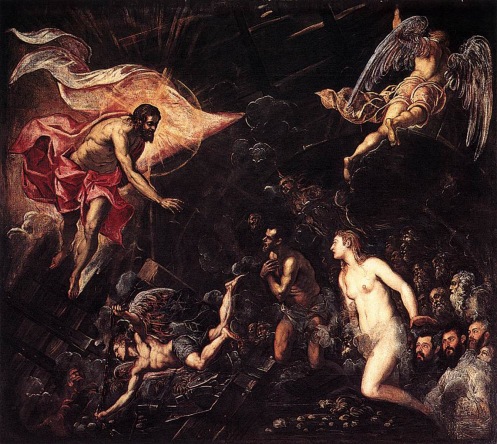
“What is happening? Today there is a great silence over the earth, a great silence, and stillness, a great silence because the King sleeps; the earth was in terror and was still, because God slept in the flesh and raised up those who were sleeping from the ages. God has died in the flesh, and the underworld has trembled.

Truly he goes to seek out our first parent like a lost sheep; he wishes to visit those who sit in darkness and in the shadow of death. He goes to free the prisoner Adam and his fellow-prisoner Eve from their pains, he who is God, and Adam’s son.

The Lord goes in to them holding his victorious weapon, his cross. When Adam, the first created man, sees him, he strikes his breast in terror and calls out to all: ‘My Lord be with you all.’ And Christ in reply says to Adam: ‘And with your spirit.’ And grasping his hand he raises him up, saying: ‘Awake, O sleeper, and arise from the dead, and Christ shall give you light.

‘I am your God, who for your sake became your son, who for you and your descendants now speak and command with authority those in prison: Come forth, and those in darkness: Have light, and those who sleep: Rise.

‘I command you: Awake, sleeper, I have not made you to be held a prisoner in the underworld. Arise from the dead; I am the life of the dead. Arise, O man, work of my hands, arise, you who were fashioned in my image. Rise, let us go hence; for you in me and I in you, together we are one undivided person.

‘For you, I your God became your son; for you, I the Master took on your form; that of slave; for you, I who am above the heavens came on earth and under the earth; for you, man, I became as a man without help, free among the dead; for you, who left a garden, I was handed over to Jews from a garden and crucified in a garden.

‘Look at the spittle on my face, which I received because of you, in order to restore you to that first divine inbreathing at creation. See the blows on my cheeks, which I accepted in order to refashion your distorted form to my own image.

‘See the scourging of my back, which I accepted in order to disperse the load of your sins which was laid upon your back. See my hands nailed to the tree for a good purpose, for you, who stretched out your hand to the tree for an evil one.

`I slept on the cross and a sword pierced my side, for you, who slept in paradise and brought forth Eve from your side. My side healed the pain of your side; my sleep will release you from your sleep in Hades; my sword has checked the sword which was turned against you.

‘But arise, let us go hence. The enemy brought you out of the land of paradise; I will reinstate you, no longer in paradise, but on the throne of heaven. I denied you the tree of life, which was a figure, but now I myself am united to you, I who am life. I posted the cherubim to guard you as they would slaves; now I make the cherubim worship you as they would God.

“The cherubim throne has been prepared, the bearers are ready and waiting, the bridal chamber is in order, the food is provided, the everlasting houses and rooms are in readiness; the treasures of good things have been opened; the kingdom of heaven has been prepared before the ages.”

from the book “From the Fathers to the Churches: Daily Spiritual Readings” 

By Thy Precious Blood: A Sermon for Good Friday

A sermon preached at Christ Church, New Haven on Good Friday 2012

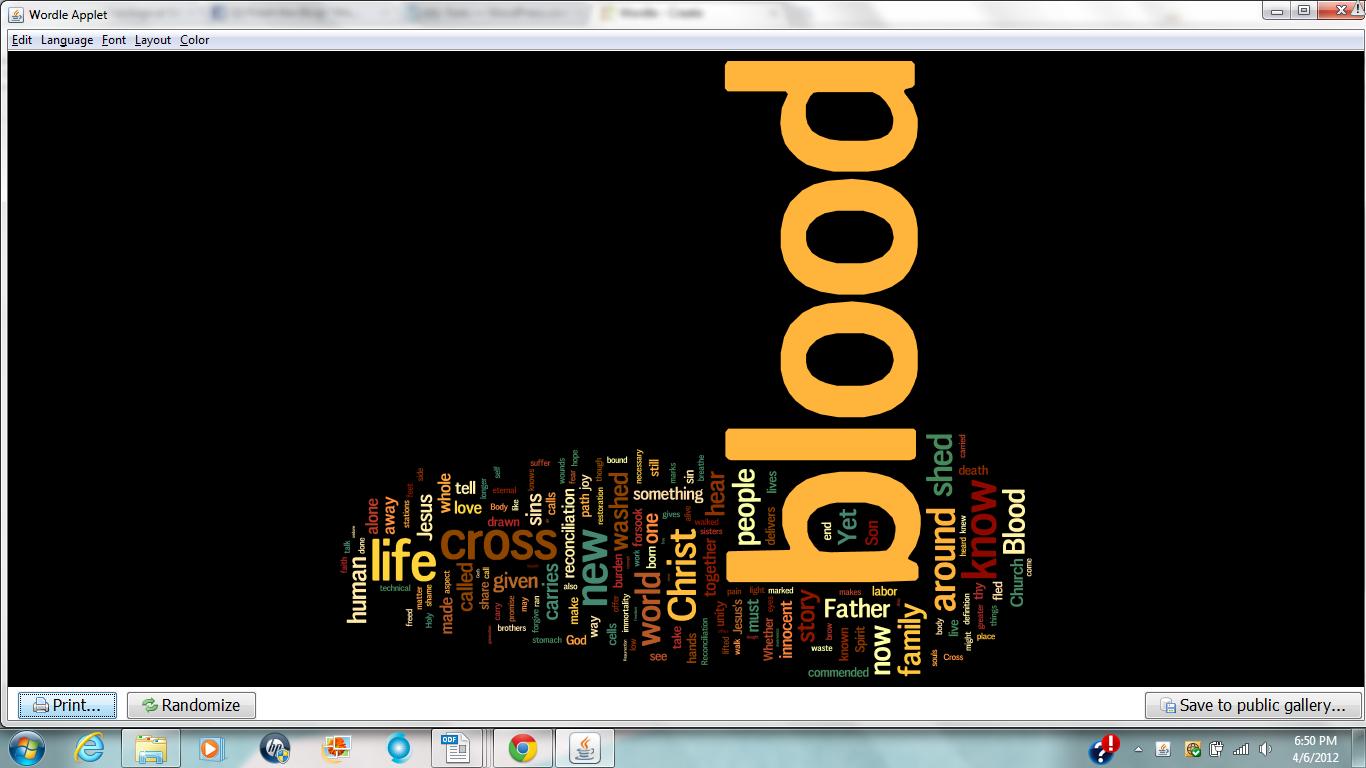
Today’s story is awash in blood. We hear the story of Jesus’s five wounds. From his head, from his hands, from his feet, from his brow came blood. Poured out, onto the ground, and forever staining the cross. We are surrounded, in this place, by images of the Passion. The rood screen, the stations, the altar, the windows – all tell the story of how this innocent blood was shed.

How do we talk about blood? A technical definition of blood goes something like this:

“Blood is a bodily fluid in animals that delivers necessary substances such as nutrients and oxygen and transports waste products away.”

Can we ever be comfortable with blood? Can we see the very stuff that gives life shed – especially when it is innocent blood – without a deep ache in our stomach? I can barely stomach getting shots or having my blood drawn at the doctor. Yet we have this story – these hours of spear, nails, and thorns which we come together to mark.

As a people – why do we do this? Who are we that we gather to tell a story of blood and agony? Why do we walk the stations of the Cross? Why do we venerate the cross? Why do we drink of that cup?

Because this blood is life. It is who we are. It is us.

Perhaps that technical definition of blood offers something more for us to consider?

Blood delivers to us that which  is necessary. It gives us life and animates our bodies.

This blood carries with it the hope of life eternal – that sure and certain promise that as Christ was wounded we were healed. As Christ’s own body was given our own self was set free from the bondage of sin and death.  This blood animates our souls.

That blood carried in it life and immortality. It was shed in a way that makes it clear that no matter our sins or offenses – no matter the gravity of our sins – we have been infused with the very blood of new and unending life.

Innocent blood was shed by sinful human hands and yet we hear “Father, forgive them, for they know not what they do.” We hear “Today, you will be with me in Heaven.” We hear “Truly, this man is the Son of God.”

As innocent blood was spilled our guilt was washed away and we were carried out of sin into righteousness and out of death into life.

Blood not only delivers that which is vital – it carries away that which pollutes. It carries off waste like carbon dioxide. As we breathe in fresh air our blood carries it around our body and makes us alive.

This blood enables us to breathe deeply of the Holy Spirit, to take in the breath of eternity, and to be made alive in Christ Jesus. Receiving this Blood has made us one body in him, filled with the Spirit of life as that same blood carries away our sins.

Blood is classified by type. Blood can be transfused. Bloodlines carry our heritage and traits from on generation to the next. We talk of blood money and blood debts. We have blood brothers and sisters. We share blood oaths.

Blood is life. It is who we are. It is us.

And by this blood we are one people. By this blood the debt is paid. By this blood we are bought. By this blood we are brothers and sisters. By this blood we are bound in a new covenant.

By this blood who know who we are.

Last night, at the end of the Maundy Thursday mass, we heard from the Gospel of Mark. At the end of the reading and the end of the liturgy the last line we heard was “And they all forsook him, and fled.”

“And they all forsook him and fled.”

They knew what was coming. Deep down, they all knew that this meant blood. Jesus’s would be shed. Would theirs too? How could they look into the eyes of the accusers and offer themselves up too? So they forsook him and fled.

Yet Jesus does not curse them for villains. Nor tell them they are cast out. He does not revile them for their treachery. He knows their fear. He knows that their dreams, the hopes, their lives are being undone before them. So they ran. This was no act of rank villainy or cowardice – it was so very human.

Yet those who ran too were ransomed by blood. They too were given new life as Jesus said “Father, forgive them.” The Church was built on the rock that thrice denied Our Lord.

Whether we run and hide. Whether we stand and fight. Whether we turn our eyes and shake our heads. We weak mortals are given immortality in the blood and we are forgiven.

Jesus’s blood has bound us together – all of us baptized into that life and death – in him all things are held together.

Yet, how do we live our lives in such a way as to live into that eternal promise? We are now called to make this unity a reality in the world around us.

All of our ministry and labor is “under the blood.” As the Church – the Body – we are called to strive for the world around us – for that blood was shed for it. To bring all we know, love, and hold dear into the same family. As the Cross is lifted up for all to be drawn to Christ, we are now part of that labor of reconciliation and love.

In the Church, we hear much of reconciliation. It is a term that is being used with greater and greater frequency. Our Catechism says the mission of the Church isto restore all people to unity with God and each other in Christ.” Restore all people to unity in Christ. To make us all one blood.

Reconciliation is more than repairing wrongdoing. Though it is that. It is more than apology, reparation, renewal, or restoration – though it may be all of those. Reconciliation is the restoration of all things in the blood of Christ as we see and know that all of the human family is brought together in that blood shed for all.

Our entirety is washed in the blood of Christ. Every aspect of our lives is knit to the Holy One by that blood and we are provided a new way to know the world around us. Because the world is beloved a and washed, every aspect of that world be seen as of the blood – which must also mean in light of the cross.

Our own heart is now washed in that blood. So treat yourself and those around you with compassion.

Our own hands are now washed in his blood. So extend them with care and tenderness.

Our own brow is marked with blood – so think on Him often.

Our own feet have stood where the blood poured out. So walk the path he calls you to.

Our own souls are washed in blood – so offer praise and adoration with your whole being.

The cross can have no private meaning though. It is not ours alone. The cross is the sign that marks all of Creation as restored by God’s own redeeming love. We must, if we are to be serious about the work of reconciliation, see the cross still standing, still stained by blood, and still by its shadow illumining all around us. All of creation is made new in that blood – Earth, and stars, and sky and ocean, by that flood from stain are freed.

The blood of Christ at once lays us low and exalts as it annihilates our ego and pride even as we glory in the grace of Christ. We are laid low for we come to know that pain of human sin. Yet are are lifted up and exalted for we are given a new being, a new Body, in that blood.

When we know ourselves as born of that blood and the essence of everything and everyone around us is viewed in light of the cross, they take on inviolability. No longer can we allow one more innocent to be paraded before us. No longer can we forsake any that suffer. For we are now of the blood. We are of the cross and the cross marks all about us.

We are changed – made new as a people not because we fear hell nor because we labor to attain heaven but because we were, we are, so loved and an only Son was given. As he commended his Spirit to the Father, ours and the whole of the human family was commended too. In this moment we are taught how to live and how to die – we hear Jesus call out through pain and perplexity – “Father, thy will be done.”

We too, by that blood, now may call out “Father, thy will be done.” For that life was lived with this one purpose – that we might be drawn nearer to the Father in faith and hope – that we might know ourselves, by blood, as a new family. “Woman, behold thy Son” says Jesus as a new family was born.

We are moved, by the cross, to a place of profound love in which our view of all around us, the whole human family, is suffused with an awareness of their belovedness as heirs of that cross, as commended by the Son, through the blood shed not for our sins alone but for the sins of the whole world.

That cross is not burden alone – it is joy for it is freedom. And Easter is not joy alone – it is burden and yoke. If we are to know the joy of resurrection life, of forgiveness, then we must also accept the burdens of a freed people. We must take responsibility for the work of reconciliation that is all about us.

We who know something of Calvary. We who have walked the path of shame. We who have shouted “crucify” as he pleads “Forgive them.” We who are of the blood know what it is to suffer and we can share that with the world that hurts around us. We, a people of sorrow who are acquainted with grief can tell the story of the triumph of the victim.

We are called into lonely places. We are called into dark nights. We are called into crisis, despair, and long passages into unknown futures. The cross calls us. The blood calls us. We too are marked with the wounds now and we who have walked this path, known this shame, been betrayer and betrayed, born this burden, can carry the suffering through to the other side.

We can preach, share, and make known Resurrection because we have known Crucifixion. We can stare into the darkness for we have beheld the Lamb of God.

Our relationships, our faith, our Hope, our world, and our very being can never be the same for they have been reconciled in blood – for it is finished. It is accomplished – this new family is formed by the Blood.

Robert+

On Many and More Controversies: Of Justice, LGBT Christians, Female Priests, and Communion Regardless of Baptism

As I talk with people supportive of Communion Regardless of Baptism (CRB), I have heard a notion offered more than once. They say that the arguments for CRB are the same as those for ordaining women or LGBT people. More precisely, they say that the arguments against changing the canons are the same as the arguments offered against ordaining women and LGBT people. Appealing to Scripture and Tradition sounds, to them, like the same appeals that were used to deny the inclusion of these individuals in ordained ministry.

I would say that these are entirely different questions. Christ Church, New Haven has a long history being supportive of the inclusion of women and LGBT individuals in the life of the Church. Long before it was a popular cause in the Church, Christ Church was supporting women for ordination and created a welcoming and safe space for gays and lesbians.

A parishioner wrote to me of his early time here,

“I remember as a young adult, when the Gay Christian Readings Group started, the genuine thrill of thinking that God loved gay people for being gay and seeing a significant number of significant parishioners at Christ Church who believed this, too. This was felt by most of us to be a radical proclamation…one we would make with the defensive shield of extreme forms of ancient tradition all around us. We simply wanted to be counted as valued children of God, worthy of full recognition and acceptance by the Church.”

Christ Church has long offered a place that counted all people as being the valued children of God. That place has evolved into a space of, to use a term, apolitical inclusion. We welcome all and make it known that they have a place here. There are no rainbow flags and few sermons that reference the issue and yet we make plain, by our life together, that LGBT individuals and all others are welcome to find a home here.

That sense of welcome is grounded in our understanding of our Sacramental life together.

As we welcome people into the redeeming work of Christ and make them part of the Body we make known that, in our mind, the love of God for His children is unbounded and unmerited. We accept that love at the font (as do the many adults we baptize and put forward for confirmation) and we are renewed in that love at the Altar.

All people are worthy of respect and are to be welcomed at the Font. In our Catechism, we proclaim, “The divine Son became human, so that in him human beings might be adopted as children of God, and be made heirs of God’s kingdom.” All are welcomed to this immense promise as “We share in his victory when we are baptized into the New Covenant and become living members of Christ.”

The Holy Spirit, moving upon all of Creation, welcomes us into the life of Baptism. The Catechism states, “We recognize the presence of the Holy Spirit when we confess Jesus Christ as Lord and are brought into love and harmony with God, with ourselves, with our neighbors, and with all creation.” The presence of the Holy Spirit is revealed in the work of confessing life and hope in Christ Jesus. As we welcome all to Baptism, we make known the continued movement of the Spirit among us.

That welcome is a welcome to the risen life. It is not simply a welcome to fellowship, coffee hour, or to our own worthy company. It is a welcome to live and die in the Lord. That new life is accomplished in the baptismal life. Baptism is a sure and certain means by which grace is received. Moreover, it is commanded of us as one of the two Christ-given Sacraments. Baptism and Eucharist are at the heart of what it means to be the Church.

The Catechism says of Baptism that it is the “sacrament by which God adopts us as his children and makes us members of Christ’s Body, the Church, and inheritors of the kingdom of God.” We become the part of the Church as we are baptized and are made partakers of the Kingdom – a Kingdom foreshadowed in the Eucharist.

The Catechism states, “Baptism is union with Christ in his death and resurrection, birth into God’s family the Church, forgiveness of sins, and new life in the Holy Spirit.” When we baptize adults or children they are welcomed as Christ’s own forever and “share citizenship in the Covenant, membership in Christ, and redemption by God.”

Baptism, for the Church, is not optional. It binds us to Christ and Christ to us. We become heirs to the Kingdom through the water and blood as we die and rise again to newness of life.

At Christ Church, we welcome all to this life – we encourage all to make that commitment to live anew in the promise of the Risen Lord. There is no welcome more radical and no hospitality more warm than to invite those that visit to membership in Christ.

The Eucharist is how the Body comes together – how we are continually re-formed as citizens of the Kingdom. The Catechism states, “The Holy Eucharist is the sacrament commanded by Christ for the continual remembrance of his life, death, and resurrection, until his coming again.”

It is not a meal of hospitality. It is not simply a chance for us to be welcoming. It is when we enter the remembrance of life, death, and resurrection – when we receive the Body and Blood.

Those who would see this issue as a justice issue or as an issue of inclusion have the issues half-right. It is an issue of inclusion – inclusion into the Body of Christ by Baptism. It is not a justice issue, as I have heard it said.

There is no injustice in asking those who have not been given the sure and certain hope of Baptism to wait before coming to the Altar.

There is no injustice in believing, as the earliest Christian communities did and as the Church throughout the ages has, that Baptism marks the beginning of life in Christ.

There is no injustice in holding onto the hope that by Baptism we are given new life and that this new life is worth sharing with all who come into our churches.

There is no injustice in believing that Baptism is the mark of ministry in the Church and that it changes our being and forms us for service in Christ.

There is no injustice in taking seriously the mystery of the Body and Blood – and that we believe “welcoming” someone to the Altar rail is not our invitation alone but is the Church’s across centuries and traditions.

There is no injustice in holding onto the belief that to share in Christ’s Body and Blood, the resurrection encounter, the sacrifice, the breaking and sharing, the pledge of redemption, the foretaste of the heavenly banquet, and the strengthening of our Union with Christ (as the Prayer Book states) requires some sort of union to strengthen.

When LGBT people and women were (and are) struggling to be recognized as “ordainable” that dignity was not just a matter of secular humanist musings. It was recognized because those very people were baptized into the mysteries of faith. They had been welcomed into the household of God, were inheritors of the Kingdom, and made part of the royal priesthood of all believers.

It was more than a justice issue – it was an issue of fundamental dignity in Christ and about who and how the baptized are marked for service to Christ. They were called to bear the Sacraments because they were marked by them.

There is no justice issue with CRB. There is no right to Communion. The language of rights and justice has so pervaded and upended the Church that we can no longer speak of responsibility – of our responsibility to baptize for example – we only speak in terms of rights. The sad fact is that the more we rely on rights language to the exclusion of responsibility language we will never have a true identity as the Body for we will have committed ourselves to one form of zero-sum antagonism or another as we claim our rights.

The Church is a responsibility. It is a weight. It is a call. We are made the Church and welcomed to the life of the cross by Baptism. All must be welcomed to our churches but all should leave transformed – there can be no casual encounter with Christ.  Baptism establishes, in sure and certain fashion, that we are members of one another – not just “welcomed” but made one with one another in Christ Jesus.  No “radical hospitality” or “Open Table” can do more than this – more than Christ offers at the font.

It is that sense of mutual obligation/reciprocity/membership/identity that has made Christ Church, historically, a voice for those without voice in the Church.  Our sense that we can really do nothing other than protect their dignity for it is Christ’s dignity and ours.  Baptism is not about being welcomed.  It is about being.

The casual nature of CRB is what is most frightening. That we may decide that people are not worth baptizing. That Communion is not worth the wait. That the Body is not worth building and upholding. That the souls of those who come to us are not really worth our time – because they are just fine without Christ.

Christ Church has a long and determined history of reaching out to the poor of the city, of welcoming the marginalized, and of bringing many to Christ. We have a long history of justice work. That conviction and mission grows out of one place – our firm belief that the Sacramental life is worth sharing and that the men and women who come into this place are not just to be “welcomed” they are to be baptized – to become one with us in Christ Jesus.

Robert+

Hail Thee Festival Day? On the Presiding Bishop’s Easter Message

So, I think I will rather let images do most of the work of this post. I read, with interest, the Presiding Bishop’s Easter message. I have given myself a couple of days to ponder it as I am loathe to string together posts that seem excessively pessimistic!

However, after an absolutely lovely Palm Sunday Mass complete with a stunning chanted Passion, a sermon of substance and depth, prayers replete with the complexities of this day, I began to think about what it is that draws people back to church – back to hear something of the faith and of the salvation promised through Jesus Christ.

Beauty, complexity, drama, struggle, and hope were all found in a liturgy that, as fully as we could manage, sought to give a glimpse of some part of the mysteries of Holy Week. We struggle to give voice to unspoken doubts, to offer a glimpse of undecipherable mystery, to raise our hearts and minds to contemplate the victory of the cross, and to draw all in some way closer to the humanity and divinity of Jesus Christ.

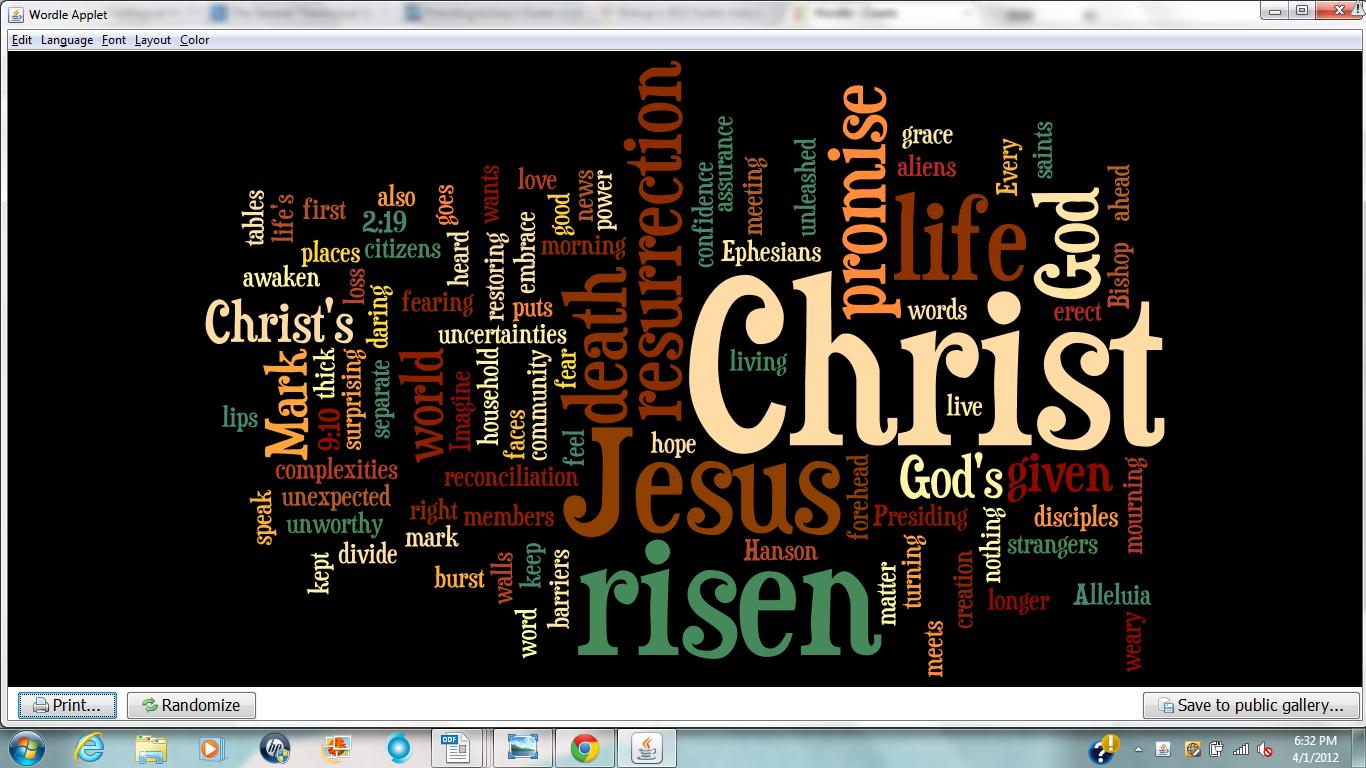
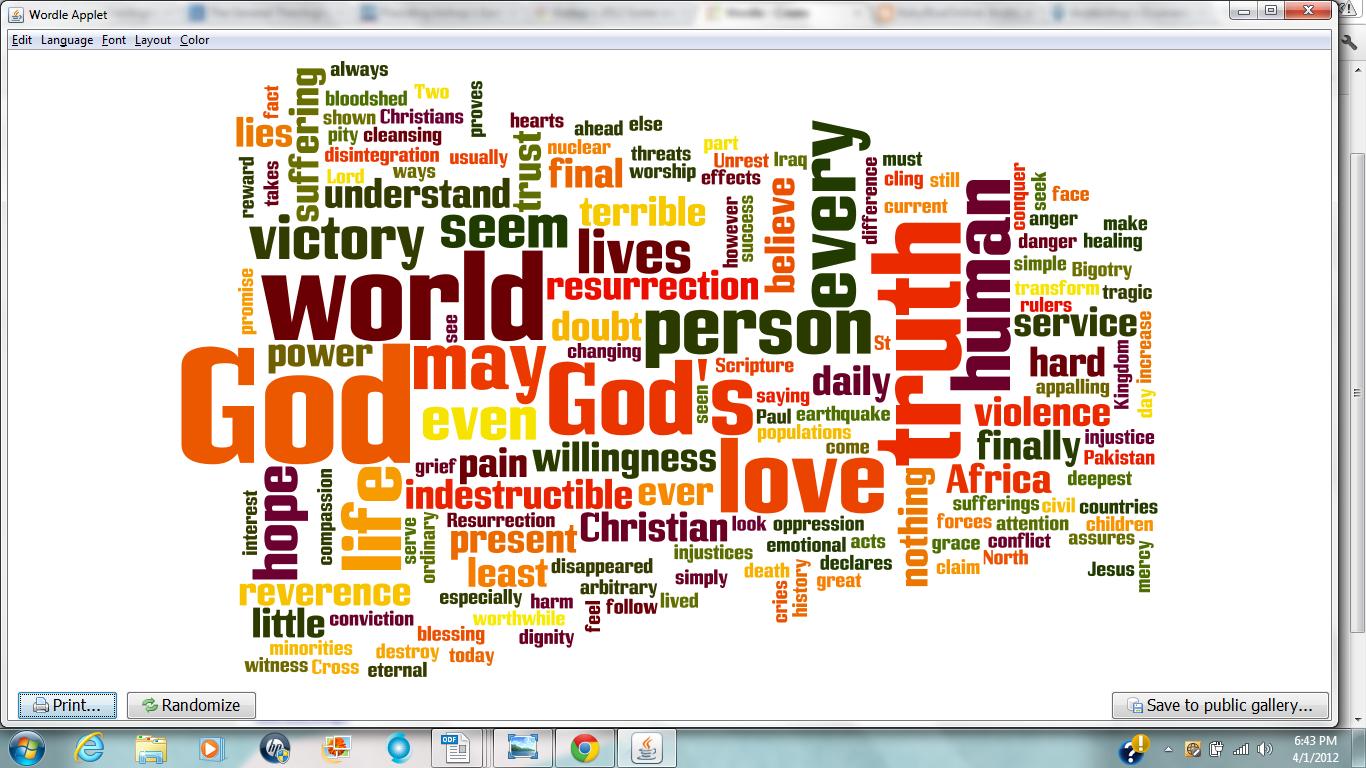
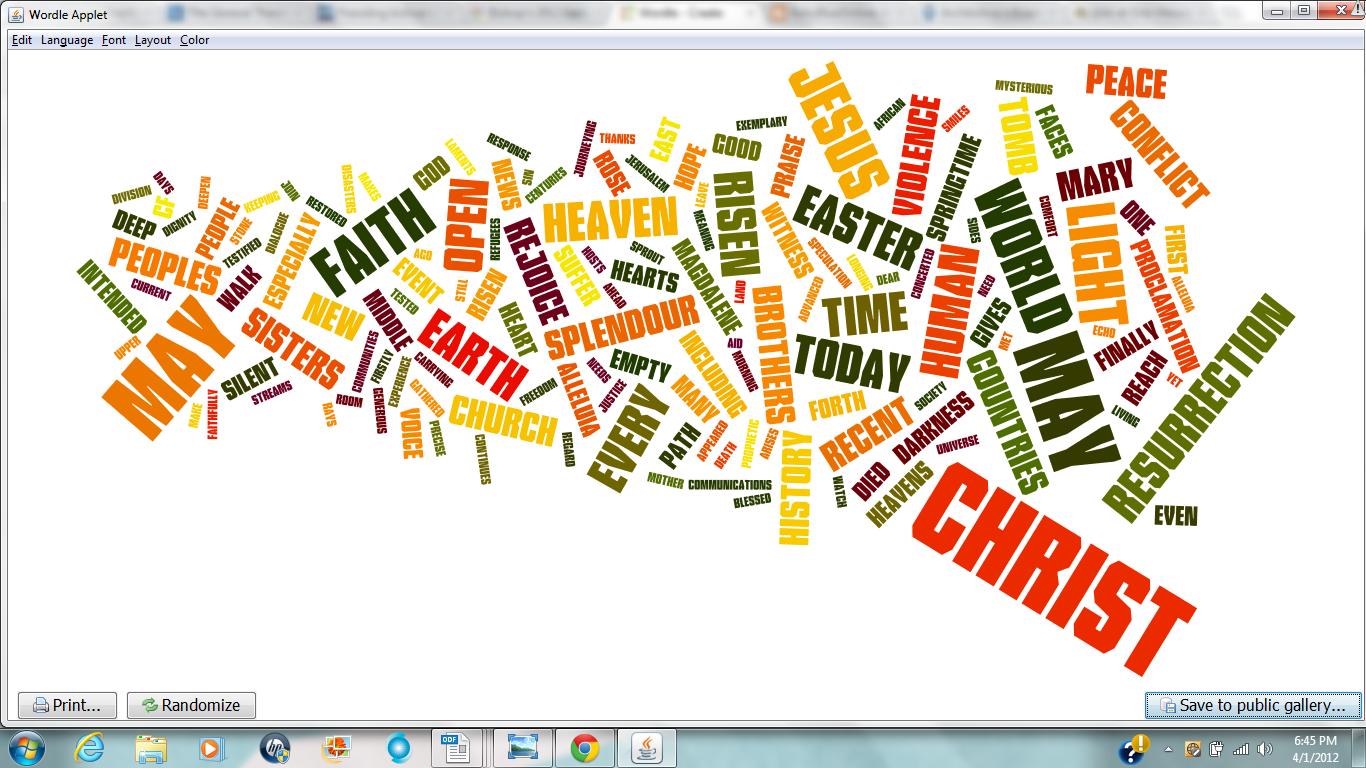
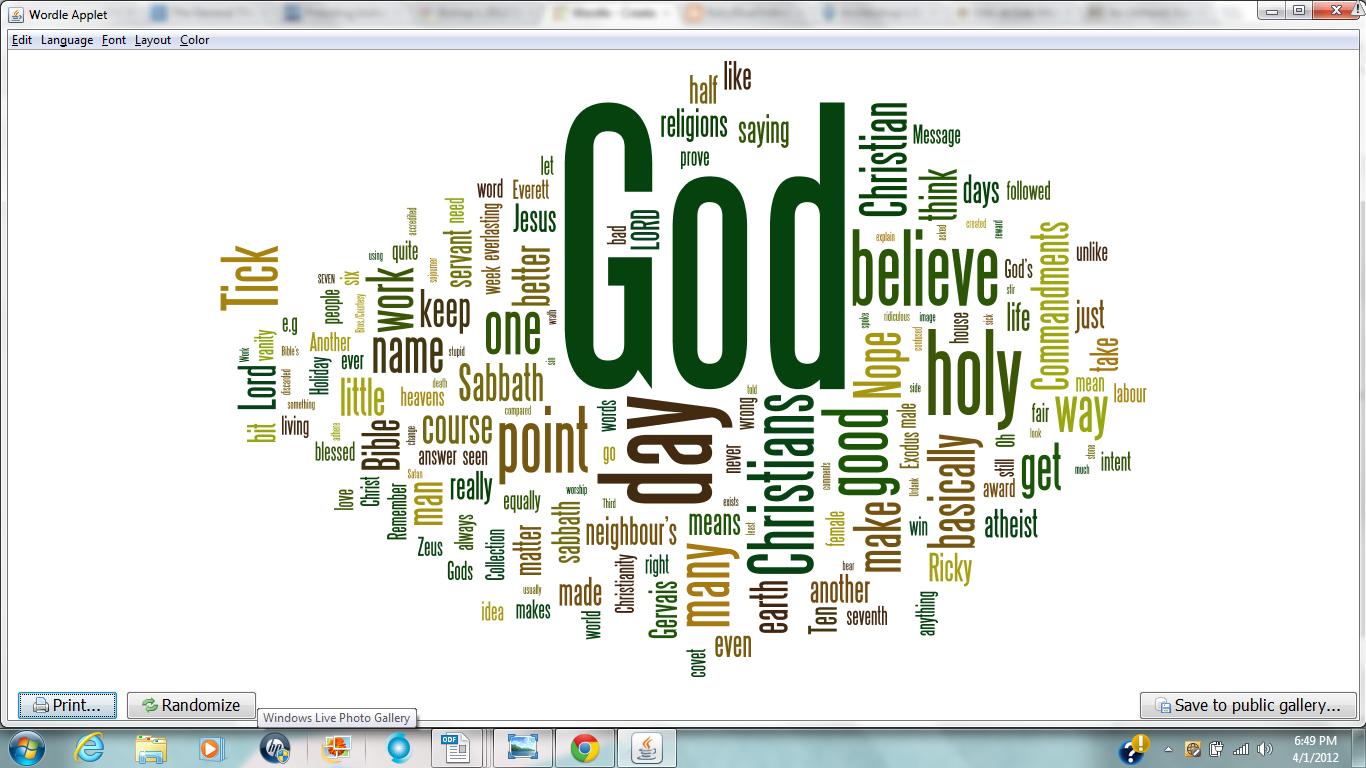
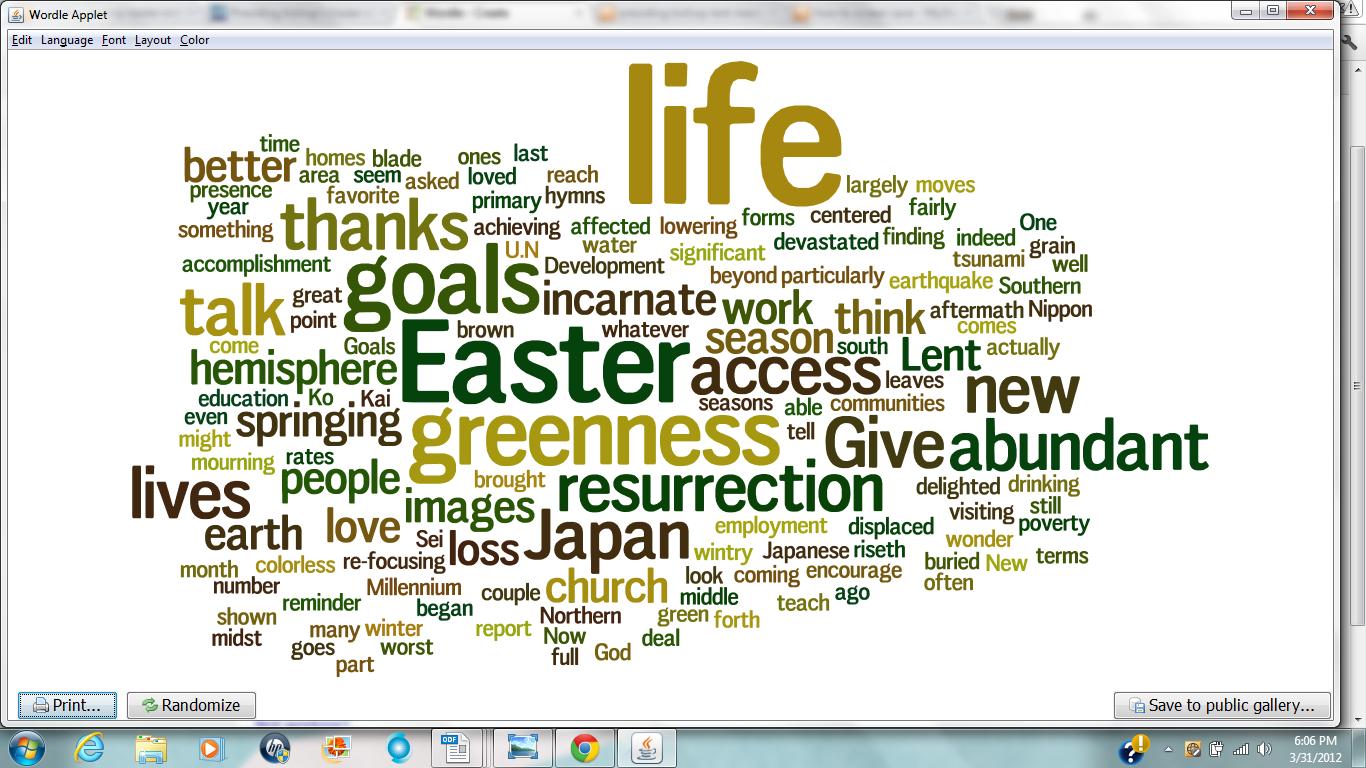
I am attaching, below, word cloud images of the Easter messages of several different leaders from various Churches and denominations – and an Easter message from the outspoken atheist Ricky Gervais.

The troubling thing about the Presiding Bishop’s Easter message is that it is conspicuous in that it does not mention Jesus Christ or God. It sounds much like a rather vague message about new life in spring – perhaps an ad for seeds, fertilizer, or a non-profit designed to appeal to the vaguely spiritual crowd that follows Oprah’s booklist with devotion. One could read it or a Walt Whitman poem and find similar themes of natural beauty and struggle. I do not see anything about the decisiveness of the Resurrection or the great gift given to humanity in the person of Jesus Christ. One does not see God the Father or the Holy Spirit in the word cloud either. In other words, it is an Easter message without the true, great hope that is Easter.

Resurrection is presented as a theme to be found in the world around us rather than as an act of love that upends the very nature of the world.

I am not one who takes delight in speaking ill of the Presiding Bishop or her office – hers is no easy task. But I opened that Easter message looking for hope and news of God’s great gift and found an Easter message that said much about the day of Easter but not about its source, meaning, or Truth. It focused on resurrection as a process (with a small R) rather than as a victory that destroyed death. What I found was a message profound for what it lacked – news of God’s mighty acts in the person of Jesus Christ.

Ricky Gervais – An Atheist Easter message 2011

Robert+