The Perfect Christmas: A Sermon for the Christ Mass

Christmas at our house was always met with lots of joy mingled with a little bit of fear. You see, whenever we had some big event coming up like a camping trip, a vacation, or a weekend away, there would come the inevitable moment when my mother, overwhelmed with preparations (and our apparent lack of concern about those preparations), would suddenly declare, “Let’s just cancel it!”

So as Christmas lights needed to be hung, cookies needed to be baked, guest rooms prepared, travelers picked up, the house cleaned, the Christmas china found – as things got hectic and details seemed overwhelming, we always feared that we would hear that dreaded phrase, “Let’s just cancel it!” I remain convinced to this day that if any mortal might, with a word, cancel Christmas, it is my mother!

She always wanted us to have the perfect Christmas. And we all do this to some degree or another. We try to recreate that perfect memory, moment, or meal when Christmas day was just as it should be.

Yet, I wonder, if that first Christmas was just as Mary would have had it? Was that her perfect Christmas? Here she was, traveling at the government’s command, finding no room for shelter, giving birth amidst barnyard animals. This may not have been her perfect Christmas – but it is ours.

Thankfully, the perfect Christmas has already been had. That first night of Jesus’ birth was our perfect Christmas. God, at work in the meanest of circumstances, created a holy night which made possible our own new birth.

Too often we let the perfect get in the way of the joys of the moment. In our search for something just beyond our reach we fail to grasp the raw beauty of just what we have been given. Lying beneath the surface of what we see often lie true gifts of love, beauty, and grace.

A number of years ago, I was given a small box for Christmas. As I opened the box I saw a tarnished, dented, and rather well worn coin. It was an 1891 silver dollar coin. At first I was rather underwhelmed with this gift. I had hoped for an x-box or even a new book (when I was a child I was particularly fond of the Guinness Book of World Records or perhaps some new tome of Arthurian legends). Yet I had gotten a coin – and not even one I could use in a Coke machine.

Then my father began to talk about this coin. It had been in my great-grandfather’s pockets as a good luck charm in the trenches of World War I. It had been in my grand-father’s pocket in World War II. It had been in my father’s pocket as a good luck token since he was young. That coin, with all its dents and tarnish, told a story that no book could capture.

It was not its shine that made it beautiful but its tarnish.

My wife, a couple of years ago, received a spoon for Christmas. It was a red cooking spoon. It was rather a mess. Melted in places, a little bent, and discolored from use. She, unlike me, was overwhelmed with the gift – or perhaps as a Southerner she was just better at being graceful about odd presents than I was.

I tend to think not though, because this had been her grandmother and grandfather’s cooking spoon. It had served black-eyed peas on New Year’s Day, banana pudding at Christmas, and sweet potato casserole at Thanksgiving. Year after year it had been used at her family’s most cherished times together.

It was not its newness or shine that made it cherished but its years of use and the love it conveyed.

Beneath every seemingly less than perfect moment and gift is more. More of life, more of love, more of God’s many gifts to us. How often do we let the search for the perfect overshadow all that we are given?

The wonder of Christmas, of Christ’s coming, is that it was done in such a very human and raw way – filled with excitement and exhaustion. Beneath dirt and dust, fear and trembling, cold and night lay joy, hope, and promise.

Less than perfect circumstances revealed a perfect love.

It is the essence, the heart of things, that makes them perfect rather than our efforts to make them so. Whether a coin, a spoon, or a holiday – there is a heart in them all that makes them more – and for that we give thanks.

Our struggle is to remain ever mindful of our blessings despite living in a culture that sells us celluloid visions of perfect days, precious moments, toned selves, and richer futures if we just have more – if we were just more.

A Christian view of the world is one that sees the movement of the divine all about us, not in what we could have if we just worked harder, but in all that we have, in all of the gifts, people, and moments we have been given.

An art historian, looking a painting, sees the brushstrokes, use of color, symmetry, and perspective and knows that this is the work of Rembrandt. A trained musician listens to the chords, notes, and form of a piece and hears Beethoven.

Faith is both art and discipline because it is no easy or precise task to hear the voice of the Holy One – to receive the one whose own received him not – and it takes practice, a lifetime of practice, to know the God who knows us.

Christmas reminds us that God is not a deity of serene detachment, content to create the cosmos, and then stand aside as it grinds along to its natural ends. Creation is not God’s hobby. This is a Father whose passionate Love is offered for us, for me, and for you – whose whole being is drawn to dwell with us. This is a God whose first dwelling here was a creche, whose sign a cross, and who promises to be with us always. In the face of such love, all we can do is give thanks.

Tonight we sang “Once in Royal David’s City.” As it began, we strained a bit to hear that voice begins the story, “Once in royal David’s city stood a lowly cattle shed…” It echoes around us and then we realize that, from some place deeper than memory, we know the tune.

New voices join in, accompanied by the lush sound of the organ. We hear a bit more, “He came down to earth from heaven…”

All around us people move, smoke comes forth, and we sing. Before we even know it, we are singing loudly, some smiling, some with tears in their eyes as we hear the voices of those gone before us singing too, and with one loud voice we know and sing “our eyes at last shall see him, through his own redeeming love.”

The song swells and we sing not of an old story, something of the past alone, but of a promise that still echoes across the ages and resounds deep in our chest, “And He leads His children on, to the place where He is gone.”

We are constantly, throughout our short days, being asked to join in God’s song of redeeming love and to give thanks as we listen for the one who is Love in voices all around us.

We experience God’s love in the imperfect people and world around us. In being given a second chance by someone we have hurt. In the self-less love we receive from our friends, parents, children, partners and even our pets. In the gracious beauty of the liturgy here tonight.

The Christmas story, this perfect story, reminds us that it is through very real, rarely noble, and sometimes challenging people and experiences that we come to know the love of God – and we give thanks for that.

May this Christmas reveal more and more of God’s transforming love. May we see the gifts of God all about us in simple moments, loving friends, and even in odd gifts given and received. May we see signs of a God who takes all things (those new and those well-worn, those still shining and those tarnished by age), all people, and all our lives and ever holds them in perfect Love.

Robert+
Of the Conception: Immaculate, Immaculate?

The Blessed Virgin is compelling to so many, in part, because of her very human role in the story of Jesus Christ. She is a figure of adoration that shares in the very human joys of birth, the challenges of obeying God’s will, and the agony of loss.

The Magnificat, the Virgin’s Song, is the anthem of the Church. It is our song of hope that saves the spirit. It is our “yes” to the will of God that we will stand in the face of doubt, fear, and suffering to witness to the love of a living and present God.

Mary’s “yes” to God calls us to an ever-deeper awareness of the Incarnate Lord. Those who follow Jesus in the way are alike to his Mother and grow to do the will of the Father. Karl Rahner writes, “To honour God’s work in her is in fact a unique way of praising and being grateful for the one great and comprehensive benefit that God has conferred on mankind.”

Our honoring of Mary carries with it the hope that all of the children of God will grow into a life of perfect freedom. In part, this begins at Baptism, the point at which we are “dead to sin” and born into new life and put on Christ through the same movement of the Spirit by which Mary became the ark of the New Covenant.

We often hear the phrase “For God so loved the world that He gave his only begotten Son” and immediately think of the Crucifixion and the Atonement. When we hear those words we would do well to remember also the Nativity and the Incarnation. For God so loved the world that he gave his only begotten Son to be loved, cared for, and raised by his Blessed Mother.

God does so love the world and that very fact is always held in tension with our own betrayal of that trust which leads us to Jesus begging his Father to “Forgive them.” We are always the beloved and forgiven of God and honoring the Blessed Mother gives us all a deeper sense of our own share in the love made known in the fullness of the Incarnation.

Immaculate, Immaculate?

I rather like the idea of the Immaculate Conception. Or, perhaps, it is simply the big brother in me that enjoys tweaking my colleagues as I sprinkle “immaculate,” “co-redemptrix,” and “assumption” through casual conversations! Call it theological shadenfreude. However, as much as I would enjoy being a fierce advocate for the Immaculate Conception of the Blessed Virgin, I wonder how celebrating such a feast impacts our understanding of her vital and unique role in salvation history?

There is much confusion over the Feast of the Immaculate Conception. A common misperception is that the feast references the conception of Our Lord. There has been a conflation of the Virgin Birth with the Immaculate Conception. The Feast of the Immaculate Conception is a feast that celebrates the Conception of Mary as being one of a unique human unstained by the blemish of sin. Does believing that Our Lady is Full of Grace imply that we believe her to have been conceived without the burdens of human nature?

What do we make of the difficulty of her choice to say “yes” to the indwelling of the Holy Ghost if she never could have said no? To say no would surely have been sin. Part of the compelling vision of Mary is her willingness to accept her unique role in history. If she were born without the ability to sin, it seems that she would have been unable to actually make a real choice – to say no (or yes for that matter) – and thus that pivotal answer to God becomes a fait accompli rather than a momentous, decisive choice made on behalf of humanity in the face of very human fears.

Saint Thomas Aquinas rather vigorously argued against the Immaculate Conception. In his view, to say that any human’s birth was immaculate is to deny the saving work of Jesus Christ for all of humanity. In the Summa Theologica, Aquinas says, “Even in the Blessed Virgin, first was that which is natural, and afterwards that which is spiritual: for she was first conceived in the flesh, and afterwards sanctified in the spirit.” In other words, her conception was of a fully human nature with all that is inherited therein, and the fullness of her grace was a gift of the Spirit.

Aquinas continues,

The sanctification of the Blessed Virgin cannot be understood as having taken place before animation, for two reasons. First, because the sanctification of which we are speaking, is nothing but the cleansing from original sin: for sanctification is a “perfect cleansing,” as Dionysius says (Div. Nom. xii). Now sin cannot be taken away except by grace, the subject of which is the rational creature alone. Therefore before the infusion of the rational soul, the Blessed Virgin was not sanctified.

Secondly, because, since the rational creature alone can be the subject of sin; before the infusion of the rational soul, the offspring conceived is not liable to sin. And thus, in whatever manner the Blessed Virgin would have been sanctified before animation, she could never have incurred the stain of original sin: and thus she would not have needed redemption and salvation which is by Christ

To argue against the notion of an Immaculate Conception of Mary may seem to lessen her status yet, Aquinas writes, “…this (Immaculate Conception) appears to be part of the dignity of the Virgin Mother, yet it is somewhat derogatory to the dignity of Christ, without whose power no one had been freed from the first sentence of condemnation.” Our Lord’s saving work encompasses all of humanity, including his Blessed Mother. Her yes to that work cannot have been an act of foreordained holiness but must have been a “yes” that had consequences, import, and full participation.

The Incarnation is the unifying of the human and the divine by the miraculous working of the Holy in the body of humanity. From that union came the perfect expression of both humanity and divinity, Our Lord Jesus Christ. It seems that the Immaculate Conception, as a theological construct, makes the Incarnation less than the full union of humanity with divinity. It implies that this union was not the coming together of both humanity in its fullness and divinity in its fullness but was a union of divinity with an immaculate being that is something more than human and less than divine.

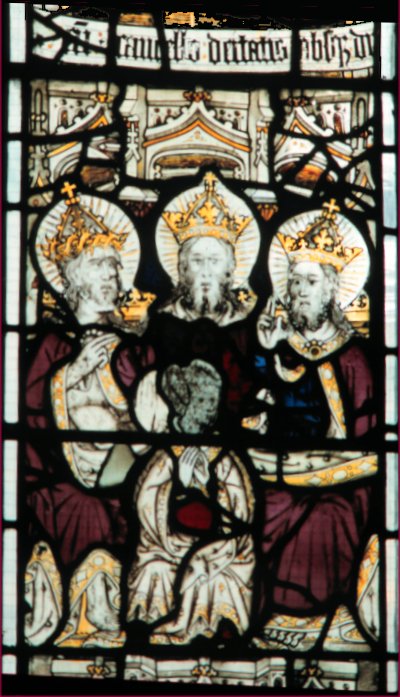
Some time ago I read a rather wonderful piece from the blog Full Homely Divinity. The author writes about Trinity Sunday In particular he focuses on images of the Trinity and on a stained glass window from Yorkshire. He writes,

Coronation of the Virgin by the Trinity, Holy Trinity Church, Goodramgate, York, 1470

…the Trinity is portrayed in this window is significant. Often, the Trinity is portrayed in a manner that might be called modalistic: each Person is characterized in a distinct manner suggestive of a special role: God the Father as a venerable patriarch on his throne, God the Son either crucified or in another manner suggesting his earthly incarnation, and God the Holy Spirit as a dove. In this window, however, the three persons are depicted as virtually identical–the same faces, the same clothing, the same crowns, and all acting in concert. The message, of course, is that God is One, and that the three Persons of the Trinity are equal in every way, and both exist and act as One in everything. Furthermore, they are united in their focus on the person who kneels in their midst and who, as every medieval Christian understood, represents the entire human race. In fact, Mary is virtually surrounded and embraced–in this window she appears to be quite literally overshadowed–becoming a fourth person in the eternal relationship to which all people are invited.

Mary is welcomed into this relationship with the Trinity on behalf of the whole of humanity. Her essential being is our essential being. If Mary is the prototypical human then an Immaculate Conception implies that her very essential humanity is not a full expression of our shared weakness and grace.

It seems that to fully appreciate the great gift we have been given by grace requires a commensurate willingness to believe, in all of our hearts, that we have been given a gift of great price and worth as we too are embraced by the holy and overshadowed by grace that comes through the Son. That gift has been given not to immaculate souls and beings but to very human, real, and beloved human beings. Beings blessed to share in the grace offered to Our Lady.

Robert+

To Preside or to Celebrate?

I am honestly struggling to understand why the inelegant and rather business-speak sounding word “preside” is supposed to be preferable, according to many in the know, to the word “celebrate.” This is especially prevalent now as churches refer to the priest celebrating mass as the “presider.” It might be helpful to look at the definition of the word “preside.”

pre·side (pr-zd)

1. To hold the position of authority; act as chairperson or president.

2. To possess or exercise authority or control.

3. Music To be the featured instrumental performer:

Supposedly, the shift in language is to represent the leveling of hierarchy and to imply that no longer will the priest be recognized as the only one “celebrating”- the entire congregation is celebrating too! However, read the definition of preside again.

There is nothing about the definition of preside that in any way suggests an anti-clerical move or a leveling of hierarchy. The very definition of “preside” is to control, hold authority, and to be the featured performer! This is not only an inelegant term but a profoundly counter-productive one if our goal is to truly bring a sense to the worshiping body that they are a vital part of the liturgical action.

One can look at the definition of celebrate and find theological excess within it.

cel·e·brate [sel-uh-breyt]

1. to observe (a day) or commemorate (an event) with ceremonies or festivities: to celebrate Christmas; to celebrate the success of a new play.

2. to make known publicly; proclaim: The newspaper celebrated the end of the war in red headlines.

3. to praise widely or to present to widespread and favorable public notice, as through newspapers or novels: the countryside celebrated in the novels of Hardy.

4. to perform with appropriate rites and ceremonies; solemnize: to celebrate a marriage.

To observe, commemorate, to make known, to proclaim, to praise widely, and to perform with appropriateness. Contrast that definition with “preside” which is suffused with language of control, authority, and management.

What are the synonyms and antonyms for each term?

Synonyms for Celebrate
1. honor, solemnize. 2. laud, glorify, honor, applaud, commend, give, grace, laud, magnify, praise, provide 3. immortalize, keep, memorialize, monument, monumentalize, observe, pay tribute to, perpetuate, remember, salute, solemnize

Antonyms for celebrate: disregard, forget, ignore, neglect, overlook

The synonyms for celebrate are full of the absolute essence of Christian worship! To honor, solemnize, laud, magnify, praise, memorialize, and remember are key elements of the Eucharistic action. They, in large part, define our life as a Body. Celebrate was chosen as the term for what we do for a reason!

Again, by contrast, look at what the synonyms and antonyms for “preside” are:

to preside (from google search)

Synonyms for Preside

administer, advise, be at the head of, be in driver’s seat, call the signals, carry on, chair, conduct, control, direct, do the honors, govern, handle, head, head up, keep, lead, manage, officiate, operate, ordain, oversee, pull the strings, run, run the show, sit on top of, supervise

Antonyms for preside: follow, serve

My eye can’t help but be drawn to the antonyms first as they are so striking. The antonyms for “preside” are to “follow” and “serve.” In the name of some sort of well-intentioned egalitarian impulse we have now made “serve” and “follow” antonyms of the priestly action!

Look at the synonyms for “preside.” One administers, is at the head of, controls, does the honors, pulls the strings, runs the show, and sits on top of. This is the language of manipulation and corporate finagling not the language of holy and life-giving encounter.

Instead of celebrants lauding and magnifying we have presiders managing and controlling. Worship is not a board meeting. It is not an exercise in human resource capitalization. Nor is it a concert in which the priest is the star of the show. It is an encounter with the Holy.

The drive to make worship more “personal” inevitably makes the person more and more central. Rather than the Spirit, the liturgy, and the congregation’s response drawing our energy forward the priest is tasked with entertaining, directing, and presiding over an experience – managing and manipulating emotions.

Good liturgy draws the celebrant in along with the congregation so that the whole Body is worshiping together. This is not the work of “presiding” but the work of “celebrating.”

The priest is not the star or the director or the manager. He or she is the celebrant. They are called to laud, honor, commend, and observe the Holy. They are called to celebrate. They welcome others to celebrate as well in the way they too are called. We are, indeed, all celebrating these Holy Mysteries together. Some in song, some it chant, some in reading, some in greeting, all in prayer, and all around the altar. One person’s voice begins the song and others join in. One person celebrates and others come ‘round.  It is the use of the definite article that, perhaps, should be questioned not the verb.

Identifying the priest as the celebrant is not an act of elevation but an identification of their primary action and role in the liturgy – to celebrate. It is the unfortunate individualism of this age that draws so much attention to the role and title rather than to the significance of the Body’s action that undergirds that very title and labor. In other words the celebrant is the celebrant because of the action of the Body which has heard his or her call to the altar. Now that the priest is there, at the altar, he or she is celebrating those Sacred Mysteries with the congregation gathered around and joining in.

Ask yourself this. Would you rather be asked to celebrate or to preside? To celebrate a joy or to preside over a joy? To celebrate a mystery or to preside over a mystery? To celebrate a birth or to preside over a birth? To celebrate at a meal or to preside over a meal? To celebrate a memory or to preside over a memory? To celebrate a miracle or to preside over a miracle? To celebrate hope or to preside over hope?

You might notice over the course of these questions that it is not really possible for mortals to preside over many of them. God presides. God gives life, joy, mystery, sustenance, and hope. Above all, God has given us his Son made known in the elements. This is something we cannot preside over but only and ever and forever celebrate.

Robert+

PS: It is also worth googling the images for the two words to get a visceral sense of their definition, import, and connotations.

On Healing Masses: Of Anointing and the Eucharist

A practice I have recently heard more and more about is the use of the Sacrament of Anointing in the course of the Eucharist.  However, this Anointing is not being offered in the course of a Mass a the Prayers of the People, but is now frequently being offered after a person receives Communion.

The intent seems to be that the individual receives the concentrated prayers of the community and/or a priest.  I read a comment that said “it makes me feel special” and “I get more attention to my need for healing.”

I worry, however, that this understanding of the Sacrament of Anointing distorts our understanding of the Sacrament of Communion.

Jesus is our healing.  All of our Sacraments find their source and power in the person of Jesus Christ.

Saint Paul says in 2 Corinthians, “Power is made perfect in weakness.’ I will rather boast most gladly of my weaknesses, in order that the power of Christ may dwell with me” (12:9).  This is not to say that pain is something to boast of or exult in, but it is something that is shared with Christ.  One of the realities of the Incarnation is that our glory is not only in the image of Christ but our pains as well.  Our human frailty is borne by the one who came among us again bearing those awful wounds.

In Communion, we come to receive the one that is the source of healing and is our triumph over the wounds of this world.  We are offered the one who knows our suffering and that bears our pain.   Christ, who visited and healed the sick, comes to us in Communion in a way like none other.  It is in that moment that we are offered union with the one who continues to visit, heal, and defend the sick.  We come to receive, be visited by, and to commune with the one who heals.

That healing is not restricted to physical healing.  So often the healing we receive is a spiritual one that gives us the strength to bear our pain.  Christ bore pain for us and we are called to bear it with him in mind and heart.  The healing we receive is a spiritual one that calls us to allow our heart and mind to be turned to the world to come – the world yet unseen.  Pain can often focus the soul on what matters most deeply to us.

A healing Mass is a holy experience.  That healing should be placed in the context of the whole of the Eucharistic liturgy though.  Prayers and anointing should be offered along with all of the other prayers of the people.  Those prayers find their consummation in the receiving of Communion.  Healing, an integral part of the encounter with Jesus, should not be something that is done after the encounter with Jesus in the Sacrament but before as we gather all of our prayers and present them to the one who comes among us and hears them all.

Anointing is a Sacrament that offers our pain and longing for wholeness to God to transform in whatever way He will.  In the tradition, when Anointing was done primarily at the end of life, it was a Sacrament that offered eschatalogical hope.  It was a Sacrament of the completion of our earthly struggle.  It was a configuration of our suffering with Christ’s in the final moments of our life.

In the fuller understanding of Anointing we now have all of our life’s infirmities and pain, not just those at the end of it, are offered to God.  Healing is not simply an end-of-life concern in this fuller understanding but a grace bestowed throughout our lives.  That grace comes, however, not in an instantaneous healing but in a conforming of the entirety of our lives to God’s will.

Anointing is like Confession in that its chief fruit is not an immediate transformation but a gradual turning of the heart to perceive the fullness of God – a fullness always offered in the Eucharist.  The healing ministry of Jesus was not simply a momentary transformation but an invitation to know God so that permanent healing could be had.

This turning of the heart and mind happens is part of the Eucharistic life.  We are drawn to a living Jesus who was broken for us and who knows our struggles and we are made one with the resurrected Lord.  This is the fulfillment of all Anointing and Healing – a oneness with Christ.  Think of the healing of the blind, it was not offered simply so that they could see, but so that they could Behold.

All of the Sacraments should be viewed in the context of the others and especially in the context of Baptism.  Each Sacrament builds upon the grace bestowed in the very beginning of our life with Christ.  Each Sacrament gives us further growth in our life with Him as we are drawn ever more fully into a life of trust, service, and self-offering.  Anointing is one part of the pattern of holiness.

The Eucharist is that place where we meet Christ and He meets us.  It is that regular conformation of our life with Christ’s.  Healing takes place, in its fullest spiritual sense, at the altar rail.  Immediately after that most intimate encounter with God there is no need of another healing – just thanksgiving for all the healing and reconciling work of God in Christ.

This is a more intimate sustenance than physical necessities being provided, it is the Lord himself coming to be among and in His people, offering healing and wholeness.

We feed on Christ.  In that moment, we are open to the Lord and Him to us. We are reminded that we depend wholly on God and rest assured of His constant love.  There is always healing to be found in the Eucharist and we should always be offering prayers for healing but we should also remember that true healing is ever on offer in Body and Blood.

A Search: Of Catholicity, Google Auto-Complete, and the Episcopal Church

It is sometimes an interesting exercise to see what Google auto-complete will fill in when you begin a query on the search engine. They are often fascinating little blurbs that reflect cultural and social anxieties, fears, hopes, misperceptions, and trends. For example, if you type in “Is there…” the following four phrases are “auto-filled”

  1. Is there…a God?
  2. Is there…anybody out there?
  3. Is there…a cure for herpes?
  4. Is there…life after death?

With the obvious exception, it is fascinating that all of these are existential questions – questions of ultimate meaning and ontology. And one of seemingly pressing and worldly concern! These fill in the blank exercises are often a mix of humorous, sad, telling, and nonsensical. Like so many trends, it is difficult to draw distinct conclusions but it is possible to sense trends, perhaps.

I was intrigued, so I typed in the beginning of the query “Is the Episcopal Church…” to see what others were asking about the Episcopal Church. The auto-fill responded with

  1. …dying?
  2. …liberal?
  3. …catholic?
  4. …right for me?

Of course, I was struck immediately by the first – dying. The others are intriguing though for they may offer an insight as to how the first can be remedied. They also, however, offer potential pitfalls in thinking about how we self-identify, self-select, and evangelize.

It might be interesting to look at how the auto-correct fills in for other Churches and denominations as well. For example, when you type in “Is the Baptist…” you get “…religion a cult.” If you type in “Is the Presbyterian…” and you will get “…liberal” and “…a cult.” None of these rivals Rome’s apparent Google issues as when you type “Is the Roman Catholic…” you will get “…Church a cult” and “…Church the Antichrist.” Interestingly, almost all of the Protestant denominations get “dying” in the results stream.

What others do not get, however, is that fourth auto-fill option that the Episcopal Church gets – “right for me?”

Is the Episcopal Church right for me?

It’s a fascinating question that, apparently, the Episcopal Church is triggering in many people. There are many ways I suppose you could look at this. One could be long-time and disaffected people asking themselves (and Google) “Is the Episcopal Church right for me…anymore?”

I rather think something else is happening though. I think those other two factors are contributing to a new look at the Episcopal Church by many. Everyone is getting dying. Only we are getting the combination of “liberal, catholic, and right for me?”.

I was at a recent small group mass with several Roman Catholics – I was invited as a guest and the celebrant was a Roman priest of some advanced age. He celebrated mass earnestly and with a sense that something wonderful was happening in very mean circumstances. It was when we got to a period of reflections on the readings that things got interesting.

One of the readings was a rather unfortunate lesson on the role and value of women. A Roman Catholic woman at mass said, “This reading makes me feel…energized.” I wasn’t sure what she meant by “energized” and then she said that, as a woman, she was not sure what her place was in the Roman Catholic Church. She expressed a disappointment that her role seemed diminished by the structures of Roman Catholicism.

A man, well dressed and well spoken, then said, “Women have always had a place in the Church.” He said, “They have been nuns and have served in parish leadership roles.” I was expecting him to defend the Roman Church and its stance on women’s ordination. However, he then surprised me by saying, “We have had women in leadership, we have a shortage of priests, I don’t understand why we aren’t ordaining them!” This was met with nods and affirming statements. The sense of the entire room was that the Church was making a mistake by not ordaining women.

Then, a fellow turned to me and asked, “What is it like working with women priests?” I, as a guest, did not want to get on too much of a soapbox. So I offered that it was, frankly, not much different! I said that from my point of view, a woman had borne the source of all of our Sacraments and I believed that they were able to continue to bear Christ for us through the Sacramental life.

Then the conversation turned to ordaining married priests. Again there was a round of affirmative nods and exclamations. Again, I was asked for my perspective as a married priest. I simply offered that I did not know what it was like not to be a married priest but that I thought it brought a fullness and awareness to my ministry that was crucial to my own life as a priest.

In other words, these folks were entirely engaged in thinking about a Catholic Church that looked different from the one they grew up with.

For folks like this, the answer to the question, “is the Episcopal Church right for me” seems like it could be yes, absolutely!

That Google search auto-complete function which gave us “liberal” and “catholic” as auto-fill responses points toward how the Episcopal Church might thus offer a resounding no to the question, “Is the Episcopal Church dying?”

I believe that many, whether Roman Catholic or from other traditions, are looking for a Church that is Catholic in its expression of faith, connected to the early Church by tradition, is creedal and has a centered life of prayer. They are also looking for a Church that honestly wrestles with the challenges of the day even as it finds the answers to those questions in that time-honored exploration of Scripture, Tradition, and Reason.

We run the risk, however, of allowing any agenda to define the Church. When “liberal” comes up as an adjective, we need to ask ourselves whether this is because we have made one political agenda or another the Church’s defining attribute. It seems that living into the word “liberal” in the fullest sense of the word is a great gift for the Church. The Church’s liberalism must be apolitical – beyond politics and able to speak to it rather than for it.

A quick look at the definition of the word “liberal” finds the following:

“Not limited to or by established, traditional, orthodox, or authoritarian attitudes, views, or dogmas; free from bigotry.”

If the Episcopal Church can live into this definition with integrity then we will have offered the Church a profound gift. If we are “not limited to or by” established ways of doing things then we are engaged in the process of holy listening that we are always being called to.

However, not being limited by does not mean not considering or not being guided by. There is a value to holding that which we have been given to safeguard with the continued movement of the Spirit. The “authoritarian attitudes” of the definition can be found in the most liberal of agendas. If our way of being is not one that invites constant conversation both with the voices of the present and the voices of the past then we will have sold short the wisdom of the ages.

However, it is foolish to assume that all in tradition is worth holding on to simply for the sake of doing so. There are things in it that are holy and true – though not all of it may be. One need only look at the damage from the clergy abuse scandals to see the cost of a too-rigid deference to tradition. It is the work of discernment, of a liberality of Spirit, to welcome the voices of the past into the conversation with the present. That willingness to engage both the world around us and the past while contemplating the hopes and fears of the future marks a Church that is free from “authoritarian” dogmas and views of any stripe or persuasion.

There are many asking the question, “Is the Episcopal Church right for me?” Our answer is yes! There are many looking for a Church that is rooted in tradition without being dominated by traditionalism. We offer a blend of forward-looking Catholic faith and worship that can draw people like those I talked with in that house group.

Moreover, there are many asking deeper questions beyond any one Church or denomination. Look at that first Google search again! They are asking, in huge numbers, “Is there a God?” We are a Church that can offer answers to that question that reflect our own honest wrestling with the anxieties of the present age and our hope for the age to come. Our answers are not ours alone either but are the answers of the Church over thousands of years whose questions are ours and whose belief ours as well.

At our best we are a liberal Catholic Church that is absolutely right for you! It is a blend of liberal catholicity that will offer a place for those weary of the absolutism of other traditions and while seeking a home that holds tradition in high regard while recognizing that God continues to speak. It is with that voice that we will be able to declare, in no uncertain terms, that the Episcopal Church is not dying.

Robert+

Will the Church be Alright? Of Relevance and Generational Shifts

So I have been trying to put together some grand unified theory of youth and young adult ministry that will tie up all of the loose ends from the last two posts into some beautifully woven and elegant tapestry.  However, that piece is forthcoming – though slow in doing so!

In the meantime, a friend of mine asked me what hope I saw in the up and coming leaders of the Church and how we both reach them and prepare the Church for their leadership.

A Church that seeks to be relevant or to matter?

The young adults I talk to are not looking for easy answers, vague spiritualities, dumbed-down theology, slipshod worship, therapeutic relativism, private faith, or a mono-cultural God.  They are desperately searching for a Church that offers an encounter with the Holy that transforms, convicts, inspires, and draws them in.

They are searching for a Church that demands their best.  Whether it is in mission, worship, theology, or daily life, they want a Church that is relevant not because it tries to tell them only what they want to hear but because it offers them a vision of the Holy and its transforming power.  A Church that reaches for and preaches relevance is a Church that makes itself irrelevant.  The quest for relevance is the mark of quiescent extinction.

This does not mean we quietly make our way off to the Grey Havens exiled in our own sense of righteous irrelevance as a new age dawns.  It means that questing for relevance, as if it is a goal worth achieving in and of itself, is a sad and tired pursuit.  It is not relevance that defines a people, that marks transformational leadership, but passion and purpose.  It is passion for God that shines through and marks a Church as Holy, as set aside for God’s use, and as deeply and overwhelmingly relevant.

There is a profound difference between a Church that is “relevant” and a Church that matters.  We are relevant only insofar as we offer a way for our believers to have their lives formed to the pattern of Christ’s own life.  We are relevant only insofar as we offer cruciform living and it is only in offering that transformation that we matter.

Young people are not looking for the easy path in life.  They don’t mind a challenge – it is too often us who fear the challenge.  They are not looking for the path of least resistance.

Look at the number of young people Occupying across the country or those joining Teach for America, the Peace Corps, the Episcopal Service Corps, Jesuit Volunteer Corps, Americorp, Lutheran Volunteer Corps, and the countless other service programs out there that call young people to live sacrificial lives in the service of others.  These young people are not trying to find an easy path – they are trying to find a path that makes a difference both to themselves and to others.

The Church must honor that deep desire by offering more – by offering them all that we have ever had to offer – the life-changing encounter with Christ.  Young people are searching for a way of being that is honest and rooted in something greater than themselves and we are too timid about offering that.

We can do so with joy for we are part of a Church that has a way of being the Body together that at once honors individual gifts while calling us to a higher common identity.

One of our teenagers, whose parents are at another parish, came to Christ Church because, as she told her dad, “The Prayer Book offers so much!” She was searching for a place that honestly tries to live into the fullness of our common identity as Anglicans.  She was searching for a place that knows that the Church has so much to offer.

A Generational Shift

We are not a Church that is really very well led by only Baby Boomers nor Generation X.  Let’s not forget that the Boomer generation was called the “me” generation.  It is a generation that places primacy on self-actualization and individualism.  These are not the marks of a thriving Church that can call others to sacrificial living.  They sought to overturn tradition and learned a way of being that is rooted in either/or thinking that is premised on a zero-sum approach to a variety of fields (including faith).

In “Mind the Gap,” a book on generational differences, Boomers were typed as “Talkative, Bossy, Inquisitive, Stylish, and Competitive.”  Generation X fares not much better, in some respects, and was marked as “Pragmatic, Individualistic, Arrogant, Risk Taking.”

It is the next generation that offers hope for a new kind of Church leadership.  Generation Y was termed “Tolerant, Caring, Honest, Balanced, Independent, and Optimistic.”

The next generation of Church leaders is one that is ideally prepared to bring the Church forward.  They understand the complexity of human nature and society.  They value honesty and real relationships (despite how we might disparage the falsity of Facebook and the like).  They have a healthy approach to life that finds identity more in relationships than career.  They have seen both the challenges of fundamentalist religion and the costs, especially to families, of a society without grounding.  They are always searching for the real amidst hyper-marketing.  They are generally optimistic and not saddled with Generation X’s deep cynicism nor with the Boomers’ reflexive distrust of (and desire to deconstruct) everything.

In other words, they are prepared to lead a Church that is grounded, honest, thoughtful, optimistic, complex, and engaged.  For those despairing for the future of the Church, I can honestly say that we have a generation of leaders coming who will make all of us very proud.  However, we have to have the courage to pass on to them a Church that knows who and what it is.  We will be deeply blessed as our leadership becomes increasingly inter-generational.

Gifts we can pass on

We have a number of gifts that equip us ideally to be the Church of the next generation (if we have the courage to hold on to them) – and they are the very things that have always marked us as a Church:

  1. Authenticity – the Episcopal Church and the Anglican Communion have an authentic identity that is steeped in a rich history of honest engagement with the world around us.  Authenticity might also be thought of as the “tradition” which we have been blessed with.
  2. Scripture – We have an approach to God’s Word that respects its profound truth for our lives and yet recognizes the Word’s changing message to a changing world.  Scripture lives and breathes through the Spirit which means it changes and expands.  Rather than narrow we seek to deepen our understanding of the Word and its always challenging message for us.
  3. Rigor – Historically, we have not been the Church of easy answers.  Faith is a complicated thing and never more so than now.  We live in a world that poses a host of hard questions for people of faith.  Our tradition of honestly wrestling with the intellectual and spiritual challenges of faith has formed us for a cultural moment which demands a faith that welcomes reason.
  4. Beauty – We value the beautiful in a world that increasingly denies the power of the beautiful to change and transform us.  The Holy speaks through beauty and we are a people that have a special place in our liturgy and common prayer for the Holy to continue to speak.  Let Church be an encounter with the Holy rather than a chat about it.
  5. Catholicity – We are a Church that finds its unity in the Sacraments.  Baptism and Communion form us to be citizens of the Kingdom.  We are a body that finds that unity expressed in Common Prayer.  That unity and our commitment to it mark us as a people who know the difficulty and joy of living with the other, our sister and brother, always in our heart and mind.  Our identity is not ours alone – it is shared with those that have come before and those who are yet to come.
  6. Mission – Increasingly, we are coming to reclaim our identity as the Domestic and Foreign Mission Society.  We are living into our call to seek and serve Christ in our neighbors at home and abroad.  This sense of mission helps us to see our faith not only as something that is only personal but as deeply needed by the world around us.
  7. Diversity – No one approach is the right approach.  God speaks to us in manifold ways and our Church reflects our manifold answers to God.  We are seeking, across the Church, to offer praise to God that is rooted in the local realities of God’s universal call.

We simply have to have the courage to stop trying to pretend that being relevant means aiming for the 1970s, 1980s, 1990s, or the ‘00s.  Whether it is the business-speak of the ‘80s, the liturgy and music of the ‘70s, or the “emerging” church of the ‘90s, or the countless other ways we are trying to catch-up, we are failing to look to the future and to be honest about who we are.  We keep aiming for marks that have already passed.

Rather than being the confident fellow who slightly overdresses (and is unashamed to do so) we have become the fellow trying on the mock-turtleneck, then the t-shirt under the blazer, then the skull-cap, then the slightly too tight merino v-neck, then the necktie casually loosened, then the leather jacket, then the jeans with the navy blazer…In other words, we are trying too hard to be something else (and something sadly dated) rather than just being who we are.

We will not manage, hand-hold, or emerge our way into the future.  We will only grow into our future as the Church when we reconnect with those essentials that define us, that are authentic to us, that make us matter as a Church.  Young people are not looking for a cool Church, the whole culture is selling them cool, they are looking for a real Church – a Church that matters.

Some interesting related things

“How to get more young people in church” by Bishop Kirk Smith

“The Entrepreneurial Generation” from the New York Times

“Yes, young people do like traditional liturgy” from the Episcopal Cafe

“Authenticity, Lessons from a Gen X Traditionalist”

“Brooklyn Church looks to tradition, community building to attract young adults” from Episcopal New Service

“It’s not about you” from the New York Times

Robert+

Will the Kids be Alright? Part II – Some Lessons from our Youth

Identity Crisis Part II

So, having put up results from the NSYR study of youth and religion in Part I, I have gotten some interesting responses.  They ranged from “Oh my God, the Church is dying” to “These numbers are really suspect” to “We are Episcopalians, we don’t do Church the way these other denominations do.”

None of these is especially helpful.  The Church is seriously challenged and these numbers absolutely call us to look at what kind of faith we are passing on to our young people.  They have to be looked at in the context of the broader challenges faith and religion face in our culture.  They have to be taken seriously though.  Ignoring them or acting as if they do not tell some sort of story about the Episcopal Church is dangerously myopic. (note: there are some questions worth raising about the sample size of the survey as the number of Episcopal young people surveyed is relatively small at 45 as compared with 311 Evangelical teens – but we are a relatively small Church).

We need to have a careful and thoughtful self-regard – neither panicking and over-reacting nor pretending things will just be alright if we don’t get serious about the faith of our young people – and ours.

These numbers reflect not just who our kids are spiritually but who we are.

Some Lessons from the Study

There are definite lessons to be learned from the various denominations that are surveyed.  For example, when the Assembly of God churches score so high in answering the question, “Will you live your life for God?” our response should not be, as one scoffing reader put it, “Oh yes, that’s our problem, we are not enough like the AG Church!!” Perhaps it is worth thinking about what does it mean for us, as Episcopalians, to ask our young people to live their life for God?

Don’t we already do that?

Question     Do you renounce all sinful desires that draw you from the love of God?
Answer        I renounce them.

Question     Do you turn to Jesus Christ and accept him as your Savior?
Answer        I do.

Question     Do you put your whole trust in his grace and love?
Answer        I do.

If we take seriously our baptismal ecclesiology then we are asking our young people to do just this – to live their lives for God.  Our preaching, teaching, service, worship, and prayer need to communicate that our very essence as the Baptized is, at its core, about living our lives for God.  Making this essential point clear and present in all that we do might help our young people to realize that their lives are consecrated, set aside, for God’s holy use already.  They are living their lives for God.  Their Confirmation is just that – they confirm their identity as being of God and for God.

Other Lessons?

Where else might we find useful information about our life as a Church in this study?  One of the interesting things about this information is that it is a direct product of our life.  It is an output that is made up of our inputs.  The kind of preaching, living, teaching, praying, worshipping, and more that we do are directly reflected in the survey results.  It requires a bit of patience and humility to hear the lessons in these survey results.

For example, “There are relatively high levels of uncertainty about God among some of the mainline denominations’ teens…23 percent of the Episcopalian teens.” Our teens reported the highest level of uncertainty about the existence of God.  We are a Church that preaches a healthy self-direction with regard to matters of faith.

Have we, however, lost the ability to preach healthy questioning while seeing that questioning as being in and of God?  It is our role, as the Church, to show that there is Truth.  There is Love.  By not communicating the essential truth of God’s being we are setting young people adrift and pretending that their unguided searching for direction is healthy.

Perhaps it is a prurient comparison but we no longer believe, generally, that the best way for kids to learn about physical relationships is from the media, the culture, or their friends.  How can we think that teaching them the fundamentals of faith, of their spiritual lives and souls, is somehow invasive or too directive?  We are obliged to give them tools to be faithful people.  Our role in the baptismal covenant is to do all that we can to see that they are “brought up in the Christian faith and life.”

It is instructive to note that the number of young people that believe in astrology and reincarnation has climbed.  There is a hunger among young people for spiritual truth.  We do them a profound disservice if we allow them to drift to vague spiritualities rather than offering them the enduring faith of the Church.

Faith is too important a matter for it to be left to the culture to teach.  The dominant form of Christianity in the media right now is either fire-and-brimstone/turn-or-burn fundamentalism or prosperity gospel preaching – both of which invert and mangle the fullness of the Christian tradition.

To allow our young people to grow up without clear teaching means that we cede faith to those who continue to use it for political or personal gain because those are the loudest voices or we risk them drifting aimlessly between self-exploration, astrology, reincarnation and the like without a firm foundation so that when life’s trials come they do not have a spiritual and moral footing that will hold them fast.

The study notes that “The majority of adolescents reported remaining at the same level of religiosity, and when adolescents did report a change in their overall religiosity, a higher proportion of them reported becoming more religious than becoming less religious.” In other words, there are opportunities for us to draw young people deeper into the life of faith.  They are not rejecting the faith so much as having it presented to them in such a slipshod manner that it is irrelevant.

The survey results bear this out.  Read again these results:

  • “…while 93 percent of Presbyterian Church (USA) teens and 91 percent of Evangelical Lutheran Church in America teens report that their churches usually feel warm and welcoming, only 69 percent of teens whose parents are Episcopalian say the same.”
  • “65 percent of Church of God in Christ teens and 57 percent of both Assemblies of God and Southern Baptist teens say that church is a very good place to talk about serious issues…while only 31 percent of Episcopal teens agree that church is a very good place to talk about serious issues.”
  • “less than one-half of Episcopalian teens who attend church more than a few times a year (46 percent) say that church usually makes them think about important things.” (by far lowest and the only group under 50%)

We have the lowest percentage of respondents that say our churches are welcoming to them.  We have the lowest percentage that says that church is a good place to talk about serious issues.  We have the lowest percentage that says church makes them think about important things.  If we are serious about intellectual engagement with the faith then the numbers would bear this out.  We would have young people who felt challenged and believed we talked about serious things and made them think about important things.

My fear is that too many of our churches are talking about things of the culture and not of the faith.  We have too many churches that try not to be too dogmatic and to be “welcoming” and “inclusive” without teaching where that welcome and inclusion comes from – the creeds, the life and death of Jesus Christ, and the Sacraments.

This welcome is not working – we have the lowest percentage of respondents saying our churches are welcoming!  Yet our slogan everywhere is that “the Episcopal Church welcomes you.”  We talk of radical inclusion and hospitality and yet we have the lowest percentage of respondents (46%) saying that teen ministry is a priority in their church.

Perhaps the most unfortunate number is this one:

  • “less than a quarter of Episcopalian teens say they feel close to God.” (at 22% by far the lowest – next lowest was UMC at 38%)

For all of our talk of sharing the love of God, our kids don’t feel it.  We are not challenging them intellectually, we are not sharing a love of the faith (84 percent of Assemblies of God teens say they talk about spiritual things with their families at least once a week, compared to only 27 percent of Episcopal teens – by far the lowest), we are not raising them up to read Scripture (only 8% of our kids – again by far the lowest – do this), and we are not helping them find a sense of God’s presence in their lives.

Without a sense of closeness to God how can we expect our young people to rely on God let alone believe in him?  Can we be surprised when we have the lowest percentage of respondents saying “faith is very or extremely important in shaping their daily lives”?

Finally, many of our churches pride themselves on raising people that are socially conscious and have a firm orientation toward justice-making.  How then do we explain the fact that the percentage of our kids that have reported helping “homeless people, needy neighbors, family friends or other people in need, directly” is among the lowest and is lower than unchurched teens?

As a Church, we say we are opening and welcoming.  We say we encourage intellectual rigor.  We say we engage society.  We say we value justice-making.

We say we value so many things and yet our kids don’t see it.  They are not responding to the message we believe we are sharing!  As a product of our inputs as a Church, our kids are telling us that we are not offering them a sense of God’s closeness, of the value of Scripture, of a sense of serious engagement with the world, nor are we imparting a sense of social responsibility.

We have an identity crisis.  What we think the world and our young people are seeing in us, as a Church, is simply not the case.  In part III of this blog I will begin to offer a bit from our own experience with young adults both in the parish and in our service program as to how we might think differently about imparting a sense of God’s love, presence, and mission.

Robert+

Will the Kids be Alright? A Look at the Episcopal Church’s Identity Crisis

Part I – Identity Crisis

For the next couple of posts I am going to write a bit about what can only be described as an identity crisis in the Episcopal Church and spend some time thinking about how to address some of these very real concerns. First though, what are the symptoms of this identity crisis?

What is an identity crisis? I found, on the interwebs, the following bit, “’Those who fail to achieve a cohesive identity-who experience an identity crisis-will exhibit a confusion of roles,’ not knowing who they are, where they belong, or where they want to go. This sort of unresolved crisis leaves individuals struggling to ‘find themselves.’ They may go on to seek a negative identity, which may involve…the inability to make defining choices about the future. ‘The basic strength that should develop during adolescence is fidelity, which emerges from a cohesive ego identity.’”

The Episcopal Church is now in a profound identity crisis. We might look at the recently released membership statistics to find proof of this. The Church has dropped below 2 million members while at our peak in 1966, we numbered 3.6 million members. Both a cause and effect of this collapsing membership is our collapsing sense of what it means to be either Episcopal or a Church.

I actually believe that the Episcopal Church is wonderfully prepared and equipped to grow in witness, service, faithfulness, and yes, in numbers. But we must take a look at where things are now, be honest about where they are going, and then pray and think about how we meet the challenges of the future. We also have to pay attention to the voices of those who are our future leaders in the Church – young adults and adolescents.

Perhaps more useful as a barometer of church health, and more troublesome for Episcopalians, is to look at the numbers from the National Study of Youth and Religion (NSYR). The NSYR is, perhaps, the most comprehensive and ambitious study of adolescent spirituality that has been done. The results are interesting in some places and jolting in others.

Some of these questions are vague and a bit stilted. I think, overall however, they paint a broad picture that we need to reflect on both in terms of what they mean for the future and what they say about the present.

This post will simply lay out some of the results, with minimal comment, from the survey and the following post will look at some causes, effects, and courses of action.

From the NSYR Survey:

“Over the three-year period, more adolescents reported they were unsure about their belief in God, fewer reported belief in a personal, involved God, fewer reported belief in a judgment day, and fewer reported belief in angels or some form of afterlife. The shift away from standard religiosity can also be seen in both their public and private religious practices. The surveyed adolescents reported attending religious services and religious education classes less often. Reading scripture alone and praying by themselves also occurred less often. On the other hand, there were slight overall increases in the proportion of these adolescents who believed in demons and evil spirits, reincarnation, and astrology.”

There are some signs of hope though and the study concludes that “The majority of adolescents reported remaining at the same level of religiosity, and when adolescents did report a change in their overall religiosity, a higher proportion of them reported becoming more religious than becoming less religious.” However, the vast majority of teenagers were found to be “incredibly inarticulate about their faith and its meaning for their lives,” with mainline Protestant teenagers ranking among the least religiously articulate of all.

The results for the Episcopal Church are stark. Below are highlights found in the report section that compares responses between the Episcopal Church and protestant denominations:

  • “At the low end of church attendance, less than half of the teens with Episcopalian parents report attending church once a month or more.
  • “Seventy-one percent of Assemblies of God teens, for example, report youth group activity while only … 34 percent of Episcopalian teens say they are currently in a youth group.”
  • “At the high end of Sunday school participation, more than three-quarters of teens whose parents affiliate with the Assemblies of God or the black Baptist denominations report regularly attending Sunday school. Conversely, only … 23 percent of teens whose parents are Episcopalian report regular Sunday school participation.” (Lowest among surveyed groups)
  • 72% of Episcopalians versus 90% for all Protestants and 62% of unaffiliated reported a belief in God.
  • “There are relatively high levels of uncertainty about God among some of the mainline denominations’ teens…23 percent of the Episcopalian teens” are uncertain as to whether God exists (Highest among surveyed groups). For comparison, consider that 26% of unaffiliated (those without a specific Church identity) are uncertain!
  • “less than a quarter of Episcopalian teens say they feel close to God.” (22% by far lowest – next lowest was UMC at 38%) – 18% of unaffiliated
  • “teens whose parents are affiliated with mainline denominations such as the United Methodist Church, the Episcopal Church and the Presbyterian Church (USA) are less likely than most other Protestant teens to say they definitely believe in life after death.” Episcopal teens (35%) are actually less likely than unaffiliated teens (37%) to believe in the afterlife.
  • “91 percent of Church of God in Christ teens say that faith is important in shaping their daily lives. Less than half of the teens from some mainline Protestant denominations, such as the United Methodist Church and the Episcopal Church, say faith is very or extremely important in shaping their daily lives.” (Episcopal Church is the lowest at 40%)
  • “88 percent of Assemblies of God teens and 80 percent of Southern Baptist teens say they made a commitment to live their lives for God, while only 32 percent of Episcopalian teens say the same.” (Episcopal teens are the lowest by far – only 5% higher than unaffiliated)
  • “Well over 40 percent of Assemblies of God and Church of God in Christ teens say they read the Bible alone at least once a week while only 22 percent of Disciples of Christ and 8 percent of Episcopal teens say they read the Bible alone at least once a week.” (Episcopal teens are the only group under 10%)
  • For instance, 84 percent of Assemblies of God teens and 76 percent of black Baptist teens say they talk about spiritual things with their families at least once a week, compared to only 27 percent of Episcopal teens. (We are the lowest with the UMC next at 31%)
  • “For instance, while 93 percent of Presbyterian Church (USA) teens and 91 percent of Evangelical Lutheran Church in America teens report that their churches usually feel warm and welcoming, only 69 percent of teens whose parents are Episcopalian say the same.”
  • “less than one-half of Episcopalian teens who attend church more than a few times a year (46 percent) say that church usually makes them think about important things.” (by far the lowest group and the only one under 50%)
  • “65 percent of Church of God in Christ teens and 57 percent of both Assemblies of God and Southern Baptist teens say that church is a very good place to talk about serious issues…while only 31 percent of Episcopal teens agree that church is a very good place to talk about serious issues.”
  • “At the low end, only 58 percent of Episcopalian teens say that adults in their churches are somewhat or very easy to talk with and get to know.”
  • “35 percent of Episcopalian teens who attend church more than a few times a year say that most or all adults in their congregations are hypocrites while only 2 percent of the Evangelical Lutheran Church in America teens and none of the Presbyterian Church (USA) teens in the NSYR sample agree that most or all adults in their congregations are hypocrites.” (Apparent hypocrisy is one of only categories we lead in)
  • “There are also sizable differences between the specific denominations. None of the Presbyterian Church (USA) teens in the NSYR sample say that most or all teens in their churches are hypocrites, just as none of them reported that adults in their churches are hypocrites. On the other hand, 28 percent of teens whose parents are Episcopalian say they think of most or all teens in their congregations as hypocrites.”
  • “Twenty-three percent of teens whose parents are Episcopalian, for example, say they drink alcohol a few times a month or more. Nevertheless, teens whose parents are affiliated with the mainline Presbyterian Church (USA) are the least likely to drink alcohol, with none of the Presbyterian Church (USA) teens in the NSYR sample saying they drink alcohol a few times a month or more.” (This is the other category we lead in by a significant margin  – one reader pointed out that they might be referencing Communion!)
  • “Forty-four percent of Protestant teens report helping homeless people, needy neighbors, family friends or other people in need, directly — not through an organization — some or a lot.” This is the same percent for all U.S. teenagers and Episcopal teens are at 38%.

You can find the second half of this post here…

From the Gates of Hell, Deliver Them: Of Purgatory and Tradition

Celebrating the Mass of All Souls’ has me contemplating the afterlife and our hope for the souls of the departed. One of the versicles we said was “From the gates of Hell, O Lord…” and the response was “Deliver them.” What does it mean to ask for prayers for those who have died and yet have not received their final reward?

Purgatory is derived from the Latin purgatorius or cleansing. References to the cleansing of purgatory are found in both the Eastern and Western traditions as early as the third century. It is a state in which those, ultimately assured of salvation and Heaven, are made ready for their rest in the Father. It is a process that most certainly involves some form of suffering.

The word has taken on an unfortunate association as a sort of mini-Hell or the outlet version of Hell. Not quite as fully realized as the fires of retail damnation – but still rather unpleasant.

In considering purgatory, it might be best not to capitalize it overly much. It seems a state or process as opposed to a location on a supernatural map. What does Holy Scripture offer in considering purgatory? There are a few verses that imply its existence. It is recorded by Judas Maccabaeus that by means of “a sacrifice for sin” offered “he made the propitiation for them that had died, that they might be released from their sin.” (2 Macc. xii. 42-45) Blaspheming the Holy Ghost would be forgiven “neither in this world nor in that which is to come” according to Matthew’s Gospel. (Matt. xii. 32) The offender cast into prison would not be released until he or she has “paid the last farthing” (Matt. v. 26)

In the time after the New Testament, writing seems to have focused on two groups of the holy dead. There were those that have received the beatific vision in full and those awaiting that reward. The Eucharist came to have a three-fold action regarding the departed. Saints were asked for their intercession, thanksgiving was offered for their work, and prayers were offered in propitiation for the departed in general. There was also mention made of the purifying fire that the departed must pass through which would cleanse the soul from sin.

In the Middle Ages, purgatory took on a rather more precise form. The sufferings of purgatory differed from Hell’s only in that the sufferings of Purgatory would come to an end. This was a suffering not only of a delay in receiving the beatific vision but of material fire as well.

The Roman Doctrine

The Reformation brought a renunciation of the popular doctrines of Purgatory that had begun to spread. It was maintained that those worthwhile went straight into Heaven after death. The Council of Trent answered this by stating, “There is purgatory, and the souls of the faithful detained there are aided by the prayers of the faithful and most of all by the acceptable sacrifice of the altar.” The bishops encouraged priests to preach on the doctrine of purgatory but to avoid and discourage that which smacked of superstition or base financial gain.

This doctrine is rather restrained if one compares it to the popular practices. It does not encourage indulgences or promise that the Church has a formula by which it can determine the appropriate amount of penance by which Purgatory can be avoided. It merely says that there is purgatory and that those there are aided by our prayers and especially by the most sacred of our prayers, the Mass, in which we encounter the present Christ and remember the sacrifice made for all of us.

The catechism of 1566 issued in accord with the Council of Trent stated simply that “There is the fire of purgatory, in which the souls of the holy, being disciplined for a fixed time, receive expiation, so that way may be made open for them into the eternal country into which nothing that is defiled entereth.”

This Roman doctrine should not be confused with what is “Romish.” The popular excesses, the selling of indulgences, and the like are not the stuff of doctrine but of human practice. The doctrine itself encourages an understanding of life as extending beyond what we see for we are ever in relationship with those who have gone on. The doctrine of purgatory, like all teaching, may be abused and is especially dangerous when taught with mechanical or transactional specificity.

Catherine of Genoa offered a vision of purgatory that suggested that the joy of the soul in purgatory exceeds any joy possible on Earth and can be compared only to the joy of those who had attained Heaven. Suffering co-exists with joy in purgatory and that suffering is that of bitter regret for imperfect living and a spiritual longing for the fullness of the vision of God.

Newman and the Dream

The doctrine of purgatory is, perhaps, most beautifully expressed in John Henry Newman’s The Dream of Gerontius. It is poetic and lyrical in the way that our language of death and the afterlife so often must be. He writes that the departed live in a world of “signs and types” and are “wrapped and swathed around in dreams, dreams that are true yet enigmatical” they know of “space and time and size, of fragrant, solid, bitter, musical, of fire, and of refreshment after fire” only through symbols as they wait in blindness for the beatific vision.

Newman says that the soul’s encounter with God is then a moment of joy like “a lightning-flash” of sight and sound and the soul is then “plunged amid the avenging flame” and there is “one sight of him to strengthen.” It is a sight that pierces and gives joy for “the flame of the Everlasting Love doth burn ere it transform.”

Newman offers a vision of a state of being in which those that have not longed for God do so with ardent desire. Those who have never given a thought to God are suddenly offered the hope of an everlasting rest in the Presence. Newman writes that the longing to see God and the shame of seeing him without being ready will be their own torment, “thy veriest, sharpest purgatory.”

The Eastern Church

Eastern Orthodox theologians sharply criticize the idea of an actual fire in which people are punished. It has been said, tongue in cheek, that the Orthodox strongly assert happiness and grudgingly admit suffering (and perhaps the Romans strongly assert suffering and grudgingly admit happiness). The Russian Orthodox Churches now state that souls “endure discipline for the sins which they have committed” and that they may be delivered, in part, by prayers (and especially the Eucharist) offered on their behalf.

What about Us?

The opinions of the 16th and 17th century Anglican divines were sharply influenced by the reaction to much of the medieval praxis and teaching around Purgatory. This often manifested itself in a rejection of the notion of an intermediate state for the soul between Heaven and Hell. The belief never entirely died out though and was revived by the Oxford Movement.

The 22nd Article of Religion gives an explicit condemnation of “Romish” doctrines of purgatory. This seems to indicate a doctrine of material fire and bought escape. It would certainly imply a rejection of mechanically proportional suffering to sin ratios and the like as well as exact offering/penance to release formulas.

This does not imply a rejection of a mediating state though. Lutheran theologian Martensen wrote, in Christian Dogmatics,

“As no soul leaves this present existence in a fully complete and prepared state, we must suppose that there is an intermediate state, a realm of progressive development in which souls are prepared and matured for the final judgment. Though the Romish doctrine of purgatory is repudiated because it is mixed up with so many crude and false positions, it nevertheless contains the truth that the intermediate state must, in a purely spiritual sense, be a purgatory designed for the purifying of the soul.”

In any discussion of the departed we must be careful not to try and be overly precise while still striving for some illumination. It is poetry rather than prose that seems to best describe the life after. To grasp for notions of what a disembodied soul’s existence may be like (or unlike) requires reaching for language, metaphor, and hope beyond what the mortal mind can hold.

A balanced sense of who we are, in our deepest being, and what we bring with us to the afterlife are necessary to think about purgatory in any sense. If we believe that we are just fine as we are, that we are ever in this life completely holy and blameless, then perhaps we need purgatory now more than ever! It seems an entirely Anglican thing to hold that those who don’t believe or whose life has been less than pure will have a chance to be caught up in the love of God – but that there will be some period (without our knowing its length or breadth) of transformation into the fullness of holiness.

A time of preparation for the fullness of the beatific vision seems entirely appropriate as our time here on earth is short and it seems the height of hubris to believe that utter holiness is the work of a soul’s short span in this earthly coil.

We maintain the hope of the life to come. We maintain that we are called to some form of justice/judgment/accord in the afterlife. If our core essence is bound to our soul, rather than to our bodies alone, then prayers for those who have gone on are entirely appropriate as they go from strength to strength and glory to glory and come, through cleansing love, to the fullness of life in God.

Morning Prayer with Hymns and Anthems: A Catholic Case for the Office on Sunday at 11:00

When my wife and I first visited churches after moving to New Haven, our first stop was at a certain Anglo-Catholic parish.  I walked out and said, “That is how church should be!” She said, “I am not going there!” She had grown up Methodist and the combination of chant, incense, and the like seemed to trigger her protestant allergies.  I am happy to report that she now lobbies regularly for East-facing celebration, kneeling, and other godly practices at her parish quite regularly – if not always successfully!

We next visited a local Methodist parish.  It was rather like a group meeting of some sort or another.  There were lots of affirmations and story sharing while the faith component was conspicuous only because of its muted nature.  I walked out and said, “I am not going there!”

Our third Sunday, we visited Trinity Episcopal Church on the Green.  The welcome there was warm without being cloying.  The music was beautiful.  The choir that day was the Choir of Men and Boys.  The liturgy was dignified without being self-conscious.  It was Rite I Morning Prayer with Hymns and Anthems done with grace, dignity, reverence, and joy.  In short, it was classically Anglican and my wife and I both fell in love with the parish.

Coming to New Haven, I had grown up Roman Catholic and my wife had grown up United Methodist.  We were looking for a church that we could attend together.  The beauty of Trinity on the Green’s Morning Prayer service was that I could participate fully and prayerfully without wrestling with what it meant to come to a “protestant” Communion service.  By the time a service of Holy Communion came around at Trinity, I had talked with the priest there, gotten to know parishioners, read large parts of the Book of Common Prayer, and made up my mind that this was the church for me.  More importantly, it was the church for us.

Morning Prayer served an evangelical function in the best sense of that word.  We were brought into the life of the parish and, over time, made the decision to receive Communion there.  It was a service in which the presence of God was made manifest through art and warmth and we were drawn into the Presence of God, in the Sacrament, over time and after much thought.  We committed to the parish and felt deeply and warmly cared for.

Trinity on the Green's Choir of Men and Boys

 We were not rushed into a relationship we were not ready for but were counseled and welcomed even as we were taught about the church and given a chance to ask questions and learn more about what would become our new church home.  I daresay that I owe my vocation in the Episcopal Church to Morning Prayer (as well as kind priests who encouraged me).

For those parishes looking for a way to be welcoming while maintaining the historic Reformed and Catholic understandings of the Sacraments, I would urge a re-examination of our Church’s history of Morning Prayer as a central act of worship.

As someone who serves in the aforementioned Anglo-Catholic parish, attended an historically Catholic seminary, helped found the Society of Catholic Priests in the Episcopal Church, and believes fervently in the Real Presence and objective grace offered in the Sacraments, it causes me no small degree of discomfort to suggest reducing the frequency of Communion.  If the choice, however, is between Communion without Baptism (an abandonment of the Reformed and Catholic traditions) or regular Morning Prayer with less frequent Communion, then Morning Prayer makes great sense.

Anglican Catholicism “won” much in the new prayer book.  Elements like Confession, Prayers for the Departed, and Communion as the primary Sunday liturgy mark the 1979 BCP as a distinctly Catholic one.  Moreover, Episcopal parishes now regularly have those markers of advanced churchmanship that once caused riots.  Candles, Incense, Chasubles, and more now are regular elements of worship.

And yet, have we lost sight of what DeKoven called “the thing itself” in our recent history?

“…to adore Christ’s person in His Sacrament, is the inalienable privilege of every Christian and Catholic heart How we do it, the way we do it, the ceremonies which we do it, are utterly, utterly indifferent; the thing itself is what we plead for…”

Now so many have much of the ceremony but little of the theology.  The liturgy at its heart points toward that divine condescension of the Divine taking the form of humanity and reconciling all to the One by blood and Spirit.  “The thing itself” invites all that we have to offer, all that we are, all that we hope to be.  Christ’s Presence is the Mass.

Our offerings add not one bit if we have masked that essential truth in our own needs and agendas.  Vestments, candles, incense, and music combine in a gaudy celebration of self-involvement if we make ourselves and our sense of “inclusion” the center of the liturgy.

Morning Prayer can be an absolutely beautiful and dignified service full of joy.  It is a service ideally suited for education, formation, and evangelism.  It can prepare believers for Baptism and Communion.  For those who are seeking a way to welcome, educate, and form believers for the life of the Sacraments, Morning Prayer is a meaningful and authentic liturgical response.

As more and more people come to our churches with little or no experience of the Church, minimal knowledge of the story of Christ, and virtually no understanding of the Sacraments, regular Morning Prayer may make far more sense than regular Mass.  In many ways, it would be a return to a time when we had a Mass of the Catechumens (those being instructed in the faith) and the Mass of the Faithful (those that have received Baptism).

This does not impart judgment or a lesser status!  This means we have a group of people being raised up in the faith and that we trust them to hear, learn, and to make the choice as to whether they want to make that step through Baptism to the Altar.  If I were to enter a temple, mosque, or any other holy place, I would not expect to be welcomed to their holiest rites as a visitor.  In fact, I would assume they were not all that important to them if I were!

Our modern Christian experience is looking evermore like that of the early Church and our practices need to be informed by them.  We will have more adult baptizands, more people knowing little of the story of Christ, and less cultural influence.  We will have to take the time to bring these folks into the fullness of the faith we have received.  It is not our role to dismantle the Sacraments we have been entrusted with but to find new ways to draw those who have never heard to the Remembrance.  Morning Prayer may be the perfect Anglican answer for this day and age.

Robert+