Full Faith, Empty Churches

The other day, I heard an old saying for the first time – “Full faith means an empty church.” The implication of the aphorism is that a church that is preaching the fullness of the Gospel will quickly find itself without a congregation.  The demands and charge of the fullness of the Christian faith are simply too much for many of us to bear for long.

Yet, I am beginning to think that the phrase might be heard differently.  Can living the full faith of the Church lead us to buildings that are empty not because the faithful are frightened by the Gospel but because they are enlivened by it and finding their fulfillment serving those most in need in our communities around us?

The challenge for the Church amidst the changes taking place all around us is not for us to attract more believers to our buildings but to welcome those all around us deeper into Christ-shaped living.  This won’t happen through the force of our pulpits or the power of our teaching alone but through the simplicity of lived Christian faith.  Our congregants are our chief missionaries and evangelists – they are equipped for lives of purpose that draw others to see something of Christ.

Full faith doesn’t mean that our buildings are absent of faithful men and women but that our buildings are the waystation for the faithful to draw strength and hope from being in Christ’s Presence so that they can go out refreshed and renewed for the work of Christian living.

It has been this way since the very beginning.  St Peter on one level appeared to be everything that faithful Christian should not be. And yet, before it was all over, Peter became the rock upon which the Church would be founded and a powerful evangelist and missionary for Christ.  His life is a testimony to what God can do with a life offered to his service.

At some point, over the course of his ministry, Jesus goes from saying “get thee behind me” to “Feed my Lambs.” Jesus knew Peter and knew what and who he was called to be.

Convicted by the teaching and preaching of John the Baptist, Peter’s brother Andrew tells Peter of Jesus, “Behold the Lamb of God.” Peter’s journey is one of faith, endurance, mistakes, mis-steps, tragedies, martyrdom, and reward. He takes a journey from beholding to becoming. From beholding the Lamb of God to becoming the Body of Christ.

Jesus knew that life with him, despite Peter’s failings, would transform Peter and make him strong enough to bear the Church. And he knows this of us too.

The new occupant of the throne of Peter seems to understand this call to go out if the reports of his leaving the Vatican at 1am to go out and to be with the poor and the hungry are true.  The Swiss Guard are, of course, upset that the pope is taking such risks and yet there is the heart of the Gospel calling us to risk so that others may see and know.

In the Church, we are called to behold and become – to know the living Body and to make it known.  In so many ways, despite our belief and our unbelief, we are being welcomed into the new life of the Risen Christ.

Empty PewsThis Body itself is not outwardly visible – it needs outward signs to be known to the world. It is our willingness to show forth in our lives what we proclaim with our lips that shows what it means to be the Church. In a time when fewer and fewer people will read Scripture growing up or receive the Sacraments as part of their everyday life – it is that much more vital that we offer some way for them to see and know something of the simple kindness and love of Christ.

Are we saved by being kind? No.  Are we saved if we aren’t kind? Possibly.   Will we help others to see the love of God if we aren’t kind? Probably not.

Probably not because being of the Body – truly knit to Christ – means allowing ourselves to be more fully drawn into a life of self-offering. A life marked by a lack of faith, hope, or charity is probably not one that is fully of the Body. This may be at the heart of sainthood and of sanctification – we grow in relationship with God and as we do so our outward lives are transformed to ever more resemble the inward grace we are blessed with.

We are being called to missionary life – to one that lives in the wilderness yet is nourished by Bread and Wine.  The paradox is that as we see our lives ever more deeply formed by the missional imperative to go out we will find our churches even more full as the next generation of believers is called to come and see.  The Church’s challenge is to move from an attractional model of ministry that is based on creating programming and a more impressive show to an incarnational one rooted in the lived Christian experience of every believer growing into their identity as the Body.

This starts at the Altar.  We receive the Body so that we might grow into its likeness.  Yet the Mass is not a moment outside of time but is time most fully experienced.  In the Presence of the Holy we know our true self revealed and exposed so that we might truly be present.  It is not simply Transubstantiation that is being effected but a substantial transformation of ourselves, our hopes, our intentions, and our purpose.

Yet after offering, blessing, breaking, and sharing comes a sending forth with strength and courage.  We are given a measure of Christ’s own self to offer it to others.  We behold and we become.  The action of the Eucharist is ongoing and manifold.  Even as we are sent out it is not because the liturgy is over but because it has just really just begun in us.  We are being called to welcome others to gather, to hear how God’s Word is changing us, to know brokenness, to share blessing, to be one in holiness, to be and share peace.

Often, the liturgy is referred to as the “work of the people” from its Greek root.  Yet this means far more than that it is the responsibility of all to take part in the liturgical life of the parish.  It means that it is our employment, our vocation, and our call.  It is as essential to our identity.  It is the work of the people in that it is the very infrastructure of our life – undergirding who we are and what we do.

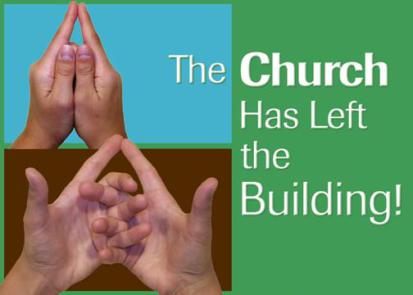
“Full faith, empty church” – it takes on a different meaning when we realize that the Church is never empty.  It is always full of the Presence and potency of Christ.  At some points our buildings have fewer or more people in them yet this is not the only measure of health.  The real question is what are our people up to when they are not in the building?  Are they living the liturgy in such a way that the Church is not confined by walls but magnified by the vision of Christ?

Our buildings are among our greatest assets.  They are a home for the hope-filled and hopeless alike.  Yet their greatest strength lies in their ability to feed us to go out – to be forgiven and restored for life and beyond so that others may see and know the Living Christ.  Are we, by our becoming, welcoming others to behold?  Is our full faith the testimony of a Church that goes out from its buildings with courage and hope?

Robert

On Penitence and Advent

Not long ago, a friend, Scott Gunn, put up a blog post on the perennial discussion about blue or purple vestments for Advent.  There are those who claim that one or the other is markedly superior for any variety of reasons.  I am partial to purple myself for reasons I shall remark more upon momentarily.

What I was particularly struck by though was the stridency of those who were advocating for blue based on the notion that Advent is “not a penitential season.” This also carried over into another conversation I read about whether or not to say “Alleluia” during Advent which reminded me of other practices during Advent that are similar to Lent, such as suppressing the Gloria or saying the Litany in Procession.

The reaction from the non-penitential crowd was a bit ensaddening though as it gets to the heart of a theological issue in the Episcopal Church – what to do with penitence, sin, and guilt.

683207010_tpOf course, Advent is a season of anticipation – even joyful anticipation.  Yet that anticipation is not of a random event – it is the anticipation of the coming of Christ among us.  We hear, throughout Advent, that we are to be prepared – to not allow our lamps to run out of oil.  Today we heard, “Therefore you also must be ready, for the Son of Man is coming at an unexpected hour.” Next week we will hear, “His winnowing fork is in his hand, and he will clear his threshing floor and will gather his wheat into the granary; but the chaff he will burn with unquenchable fire” and that we must “Bear fruit worthy of repentance.” In Advent III we will hear, “See, the Judge is standing at the doors!”

The message is fairly consistent, Advent is a time of self-examination for the Christ who comes does not simply come with flowers in hand – he comes to make new our hearts within us.

Yet for that new creation to take root in our lives, we must do a little careful preparation.  This is the heart of repentance.  Advent, as a penitential season, is one of careful reflection and making room for the Living One to find a place to dwell within us.

We are on pilgrimage in Advent as a people paradoxically as strong as we are weak for we are creatures of Body and Blood and Water.  This journey is one we have made before and that we are making again and will make in the future. It is the never ending journey of our lives back to the baptismal font.

We make our way back home to those waters of new life where the pledge was first made to renounce the vain works of the Devil. John Macquarrie writes of Baptism, “Sin, or rather the conviction of sin, is the presupposition of baptism. We have a sense that all is not well with us.” The baptismal mystery is that we understand ourselves to be washed from sin in Baptism. Yet, we also recognize the reality of sin and temptation in our lived Christian experience.

That reality – that we sin – inhibits our ability to truly welcome the Christ who comes in the most unexpected ways.  Penitence in Advent is not about lamenting and bewailing – it is about creating.  It is the re-creation of space for Christ’s birth to find a place within us.  As our lives are filled with the stuff of busy lives we find ourselves wandering ever further from the oasis of Font and the refreshment of Altar.

How do we hold onto that centered place in which we know ourselves at one with Christ, literally donning Christ at the font?  This holy season of Advent is not about becoming perfect, but about walking toward the perfection that we were one with at the baptismal font.

Just as Mary’s yes to Christ made Divinity known in humanity – we are being called to say yes in ways that will enable those all around us to see Christ made Present in our very life and love. The process of Advent repentance is one in which we re-remember who God has made us to be and make room for the wholeness of Baptized Presence to well up in us anew even as we are tempted by pride to false self-sufficiency or by the toil of life to despairing nihilism.

Baptism is the sign by which we are to see, feel, and know our life as awash in divine promise. Repentance makes the unobservable and the easily avoided more concrete so that we also know the concrete reality of Grace.

As we repent and make our Communion, the Holy Spirit strips away those things which distance us from one another and from God.  We begin anew the migration back to the baptismal font, that place where we are who we were meant to be when our deepest being was one with Christ.  We ask now to again be indwelt by God.

The reality of the Incarnation means, necessarily, that we will fall short.  The season of Advent offers not only a time to anticipate and rejoice but to do the hard work of making room, of creating space, and of finding our way back to the source of our wholeness and health.

The promise of the Incarnation is that humans are caught up in divine promise – that promise is not a gnostic one though nor without form or shape.  An incarnated faith requires, from time to time, that we come to terms not only with the miracle and the promise but with the messiness and the pain so that we can even more fully find ourselves caught up in the joy of new birth.

Robert

Yearning: A Bit about a Book

A couple of parishioners and interested folks have asked me about the book that I recently finished in partnership with young adults involved in ministry at Christ Church, New Haven.  Specifically, the question usually is, “So what’s the book about?”

Here is a short answer – it is about what it means to welcome the voices of young adults into the life of the Church so that we and they can be transformed in the miracle of being the Body together.  There are essays from 22 young adults in the book along with my own various essays as well as essays from three clergy colleagues who also work with young adults.

The chapters are the following:

Spiritual Wandering

Tradition and Relevance

Authenticity and Identity Crisis

Rigor (in prayer, theology, and mission)

The Beauty of Holiness

Catholicity

Mission and Evangelism

Seeking and Searching

Communities Changing Individuals (how do intentional communities change those in them)

Communities Changing the Church (how do these communities change the Church around us)

coverThe essays from the interns are really the heart of this book as they lay out what it means for them to be a faithful yet searching people in today’s society.  One of the challenges I noticed in the wider Church was that there are many people who are talking about young people and the Church but there did not seem to be many places where their voices were actually being heard.  This book is an attempt to give them a forum to share what is going on in their hearts and minds as they struggle to live and serve as people of faith in a cultural context that is changing faster than we can analyze or catalog.

I want to lift up a couple of quotes from different contributors that give a flavor of the book:

“When I think about tradition, I think about our grandparents.  I think about the very root of the word “tradition,” which comes to us from the Latin trader – literally to give across time, to hand down, to transmit.  I think about the wisdom that our grandparents hand down.  I think about how much was handed down to me.  I was marked, claimed, formed in ways that were not of my own choosing, in ways that make me who I am.” – Joseph Wolyniak

“Countless of my college classmates, friends from church, and childhood playmates followed a path similar to my own, living in community and finding new ways of encountering the Divine.  Faith-based intentional communities offer stability, relationship, and discernment.  But more than anything, they address this hunger, which, at its core, is hunger for authentic connection with other people and with God.” – Jordan Trumble

“Authenticity is less a matter of what we do than a matter of who we are.  It cannot be divorced from knowledge of self: If we are to be true to ourselves, we must know to which self we must be true.  It is difficult to live an authentic life when trapped in the middle of an identity crisis, for Christians as much as anyone.  Christians and the Church find their identity in Christ.  To be authentic, and so true to ourselves, we must be true to Christ.” – Ed Watson

“The Daily Office was not something that I just stumbled upon; people I trusted in my church community recommended it to me.  They invited me into a process of deepening my relationship with both God and community and served as comfort and support along the way.  They asked me to try something difficult and for that I will be forever grateful.” – Neil Raman

“As with acolyting, Christian community living is not about how much or how often we “get it right” and successfully fulfill our obligations.  It is instead about our intention, the care we take to serve and be present for one another.” – David Burman

“I have known Christ most fully in churches that took me seriously as a young adult.  I want my friends who are sitting on the fence to be exposed to these churches.  I want these churches to know that they can draw my friends in.  In these churches, I was offered Christian responsibility, discipline, and intergenerational community.” – Laurel McCormack

“The Church’s greatest gift to young people is not becoming something different than who it is and has been but instead, the greatest gift is in sharing and inviting people to be a part of that which has given life to so many throughout the centuries.” – Steven King

“I lost some control of my life, let others have a say in it, let them determine the pace and nature of my days.  In doing so, I became part of a group, a larger we, a process that helps me learn to accept God’s presence in my life.” – Carrie Staab

There are so many great contributions that it is impossible to lay them all out here without basically cutting and pasting the entirety of the book!  It is a joy to read through these wonderful essays and see in each of them the struggle and joy of faithful Christian lives.

In the foreword to the book, David Cobb, the rector of Christ Church says:

“What we aim for is not the ‘pretty” – the decorated or the trendy.  It is beauty that matters.  And that word encompasses any work that reflects human dignity and the innate goodness of creation.  Beauty is not confined to the useful, but it does speak of purpose – of the deep purpose in all things and in all people – to reflect the glory of God.  What we strive for is not to be relevant or to catch the wave of current imagination, but to speak as truly as possible of what we have heard of God and know of ourselves.”

In my introduction, I wrote, “We are acutely aware, in many circles, that whatever we have been doing just isn’t working anymore.  We now have a chance to find a new and yet very old way forward that is built not on cultural assumptions, social expectations, or privilege but is something that can tap the most essential of desires – a yearning for a deeper relationship with the Triune God.  I firmly believe that our young adults can lead the way in this revitalization.  In some ways, the task at hand is to figure out how to pass along the tools, traditions, and more that are essential to our identity and let them take the lead.  The emerging generation is less invested in tearing down or even rebuilding.  They are passionate about conserving, caretaking, and community.”

Others seem to have found it worth the read and for that I am thankful.

Susan Snook writes, “A book that points the way to a new hope for the church, rooted not in innovation, but in the recovery of the most ancient traditions of the church: community, beauty, liturgy, serve, prayer.  Young adults are hungry for these ancient, transcendent experiences, and want to serve a God who calls them to give their best.”

Bishop Ian Douglas kindly wrote, “In this wonderfully accessible book, Robert Hendrickson brings together the deep tradition and commitment to God’s mission at the heart of the Anglo-Catholic movement with the passion and spirituality of young adults today.  The lessons it offers are far reaching for any church that seeks to be faithful to God’s mission in the twenty-first century.  Read this book and be inspired.”

I hope that gives people a snapshot of the book – it can be found on Kindle, at Church Publishing, or in the hands of other reputable book merchants.

Robert

The Sadness of Reformation Sunday

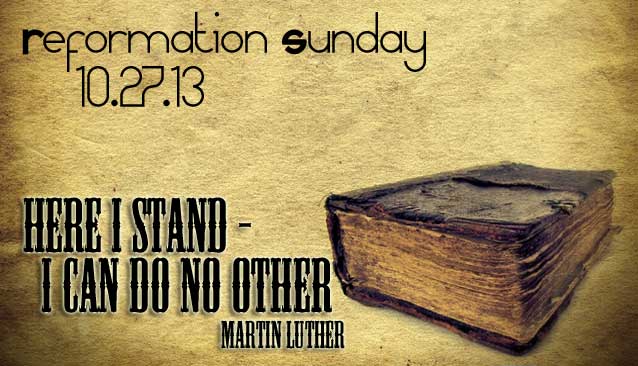
There is no such thing as “Reformation Sunday.” Or, at least, there is no such thing as Reformation in the heart of God.  There is only the Church.  Our obsession with the nature of the earthly Church obscures God’s vision for the Church Universal.  In God’s heart, the Church is ever as it was, the Body of the Faithful drawn into the love of the Trinity.

reformation.sunday.13The challenge for the earthly Church is our fixation on right or wrong.  The Body is the fullness of relationship, not the vagaries of belief or doctrine.  Sadly, we have determined that dogma somehow takes precedence over the harder and more essentially catholic work of being in relationship.

Reformation Sunday, as so many celebrate, elevates brokenness over wholeness.  It celebrates the schism, the breaking, of the Body.  It is a sad celebration at its heart.  It reminds me of the families that insist that the funeral is a “celebration of life” rather than a recognition of the loss of and intercession for the deceased.  It is a forced and disjointed thing that insists that pain is merely joy in another gauzy form.

Those churches that celebrate “Reformation Sunday” are celebrating human blindness to the wholeness of Christ’s own Body.  They are celebrating our inability to find wholeness in the midst of division.  They are celebrating the triumph of “rightness” over relationship.  They are celebrating the elevation of “right thought” over grace and comprehension.

It is easy to be right – it is a far more challenging and sacrificial thing to be in relationship.

Of course there were abuses in our past – and there are in our present.  Yet where does division end?  When can we be right enough?

This is the challenge of the Reformation – when are we Reformed enough?  The current state of Protestantism would be unrecognizable to Luther or even Calvin in its distance from tradition and, too often, reason.

The wholeness of Catholicity is not about right or wrong – it is about sacrifice.  The reformers sought to underplay and even eliminate notions of sacrifice in the Eucharist.  There is a necessary self-abnegation that is inherent to notions of Eucharistic sacrifice that is inimical to hyper-Protestantism.  Just as an over-emphasis on table fellowship puts us at the center of the Eucharistic action so too does an emphasis on our need to be right or for others to be wrong put us rather than the Living Presence at the center of the Church’s life.

Catholicity calls us to self-giving – it calls us to be the Body – to hold up one another in brokenness rather than drive one another away.

Christ’s sacrifice, the pierced Body of Christ, the Resurrection Victory of Christ – his self-offering, his forgiveness, his coming again– all that we remember and encounter in the Eucharistic action – call us to remember that our bodies – our earthly bodies and our souls are knit to his in both sacrifice and resurrection – in love for and service to the world around us.

Therein lies one of the glorious mysteries of faith – God counts us precious – knows each of us in our trembling weakness and our tearful joys, in our rightness and our wrongness, for he has walked alongside us, suffered for us, and raises us to glory.

We are given a prayer to pray daily, over time, and with intention that will open the depths of the Kingdom bit by bit, day after day, year after year.

Hallowed be thy name. Thy kingdom come.

We know that even as we are welcomed to call God Father, we are not God, so we place his name above all others and we ask that his reality become ours – that his peace and righteousness may come to pass. We ask that He would fulfill the promises declared unto humanity – and he asks it of us – he lays it out for us in the next line.

We receive our daily bread as a gift of grace and we are to forgive those who are indebted to us, who have wronged us, who owe us – because that is exactly how God has dealt with us. Forgive us our trespasses as we forgive those who trespass against us.  The Church is a Body at the work of forgiveness – we are called to model what it means to strive to be in ever deeper relationship.  This is not simply for the sake of being in relationship but for the sake of showing what it means to follow Christ.

We are not called to draw lines in the sand but to erase the lines between us.

May we all be forgiven for the need for Reformation – for the sins of those who create systems that seem, at times, beyond redemption, and for the sins of those who break away when wholeness is most needed.

postscript

A thoughtful friend raised the question of a relationship that is abusive – are we obliged to remain in such a relationship?  My answer would be, absolutely not.  Yet there too is a cause not for celebration but for a recognition of human sinfulness and our capacity to do violence to one another.  The question, for me, is how do we provide for systems of justice and mercy that hold us together and mutually accountable?  That mercy and justice must include us as well – include our need to be treated with dignity – even as it places demands upon us.

We must grieve the loss of relationships for they represent the places in which we have a chance for our faith to come alive.  The way we treat one another is a point at which we manifest Easter living.  The ending of a relationship is a thing of sadness as it means that we, either by choice or necessity, have found ourselves unable to dwell in peace.  That is the crux of the sadness.  It is no sin to flee abuse – but we need to mourn and address the injustice of the situation.

Robert


The Boat is not the Church: The Sinking Ship Metaphor

Working in the Church, one often hears the metaphor that we are “rearranging deck chairs on the Titanic” or some other sinking ship metaphor. What is often implied is that whatever is being done is not enough and the Church is sinking fast.

It works, if your definition of the Church is as something that is actually sinkable. The problem with the Church-as-sinking-boat metaphor is that it completely misidentifies who and what the Church is. The Church is not the burst hull and sinking vessel, the Church is the Body of people who are trying to find rescue and respite – who are caring for the lost finding the desperate. The Church existed before the worlds were born for it was held in the heart of the Trinity and revealed in Christ’s walking among us.

The Church is not sinking – the structure of the Church is undoubtedly creaking and cracking – but the Church herself, the Body of her faithful people, is reaching to find some way to a new craft that will carry them in to calmer waters.

The Church is the people who have built and trusted the structure to carry them in relative comfort. The Church is the people who are relying on the institution to help carry them from one place to another. The Church is the people longing to find a place a peace amidst stormy waters. The Church is the people who found themselves with no hope left and then were rescued. The Church is the people who were lost beneath the waters before they could be rescued.

My friend and I were sitting next to one another when we heard the metaphor most recently used. We both had the same reaction at the same time – we need to stop using this metaphor. He offered the image to me of a ship sinking down into the water and landing on something rising up to meet it – something like the City of God rising up through the waters.

In other words, there is no doubt change coming and the Church (both her people and the institution) will look different, sound different, be different. Yet I don’t think it will look that different from the Church of the earliest centuries – a time when the people of God gathered around font and altar and sought ways to share the Good News with a world that was at best indifferent to the message they shared.

Before we had structures, bylaws, and committees – before conventions and deaneries – we had a Meal and a Great Commission.

cityroom-titanic-2-f-blog480 (2)Institutionally, it is time for us to stop identifying with the Titanic and to start identifying with the people shifting, by fits and starts, from one ship to another. The image that remains with me is the image of the Carpathia, a rescue ship, coming into port with those who had been saved from the sinking of the Titanic. You see in that picture the wounded, the frightened, the relieved, and the thankful. It is in the midst of that party of saved men and women that we are found as the Body.

No doubt, we are a group going through something unsettling and terrifying, knowing real loss and genuine grief. And yet the Church is at her best when she finds herself caught up in a vision of new life. We are being called no longer to know ourselves as the floundering ship but to be the brave men and women calling out to, reaching for, nursing, and making whole those all around us looking for a Church that outlasts rust, wind, ice, and fog.

Robert

Sacramental Leadership: Church, Restructuring, and Holy Vision

What does it mean for a Church to be led in a way that is life-giving and invites the transformation of her members to be set aside for God’s holy use?

There is much talk of restructuring in the Episcopal Church right now.  There is lots of conversation about the nature of our structures, our need to be a missionary (or missional in more contemporary parlance) people, and our need to create a culture that responds to the society we actually find ourselves a part of.

One of the challenges of administering Sacraments is that we are administering an objectively changed reality to people with varying degrees of perception as to their truth and efficacy.  We rely on the wisdom of our people to allow the changes being wrought to take root in their heart and way of being in the world.

Our challenge as a Church now, with regard to the shifting of society, is much the same.  We are being called into a new time that requires the fullness of human creativity and participation to match the changing reality in which we find ourselves.  The task is one of perception and discernment – to see God at work as much in the world around us and its manifold changes as we are aware of his action and Grace in the Sacraments.

It is a difficult thing to see and lead Sacramentally for it means necessarily to lead and see by trust.  We have only the Lord’s word that anything new is happening with bread and wine or by water.  We also have only the Lord’s word to know that he is still with us and drawing us into an ever-changing reality grounded in his love and guidance.

We only have the promise of the Holy Spirit at the Altar and in the world.  And that promise is more than enough.

eucharistWe talk much about a Baptismal Ecclesiology in the Episcopal Church but it might be helpful to also talk of Eucharistically-shaped communities.  These are communities of vulnerability and boldness that find themselves and their hope revealed in the offering, blessing, breaking, and sharing of the Altar.

As communities, we gather together in our hope, joy, confusion, and pain.  We come to know the many gifts that God has given us.  From our first breath to our eternal promise we are gifted in ways that defy explanation and undo human understanding of earning and effectiveness and we gather to give thanks.

We are a people who hear the Word and promise of God together and pray without ceasing for one another and the world as we are welcomed to the throne of grace where we send up our intercessions and thanksgivings.

We take all that we have and all that we are and offer it for God to take up and transform.  We join our small gifts to that one great gift offered on the Altar and pray that we might find our offerings taken up for the spread of the Kingdom of God.

We are a people whose own brokenness – whose fracture – is known and grieved over by God.  We share not only in the perfect image of God but in the brokenness of the cross as we are those who shouted “Crucify” and those whom Christ forgave.  We carry the cross and know that others around us find themselves, all too often, at the foot of the cross hiding from the terrors of this world.

We are a people who share in the blessing of the Body.  We are called to be blessed and set aside for God’s holy use and given new life and purpose as the Holy Spirit pours out upon all our gifts and the Body is healed and formed for the feeding of the whole creation.

We are a people who are blessed for holy work.  The blessing we receive, as a Body, is not so much a benediction alone as much as a charge to heal and offer hope and renewal.  We are given the blessing to go and offer what we have received.

Finally, we are a people called to love and serve the Lord, to which we reply “Thanks be to God.”

There are committees and structures that will guide and govern our work as a people.  But there is a more concrete reality unfolding all about us.  People fed by Christ are doing Christ-like work all about us and the task ahead of us is not so much one of governance or management but one of finding ways of naming and lifting up that holy work.

Our Church leaders are being called to a deeper conversation than one about structure.  What does it mean to lead?  We cannot simply try to pinpoint the strategic or sociological difficulties that confront us.  We must ask ourselves basic, needful, and pressing questions that are not just for Episcopalians.

What does it mean to be disciples of a Prince of Peace in a death-denying and yet violent culture?

What does it mean to be disciples of a God of abundance and serve those who are financially or spiritually poor?

What does it mean to serve a God of Truth in a culture of falsity and distraction?

What does it mean to preach Kingdom in the face of Empire?

What does it mean to be the whole Body in a culture that exploits and shames difference?

What does it mean to follow Christ, to preach the Way, in a culture of temptation and indifference?

These are Sacramental questions because they naturally lead us to look deeply at the world around us and not just see where God is acting but to inspire others with a vision of what a new and holy life looks like as transformation unfolds.  We need to be the kinds of Christians that non-Christians have never met.  The kind of Christians who see the world with the Love that God sees it and name God’s abundance and action in spite of the rampant insecurity and culture of scarcity that has us in its grips.

We are being called to be the Church – to gather, to offer, to know brokenness, to find ourselves made whole, and to share the blessings of God all about us.  We are called to be the Holy People of God within whom the Holy Spirit is welling up and who trust that the Lord is making common things holy indeed.

Robert

20 Tips to Make the Most of Your Church (and your twenties)

As someone who has been working with young adults in ministry for a bit, I keep my eye out for pieces that deal with millenials and twenty-somethings more broadly. So I thought I would take a look at this piece on “20 Tips to Make the Most of Your Twenties” on huffingtonpost.com. Now that I have read it though, it seems to have some advice not only for those in their twenties but for those of all ages. More than that though – I think it has some lessons for churches too.  The first ten are below with the next ten to follow in a subsequent post.

church building

Here are the lessons and some ways they might apply to churches:

  1. Don’t be afraid to jump at an opportunity: I firmly believe that more churches have failed because they have failed to innovate and imagine than have failed because they took one risk too many. Would you rather have Our Lady asking you about the risks you took to share the Good News of her Son or the times you thought, “Well, that’s just too risky.”? Fear is crippling our churches as we try to insulate ourselves against cultural currents and trends – now is not the time for false security – it is the time for holy boldness.
  2. Don’t waste time on a job you hate: Churches are called to difficult work not damaging work. If the task isn’t life giving to the community then consider giving it up for a time. No volunteers for coffee hour? Go to a diner with parishioners. Do you feel like you are offering an appendectomy when you recruit acolytes? Simplify the liturgy and grow the garden guild. Hate meetings? Have fewer. We are not called to kill ourselves in ministry – we are to be living sacrifices. Find things that give your community life and lean into them – make them the heart of your sacrificial work and stop trying to force the issue where it is life-draining.
  3. Stop Complaining: The priests I had when I was a kid had a point – Jesus had it worse. Our parishioners have it worse than we do too. They work full time and then throw themselves into ministries all around the parish. It is easy (not to mention tempting and emotionally gratifying) to complain and yet we are called to something else – a people shaped by the cross are called to carry it like Simon of Cyrene – with a sense of purposeful servanthood. We all have our burdens to carry and barriers to jump over, save them for your best friends, therapists, and maybe spouses.
  4. Pick up the phone and make a cold call: Where are we being called to fresh evangelism? All of us are being called to some new place to share the Good News. If we can make room for the still small voice to reach us, we can hear where it is that we are being called to new forms of ministry. Perhaps it is the local nursing home, pub, gym – maybe it is further afield to a country we visited or a city we know is in need – we are being called to cold call for God and surprise others with Good News. This doesn’t mean badgering unsuspecting passersby – it means offering word of God’s love in new ways that open the doubting or hurting to hear the comfortable words of our Savior.
  5. Write down your non-negotiables: Where are your lines as a community – not the lines that proscribe others from being part of your community but those lines that give shape and dimension to your community? This can be a broad statement of belief or a more narrowed statement of mission and doctrine that offers direction and vision. Each true community must have clear claims that it makes on the conscience and core values of its members. This doesn’t mean that we adjudicate belief or dictate values but that we offer a clear framework for our members to understand their Christian journey. We have Scripture, Tradition, and Reason to start with – they give us a way to begin to shape our members’ search for patterns and meaning. What does it mean to belong? This has to be more than simple affirmation – identity requires sacrifice and true communities are clear about their non-negotiables.
  6. Follow through: Set goals and meet them. Don’t allow yourself to be overwhelmed by email, calendars, or more that distract you from the core of Christian ministry – the care and tending of the flock. It is easy to think that there are more pressing concerns – there aren’t. People won’t remember your best sermons, your wittiest riposte, or your longest day in the office – they will remember if you said you would follow up and you don’t. This applies to churches more broadly – when we commit to something we need to provide for it to be carried through.
  7. Be revolutionary: Churches are inherently conservative – they hold on to elements of our tradition. This is a noble and worthwhile vocation. Yet that impulse must be paired with holy boldness. Once you have your non-negotiables set you can then figure out how to carry them out in a revolutionary way. Across our history, there are churches that used revolutionary means to share the Gospel – and then there are those churches that fail. There aren’t many in between – look at your church’s history – I’ll bet that at some point it was part of a revolutionary movement, an experiment, a risk worth taking. Hold onto that tradition of progress.
  8. Do the thing you are afraid of: No apostle, martyr, or saint got there by not facing their fears. The definition of sainthood is, perhaps, to face down one’s fears on behalf of Christ. We are constantly called to new forms of service by Christ across the Gospels. But, perhaps, the greatest fear we face is that we can actually do it – Jesus asks the lame man at the pool, “Do you wish to be healed?” So many of us are afraid to be healed because we know what lame looks like – healed looks too new and too frightening. Give the answer, face the fear, be healed.
  9. Be willing to embarrass yourself: Part of the work of Christian ministry is to be a little foolish, a little rude, a little over the top. The greatest tool the Devil has is comfort. It is for the sake of comfort that we do not risk sharing the Good News, opening ourselves, or confronting injustice. How many times have we not done what is right for the sake of not causing or risking embarrassment? This might be the heart of sin – we are afraid to look weak, stupid, poor, or out-of-the-mainstream so we sit on our hands and smile pleasantly as we hope that others will embarrass themselves. Where do we see Christ not risk embarrassment?
  10. Accept failure: There are churches across Christendom, over the centuries, that have failed. Is yours about to fail – then seek the new life being offered. Is your ministry seeming to totter? Know that the apostles died in the service of Christ – their ministries failed as it were. Failure is not the mark of a dying community or minister but of one that is risking. Balance, equilibrium, and stasis are the marks of impending death not life – risk failure so that you can know true life. Those organizations that are the healthiest are those that risk failure, repeatedly, and embrace its lessons so that they can grow, adapt, and thrive.to be continued with the next ten…

    Robert

Solving the World’s Problems with More Benediction: Of Grace, Transcendence, and Potential

I once read a piece that argued that all of the world’s problems could be solved by an increase in devotion to the Blessed Sacrament. At first I thought it a somewhat silly statement but the more I contemplate it, the more powerful a statement it is. What could not be changed if men and women were able to see within the Sacrament all that they are called to be as members of the Body?

There we can fix our reference point such that violating one another or even creation itself becomes unthinkable. Bound up in the Sacrament are all we have been and all we are called to be in the patient Body given for us. That fixed and yet ever-expanding reality has the power to undo our false perceptions and blind us with the light of true sight. It may be such devotion – such mystic perception of reality that even extends across traditions and religions – that may hold the key to so many of our earthly dilemmas.

With the loss of a fixed point of reference outside the cosmos, that which is observable, there has been a commodification of culture and a turn toward nihilism. John Milbank argues that “…because post-modern culture emphasizes rapid change and impermanence, differences become less significant, even as they are proclaimed more loudly.” Milbank writes,

“In post-modern times, there is no longer any easy distinction to be made between nature and culture, private interior and public exterior, hierarchical summit and material depth; nor between idea and thing, message and means, production and exchange, product and delivery, the State and the market, humans and animals, image and reality—nor beginning, middle, and end.”

The challenge, the dissolution of limit, is the removal in post-modernity of a sense of natural limits or meaningful direction. We too often metastasize rather than grow. Without the limit of the Divine we lose the sense of the outline, the shape, that God offers for us to truly find calling and hope.

Our culture is a death-denying one that struggles against the limits of nature while at the same time placing increasingly little meaning on those limits. In post-modernity, the notion that the self is the center has eroded notions of individual limit and propelled us into a space in which this dissolution of limit has left us unmoored and disconnected from the divine and one another. The self is asserted for the sake of self and no limit can be tolerated – the true sadness is that this quest to assert the self in the face of dehumanizing societal energy results in the grinding down of good people who have lost the means and the gift to see just beyond – just over the horizon of heart where God is always reaching.

The dissolution of self-limit and perceived non-participation in the divine present us with a host of real difficulties that are not transcendent or philosophical problems, but measurable evils in the world. The invasion of nature by culture, the AIDS crisis, the virtual elimination of public space, and even global warming all have some root in the pursuit of difference in the context of post-modern indifference, blind transmigration, and ultimately the rejection of the transcendent.

These ills can be challenged with a return to understandings of indeterminacy and infinite personal relation in which we actively seek to participate in the divine which suffuses all around us. It is, in some ways, a contemporary rephrasing of Abraham Kuyper’s famous quote, “Oh, no single piece of our mental world is to be hermetically sealed off from the rest, and there is not a square inch in the whole domain of our human existence over which Christ, who is Sovereign over all, does not cry: ‘Mine!'” The recognition that all creation participates in the divine demands a level of respect for the created mystery of all creatures. We are part of a dependent co-arising, caught up in the love of God, given our true form in God’s self-offering.

There is something unknowable, mysterious, and inherently both immutable and immaterial which lies at the heart of matter.  Bread can be more than bread. Wine than wine. The Body than a collection of individuals.

Christ’s revelation in the Sacraments mirrors the divine/human revelation of the Incarnation. Matter and form are ennobled in his holy condescension and all of creation has been baptized and renewed by that indwelling. Common things are given a new destiny by grace.

Because of their participation in the Divine, all creatures are in one way or another as transcendent as the Lord we know is Present. Even as he has walked with us he is calling us beyond and deeper into holy mystery, into his ever-revelation.  All as participating in the gift of more. This transcendence liberates us from post-modernity’s seeming boundary-free geography of no-where (in which we are always lost because we imagine we know the lay of the land – a land without true direction or arrival).

catholicThis immanent divine is accessed in myriad ways across the religious traditions – and may especially be known in the Presence of the Mass.

The ground of the transcendent is open for conversation across traditions and religions. Islam, Hinduism, Buddhism, and Christianity offer manifold, cross-cutting theological arguments.  Each of them possesses a mystical tradition which emphasizes the fundamental rooting of all in a transcendent unity. Yet, for the Christian, this unity is more than transcendent for the Christ has been carried in a mother’s arms, born our sins and sorrows, and risen to new life – and opens the way for us as well.  This is a transcendence that is more than mystic unity – it is flesh and blood oneness with us.

This unity give richness, depth, and definition rooted in mystery and grounded in reciprocity and hope. We may just find that, if we can open ourselves to the potential and Presence of the Sacrament, we may come to see the whole of creation in a new way – in the way God himself might see it and us – potentially full of grace and calling for our love and care.

Robert

Catholic Evangelism and Evangelical Catholicism: The Shape of an Anglican Future

Grab a cup of coffee and a lovely pastry, this one is a little on the longish side…

One of the facts of being Anglicans is that we are blessed to be part of a tradition formed and informed by both the Reformed, Evangelical stream of Christianity as well as the Catholic. We blend, in a unique way, traits of both that form a distinct persona within the spectrum of Christian belief, practice, and history.

Another fact is that we are part of a tradition within which is a distinct distrust of the perceived excesses of both strains. How many times have we heard that something is “too Catholic” or “too Evangelical” to be Episcopalian? We have many within our Church who have been hurt by the unreflective and reflexive adherence to respective sources of authority within both Protestantism and Roman Catholicism.

The genuinely sad thing is that we seem to often miss out on the gifts of both traditions in our rush to run from popular excesses in either. So we are left with a certain blandness that conveys, at its most unfortunate, uncertainty about Salvation, indeterminacy of Doctrine, and a lack of force in the proclamation of the Good News.

The Episcopal Church, I think, might be better served by finding within the scope of our tradition the best of both the Catholic and Reformed traditions rather than simply looking to other expressions of those traditions and saying, “Well, we’re not that!” It is easy, and sometimes emotionally gratifying, but ultimately unproductive to build an identity on correcting the negatives of other traditions.

The more difficult task is not differentiation but self-expression – who is it that we are not in reaction to the hurts of the past but in response to our hope for the future? Where are we being called as a people who come not cast out of one place but called into another?

When I came to the Episcopal Church it was with the great hope that I had found a place of Catholic Evangelism – or Evangelical Catholicism. It is a place that draws on what is essential to the nature of both Evangelicalism and Catholicism and holds these in tension – correcting the imbalances that arise and drawing strength and hope from the wellspring that is both.

Each tradition is a source of renewal and grace for both the individual believer and the whole Church.

When I think on our most essential quality, I often ponder the collect for Richard Hooker. It reads,

“O God of truth and peace, who raised up your servant Richard Hooker in a day of bitter controversy to defend with sound reasoning and great charity the catholic and reformed religion: Grant that we may maintain that middle way, not as a compromise for the sake of peace, but as a comprehension for the sake of truth; through Jesus Christ our Lord, who lives and reigns with you and the Holy Spirit, one God, for ever and ever.”

The way forward for the Episcopal Church – and perhaps for the Church Universal – is not found in compromise for the sake of avoiding hard questions but in a comprehensive approach to our faith that draws from the wisdom of men and women across the ages who knew something more, something deeper, something true of the walk with Christ. This has happened in places and ways we can scarce imagine and continues to give new life in ways beyond our knowledge yet deep within our soul.

The great Evangelical truth is that Christ is at work in the life of each and every person and this is occurring within a world that the Catholic faith knows as full of promise and Presence.  From the source of Scripture comes the knowledge of the grace offered in the Sacraments as we are made free by authority that comes from outside of ourselves.

What can a renewed Catholic Evangelism look like for the Episcopal Church?

At its core it should have at least the following:

A Belief that Christ is active in the Sacraments: Christ is at work in Baptism, Communion, Confession, and more. He is not at work simply with the goal of a vague amendment of life but for the sake of every person who would rest their hope in him – and beyond. He is at work in the Sacraments for the salvation of the whole of humanity – for the reconciliation of humanity to God that is mirrored in our reconciliation with one another. The Sacraments do not exist for their own sake (for the sake of the Sacraments) but for ours – to draw us more deeply as the People of God into the Holiness that is Christ’s own Body. The whole of the Church is taken up into the mystery of faith – and even as all are drawn so is each one – and as each is drawn so are we all.  Participation in this mystery is not a right but a gift we should enter with thought, care, and preparation.

A Commitment to the Historic Church: There can be few deeper marks of hubris or heresy than to believe that the Holy Spirit is speaking to us and not to others. Across our history, the Holy Spirit has moved and given of himself to bring consolation and transformation. The very nature of our being is revealed in our forebears and their engagement with the Spirit. We inherit both the things that are of the Spirit of God and those that are of the spirits of this world, however. Thus, we are tasked with the work of discernment. Yet, we impoverish our whole self if we allow ourselves to cast aside aspects of our heritage without the careful witness of the whole Body of the faithful across time and boundaries. The Spirit moves across the ages and we receive this as the Holy Tradition of the Church. The Historic Church, the Church in her fullness, has lessons for each and every believer. Whether zeal, penitence, prayerful centering, selfless service, divine liturgy, theological inquiry, prophetic witness, scriptural rigor, and much more – across the whole of the Church’s being and history are lessons for us to deepen our participation in the ongoing revelation of the Holy One.

A Conviction that the Holy Spirit is still transforming us: A Spirit active across the ages is still speaking and proclaiming today – still drawing us into the wonder of God Incarnate. Just as we impoverish our identity by ignoring the past we do as much harm if we pretend that revelation is no longer being made known – that we have no more tidings to hear. We are being called by prophetic voices all around us to engage the world and to know its pain so that we may bring word of Christ the Healer. Just as we ask for the Holy Spirit to descend up Bread and Wine and to sanctify water, we need to be praying for the Holy Spirit to descend upon the whole of the Church and upon each of us daily that we might know and share the gifts of the Spirit.

A Belief that Sin, Powers, and Principalities are real: It is an unfortunate side-effect of having so many of us fleeing traditions that belabor the power of sin and death that we often now downplay their very real role in our lives. If we are, indeed, saved, then from what are we being saved? A simple answer would be, from ourselves. We are being drawn out of the depredations of unmoored souls adrift from the abiding strength of Christ. We spend much of our lives in the pursuit of some identity or another that will allow us to know ourselves as “independent” or “in control” and at the heart of our yearning for control or independence is a sinful impulse to know ourselves as belonging to ourselves. Only when we know ourselves as held in the hands of a Sustaining Father, shaped by the will of a Creating Christ, and caught up in the power of a Redeeming Spirit, can we begin to more clearly see the hold of sin and death. Often, those brought up in dysfunctional families are unable to see the dysfunction until they stand outside of the system and see the hold it had over their energy and being. In the same way, we need the community and the Church to help us stand outside of the shape and structure of society and help us name that which is sinful and holding some piece of us in its grip. The Church gives us the vocabulary to name that which must be exorcised in our individual and corporate lives and to name and hold onto that which is holy and life-giving.

A Belief that a relationship with Christ matters and is decisive for individuals and the whole Church: A world of diversity makes the declaration of the Lordship of Christ a sometimes uncomfortable proposition. We encounter good and even holy men and women of different and sometimes no faith and ask ourselves how a universal truth claim might be made. Yet, the way forward is not with bland or generic attempts to erase difference but to engage difference with the holy awareness that we just might be wrong. And yet, we know that our own lives and the lives of those we know, have been bought with the Love of Christ. That conviction and conversion gives us a certain foolishness to offer Good News. The most fruitful conversations I have ever had about difference were not attempts to erase or erode difference but to name it and share stories of where that difference had played out in our lives. A conversation with another is not a chance to convert them (though the Spirit may just lead that change of heart) but a chance to know our faith deepened by encountering the diversity of God’s Creation. We lead not with the fear that another person might be damned but with the joy that we are known and claimed as Christ’s own. No one is saved as an individual alone and no Church is truly holy without a Holy People of God who know themselves, in their deepest self, as given new life.
0962329bda74d2421145211b29036a20710715ebA Conviction that sharing the Good News is required for those transformed by the Good News: A people given Good News are called to share the Word with others. Sharing the Good News is the stuff of reaching the people of God in the way that God reaches us – with tenderness, compassion, forgiveness, and love (though this may mean bearing hard truth). In the way that Jesus walked amongst us and gave of himself we are called to be among those for whom Christ gave himself. We are to walk with the living Word – devote ourselves to be walking Sacraments – bearing witness to the Presence of Christ among us. The reality of God with Us is made known in our own willingness to be with, among, and alongside. Each of us is given a bit of the Good News to share in all the ways we know – with each of our many gifts we are called to offer some glimpse of the one whose very nature is relationship and self-giving. This is at the heart of good stewardship – that God blesses and we share that blessing to bring others word of God’s abundance. At the heart of Good News is God’s great abundance – the outpouring of God’s own self.

A Grounding in Scripture that welcomes the Word of God into our daily lives: A people who read, mark, and inwardly digest the word of God will be marked by that word. There is something life-giving and powerful in the engagement with the deepest stories of our faith. In the same way that we can appreciate the complexity of a dish when we’ve delved into a cookbook or two, the complexity, joy, and demands of our faith take on a new depth each time we open God’s word and let ourselves be transformed by it. Of course, this means we will wrestle with hard passages, frustrating bits, and confusing narratives. We will stumble over names, dates, and places. We will be told things we might not want to hear and delight to discover things we didn’t dream were written for us. Reading the Bible is like being told stories of your family tree – sometimes shocking, sometimes a little boring, sometimes liberating, always telling us a little more about who we are and where we come from. God’s holy word, passed on to us through the work of the Holy Spirit (and no small amount of Byzantine maneuvering), is given to us as guide and gift to be the place where we begin to know the story of God’s unfolding work, the nature of Christ, and the birth of the Church. We will be unsettled and convicted – and welcomed in new ways into the story of Salvation.

A Pattern of Prayer that shapes our days: Paired with a daily pattern of Scripture reading is a daily practice of prayer and marks and shapes our daily life. A Church prays. Period. If we are to be the Church outside the walls of our buildings then we have to pray. Period. We are given a pattern for this in the Daily Office. A young nun was once walking through the halls of the nunnery away from the chapel, a much older nun saw her in the hallway and asked, “Sister, are you not going to prayers?” The younger nun replied, “I just don’t feel like it today.”  The older nun, sighed and smiled and told her, “Sister, I have not felt like going to prayers for 20 years – which is why I go.” And off they went. The purpose of a regular pattern of prayer is not our enjoyment – it is a way of structuring our day with God’s will for us in mind.  We hear a bit of Scripture and remember the One who guides our days.  This will not always be an unadulterated joy or moment of bliss – prayer (like life) is often a thing of offering and struggle which is punctuated by moments of clarity, understanding, and joy.  Like so many things, without the investment of ourselves in regular patterns of spiritual discipline, it becomes harder and harder for us to hear the Holy Spirit speaking in, through, and to our days. One of the things about a regular pattern of prayer is to hear God’s charge to us in the morning (to serve God without fear, in holiness and righteousness as we go before the face of the Lord). We close our day of work hearing the promise of God (He that is mighty has done great things for us and fills the hungry with good things). We go to bed with Compline (Into your hands O Lord I commend my spirit). Prayer brackets our days and prepares us to hear, serve, and trust more fully.

A Sense of the Power and Promise of Worship: Whether in the joyful strains of a full Gospel choir, the rich hymnody of Choral Matins, the simplicity of an 8:00am Low Mass, or the choreography of Solemn High Mass, there must be a sense that worship is an act of profound and holy joy. We are given injunction, over and over again, to praise God with our whole selves. With all of our being we lavish upon God our share of Mary Magdalene’s fragrant oil. We offer from the bounty of God the sacrifice of praise and thanksgiving. This is a necessarily Evangelical and Catholic act – it engages the whole person and deepens their encounter with the Holy One who makes himself known to us as the blessed company of all believers. If we want people to think something important is happening at church then we need to act as if something is. In a world of hyper-marketing there is nothing more winning and latent with potential than true, unvarnished honesty. The power of lovingly and attentively offered worship is that we can give others a glimpse not only of the majesty of the one we worship but a sense of just how we are being caught up in the Wonder that is his Presence among us.

There is Holy Mystery:  In the unanswered questions of our faith, in the divine-human interplay of the Incarnation, Crucifixion, Resurrection, and of Baptism and the Mass – in all of this and in countless other ways there is Holy Mystery at work in our faith.  Our attempts to explain the Sacraments or explain the nature of Salvation are ultimately the grasping attempts of creatures to ascribe motive to the Creator.  We know the story of faith and we grasp for its deeper meanings in the eddies and currents we feel washing about us.  Beyond the order of expectations and the patterns of explanation is the salient fact of our faith – we see through a glass dimly.  We are left with the one great mystery which we explore together in Word and Sacrament, by fits and starts, as individual believers and the whole Body. We offer together the lasting Good News and the joyful proclamation – Christ has died, Christ is Risen, Christ will come again.

These are not the only marks of Catholic Evangelism or Evangelical Catholicism, yet they are a beginning such that we can find anew the particular vocation of the Episcopal Church and deepen our shared life and labor as we work, pray, and give for the spread of the Kingdom.

Robert

Decently and in Order: Of Dr Seuss, the Mass, and Authenticity

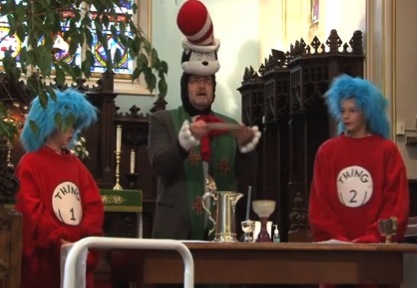
The Living Church has recently carried a story on the celebration of a “Dr Seuss Eucharist” in the Anglican Church of Canada. My understanding is that the particular clip is about three years old but that this worship goes on in other places currently. After getting over my initial facepalm (which nearly knocked me out) I tried to decide what I found so troubling.

Cat_in_Hat

This unfortunate liturgy has made me think about the Cult of Cuteness and its hold on much of our culture.

There are many who come to our churches with all manner of worries, fears, hopes, and sorrows. Often those returning to the Church are here for solace and a place of genuine peace. We have reached a point in our collective cultural life, however, at which things that are “cute” are beyond reproach. Under the cover of appealing to “the children” we allow or encourage all manner of practice and theology that undermines the deep and lasting power of the rites we share. Among the definitions of cute that one might find are “attractive or pretty especially in a childish, youthful, or delicate way” and “obviously straining for effect.”

The faith we are welcoming people to is anything but pretty – it might be beautiful at times but it is hardly defined by our notions of pretty, childish, or delicate. We offer a faith of Cross, Body, and Blood – a faith born in a stable and risen through spear and nails. Our Lord is one who cures with spit and mud. We wash feet and cure lepers. Cute is a thing of antiseptic silliness. It is meant to be endearing rather than to capture the heart – it is of the moment rather than timeless. It strains to have an impact and makes of itself a spectacle to be seen rather than a reality to be known.

Cute is the antithesis of beautiful – the beautiful grabs the heart and strains the senses. Cute dulls our sense of the sublime for it rests only on the superficial quirks and charms of the moment rather than challenging our deepest sense of what is made possible by the Holy One.

My main problem with this sort of thing is the inversion of the relationship between the worshiper and the worshiped in such services. The liturgy’s chief function is as an act of praise and adoration for God in which we are drawn closer to the one who is sacrificed for us. We are called into deeper union with the Christ made Present in the Gifts. Saint Augustine of Hippo says in Sermon 229 for Easter “there you are, on the table; there you are, in the cup!” He says this not to indicate that the frailty of our humanity is there offered, but that the health and fullness of Christ is being offered – a fullness and health by and through which we are to be utterly transformed and shaped.

Services like the Seusscharist take that ancient pattern and upend it such that what is offered on the Altar is some other, cuter, version of us. We take our cultural relics and toss them up there as if they have some power or dignity.

The ancient patterns of worship invite us into the petition, prayer, offering, and raising of Christ. Standing at the Altar is the Priest saying for us Christ’s own words – taking his place at the Altar and making known the Presence of Christ. We share in Christ’s prayer calling together upon Our Father. We see him broken and shared for all.

I cannot fathom, honestly, where in this divine-human dialogue there is a place for clowns or for the Cat in the Hat or for any other fictionalized representation of cuteness to be interposed. We have enough problems in this culture of worshiping our own creations. The call of the Church is to find a deeper place to dwell with God and to hear the Still Small Voice speaking to us amid the many distractions and even the despair that occupies our hearts and minds.

As so often happens we write from the point where our needs meet the Church. From my own point of view, the Church provided a firm foundation when so much else in life seemed to be upturned by loss and grief. I can say, without a shred of exaggeration, that I would not now be a practicing Christian had I returned to the Church to find such a thing as a Seusscharist. It is a rich temptation to theologize one’s preferences but I cannot see the theological justification for worship such as this and find its scant potential pastoral benefits to be drowned by the deep needs of the many lost and searching who find our doors needing the deep and abiding promise of the Church at her most reverent.

That reverence can take the form of joyful proclamation, exuberant exultation, or solemn dignity. Yet it must be, as a friend of mine says, “ruthlessly authentic.” True worship bears the marks of a community that has reached into the depths of its being to raise praise to the Almighty. Out of the very heart of its being – deep calling to deep – we allow the essence of the Holy to pull from us our most fervent praise.

I am happy for churches to experiment – and boldly so.

Yet can we avoid making the faith look cartoonish in the process? Can we strive for true boldness not just cuteness? Can we please, for the love of the Holy, make God the center of our worship and not find one more way to worship ourselves in mawkish costume?

R