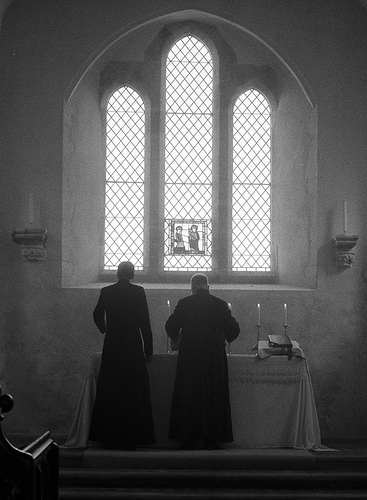
On Being Made and Ever Re-Made: Of Baptism and Communion

As our diocese is voting tomorrow on a resolution calling for a yearlong conversation about the practice of “Open Communion” (properly called Communion without Baptism as the Presbyterians point out) I began to think about the broad implications of this move.  First I thought about our ecumenical relationships.  What do other traditions make of the relationship between Baptism and Communion?  Here is what the Presbyterian Church and the ELCA state on their websites:

“Presbyterians practice open communion. That is, all those who have been baptized, whether members of the Presbyterian Church or not, are invited to participate. Baptized children may participate if their parents have instructed them in the practice and believe they are ready to partake.”

Lutherans: “Because admission to the Sacrament is by invitation of the Lord to the baptized, ‘baptized children begin to commune on a regular basis at a time determined through mutual conversation that includes the pastor, the child, and the parents or sponsors involved, within the accepted practices of the congregation.’”

There is an assumption among these reformed partners that Baptism is the necessary and natural Sacrament of inclusion into the Body of Christ.  Once included in that Body, the reception of Holy Communion becomes a means for strengthening that union and being drawn evermore to the Holy and formed in the likeness, mind, and will of Christ.

This, of course, does not include the clear teaching of Rome and the Orthodox on the relationship between the Sacraments – nor our own century after century of tradition.

One of my great worries about Communion without Baptism is that it undoes the very work that undergirded the Book of Common Prayer’s approach to the Christian life – that Baptism is the full inclusion in the ministry and Body of the Church.  That baptismal ecclesiology is drawn from the depths of Christian tradition.

We have, from S. Gregory of Nazianzus, “Baptism is God’s most beautiful and magnificent gift. . . .We call it gift, grace, anointing, enlightenment, garment of immortality, bath of rebirth, seal, and most precious gift. It is called gift because it is conferred on those who bring nothing of their own; grace since it is given even to the guilty; Baptism because sin is buried in the water; anointing for it is priestly and royal as are those who are anointed; enlightenment because it radiates light; clothing since it veils our shame; bath because it washes; and seal as it is our guard and the sign of God’s Lordship.”

The liturgy of the Easter Vigil reminds us of the awesome and awe-filled grace of baptism.  The Vigil liturgy echoes across not only that night but across the centuries drawing the Body of Christ to prayer and holy remembrance:

“How holy is this night, when wickedness is put to flight, and
sin is washed away. It restores innocence to the fallen, and joy
to those who mourn. It casts out pride and hatred, and brings
peace and concord.

How blessed is this night, when earth and heaven are joined
and man is reconciled to God.”

The mystery of Baptism echoes the essential mystery of creation – that all is beloved of God.  Earth and Heaven – Humanity and Divinity – are joined in the perfect offering of God in Christ.  The Creation is made and God calls it good and yet we stray from the love of God and are called back through the grace of Christ at the font.

The mystery of Baptism is that we can be one with the perfect love of Christ offered and poured out for us.  It is that mysterious union that prepares us for a life of union – of Communion – with Christ Jesus.  This is our Sacrament of full inclusion.  It is this fundamental shift in our very being, our welcome as citizens of the Kingdom, our washing for the feast that frames the fullness of the grace offered in Communion.

Baptism is communion with Christ’s death which welcomes us to Communion with Christ’s living Body which draws us to the perfect wholeness of Christ’s Resurrection.  S. Ambrose wrote, “See where you are baptized, see where Baptism comes from, if not from the cross of Christ, from his death. There is the whole mystery: he died for you. In him you are redeemed, in him you are saved.”  Baptism frames the totality of life with the Holy.

Neither Baptism nor Communion are simply means of welcome.  If they are simply this then they are deadly for they do not call us to new life – to reconciliation with one another and Christ.  The Sacraments are not about our action they are about God’s welcome into the redeeming life and death of Christ.

S. Augustine says of Baptism: “The word is brought to the material element, and it becomes a sacrament.” This is the essence of the Sacramental life.  Matter is transformed and so are we.  Michael Ramsey spoke of the priestly vocation as being called to be a “walking Sacrament” showing forth the transformative grace of the Spirit.  This is the essence of the priesthood of all believers – to be walking sacraments upon whom the Holy Spirit is poured forth in an act of perpetual new creation.

This transformation is at the heart of the Sacraments.  When we ask someone to come to Communion that is not baptized, that has not begun or contemplated the transformation of the Spirit, then we are tricking people into an encounter with the death and resurrection of Jesus Christ.  We impose upon them that unfortunate status of “anonymous Christian.”

We assume that we know what is best for them because we see “hospitality” as the highest virtue when God is calling us to transformation – utter and profound self-offering which begun at the font when we don Christ and ever-continuing as we join our humble offering to Christ’s great sacrifice.

By not doing the hard work of truly welcoming people, by sharing our deepest belief about the transforming power of the Sacraments, we do a profound disservice to good people, friends, neighbors, and those who simply feel some compulsion to come forward as everyone around them does.  We impose an encounter with the life and death of Jesus Christ – participation in the crucifixion and resurrection – without truly sharing just what this means for their life, their being, and their soul.

That beautiful prayer from the Vigil shares our baptismal and Eucharistic hope, “O God, who wonderfully created, and yet more wonderfully restored, the dignity of human nature: Grant that we may share the divine life of him who humbled himself to share our humanity, your Son Jesus Christ our Lord.” Baptism is our welcome into the restoring work of Christ.  God did wonderfully create and He is ever more wonderfully restoring us.

That work is incomplete and requires our participation – our active yes to God.  That is one of the miracles of the Incarnation.  Mary’s “Yes” was part of the indwelling of God.  Our yes is part of God’s dwelling in us.  Grace is ever offered – objectively present.  But our reception of that grace, that indwelling, is a vital piece of the salvific action.

The Book of Common Prayer offers the Anglican view of the Eucharist in the Exhortation, “Beloved in the Lord: Our Savior Christ, on the night before he suffered, instituted the Sacrament of his Body and Blood as a sign and pledge of his love, for the continual remembrance of the sacrifice of his death, and for a spiritual sharing in his risen life.  For in these holy Mysteries we are made one with Christ, and Christ with us; we are made one body in him, and members one of another.”
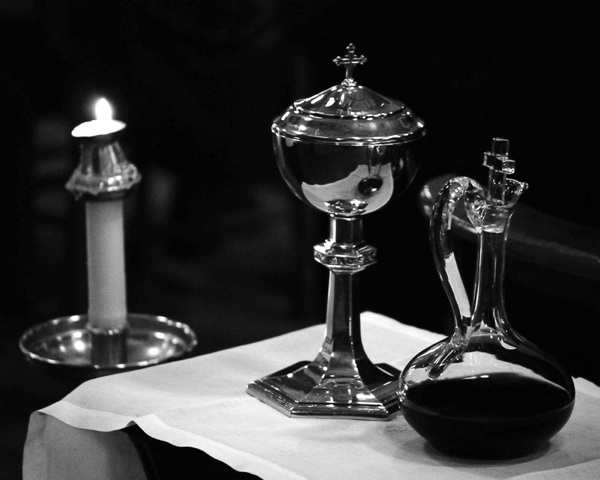
All of this is offered and expected in the act of the Eucharist.  It is profoundly and deeply unwelcoming, inhospitable, and unkind to fail to share with those who come to the Table God’s deep promise and concomitant expectations.

The very words we use at the crux of the liturgy declare its intent, “Do this in remembrance of me.”  What are we called to remember?

Do those coming to the Altar see that Christ offered this Sacrament on the night he was betrayed – as his Passion was to commence – so that we could evermore find his Presence?

Do those coming to the Altar see this as a sign and pledge of that Love?

Do they want to remember continually his sacrifice?

Are they desiring a spiritual sharing in his risen life?

Are they seeking and hoping to be one with Christ?  To be one Body with Him and members of one another?

Are we being honest – fully open and deeply humble – about the hope and risk of the Eucharist?  It is a risk for it asks us to offer all that we are so that we can be transformed into all that Christ calls us to be. The Eucharist is not a right.  It is a gift of responsibility.  It is a call to a life of holy witness, transformation, sacrifice, hope, striving, and ultimately of Resurrection.  God’s radical welcome is simply this – come and die.  Come and be re-born.  A Church of radical welcome will preach, teach, and live in the shadow and light of this radical promise.

Ascension House in the Hill: A New Ministry of Presence

“…the glory of God gives the city light, and the Lamb is its lamp…” (Revelation 21,23).

This past week, interns from our young adult service program, Saint Hilda’s House, and I walked the Hill neighborhood of New Haven to collect prayer requests from folks around the neighborhood. Eight of our Saint Hilda’s interns now live in the Hill near Ascension Church. Ascension has not had a regular Episcopal worshiping community for many years now. We spent our time offering prayers, blessings, making connections, and handing out prayer cards. We will take the prayer requests we received and make them part of the prayer intentions we offer every morning together at morning prayer.

We met Luiz and Mike, two young men that are off drugs now and looking to share word of how Christ helped them find sobriety – they offered to help with translation so that we can better communicate with many of our neighbors. We also talked with Luke, Will, and Hector. They are guys who spend most of their day out in the park near the church. They asked for prayers and offered ideas as to how the church could be of help in the neighborhood. We also met Franklin who said his hope was for a neighborhood church that was diverse and prayerful. I also met Rosa who told me that she watches mass on the television in the morning and evening but has no church nearby to go to. A local deli owner offered donations of food so that we can begin some community dinners.

We are beginning these walking and listening exercises in the hope that we can hear what the neighborhood’s hopes and needs are. In the recent past two large Roman Catholic churches, Sacred Heart and Saint Peter’s have both closed. One parish had around 350 families and the other 225. There is now no Roman Catholic, Lutheran, or Episcopal presence in the neighborhood other than Ascension Church.

One woman said of the closing of Sacred Heart, ““There is no dialogue. They just went through the motions. Basically, it is a death sentence for us. This will have dire consequences for the neighborhood.” Another said, “The poor minority neighborhoods have always been left out…when you see something that’s truly beautiful and has been well loved by the community threatened, it’s really soul-destroying.”

There is an obvious and deep need for a church in the neighborhood that hears and responds to the spiritual needs of its residents.

We are welcoming New Haven Reads as a new partner on the site to use the parish hall at Ascension. They are an organization that provides nearly 500 reading tutoring sessions per week with a backlog of more than 250 students. Our hope is that Ascension can become a place for many of those young people that attend a number of nearby schools to learn and grow. We are also in conversations to use part of the property for a children’s community garden.

These are first steps in making Ascension a resource for the wider community. Coupled with that service we plan to begin offering some sort of regular worship there. We are still thinking and praying about what that can look like. We are proposing a community that is a blend of a more traditional worship community paired with an intentional community of service and prayer.

We are now called to do more than pity and to offer more than worship. Those who are part of Ascension House live, pray, learn, struggle, walk, and work alongside those whom God calls us to love – our neighbors. We are engaged in work that is in some ways new and radical and in other ways is the very essence of tradition.

One of the keys to the ongoing work at Ascension will be both the work of the Saint Hilda’s House interns and those serving with a newly forming community, Ascension House.

A Proposal for Ascension House in New Haven

We seek to found a community of post M.Div. interns whose vocation it is to provide an oasis of prayer, silence and peace in the “desert” of modern cities. The multi-faceted community will live out the call to common life, prayer, work and welcoming others “in the heart of the city”, while striving to dwell always “in the heart of God” using the Ascension Church worship space and rectory in New Haven.

A key aspect of the program is the development of significant and comprehensive community service with a goal to nurture individual and community health and flourishing. The program would also be responsible for building a new Eucharistic community perhaps centered on a Saturday evening community meal and mass and would also share in the daily office which would be open to the community as well.

These “interns” would serve at various local parishes in a “curacy” and potentially assist in the administration of various local ministries such as Your Place at Saint Andrew’s. Their formation would include individual and group spiritual direction, theological reflection, mentoring, peer review, and corporate prayer in addition to the growth to be had in the daily labor and reflection at their respective work sites.

This program serves manifold needs:

  • It provides curacy experience when the number of curacy positions is dwindling
  • It affords parishes access to a “curate” at a substantially reduced cost as budgets are strained
  • It serves as a nexus between parishes, community service sites, and ministries in New Haven
  • It creates a new semi-monastic community to serve God’s people
  • It rehabilitates a property that has languished and plants a new Eucharistic community
  • It draws us deeper into God’s mission, the community of New Haven, and the Hill

The program would make use of several current programs in New Haven. For example, interns would be interviewed and admitted via the existing Saint Hilda’s House infrastructure, spiritual direction provided through existing Saint Hilda’s spiritual directors, food distribution coordinated with such ministries as Loaves and Fishes and the Saint Andrew’s food pantry, transitional housing arranged through ongoing partnership with Christian Community Action, and more. Each of these partnerships would be strengthened and their service expanded through the coordinating efforts of the new community.

Key Components of the Intern Community

  • A group of five or six post-M.Div. interns that would live in the community and be responsible for the Saturday liturgy intended to serve the community.
  • These interns would be admitted through the existing Saint Hilda’s infrastructure for a period of 18-24 months.
  • One of those interns would organize the service life of the community and the use of the building for the balance of the week.
  • The other interns would serve with local congregations and ministries in a “curate” capacity.
  • A new Eucharistic community which gathers on Saturday evenings. This community would explore new modes of worship while drawing on our tradition.
  • The interns would live in community, share a common prayer life, participate in both individual and group spiritual direction, and receive ongoing mentoring from experienced clerics.

If you would like to learn more about Ascension House or Saint Hilda’s House or help support this new ministry, please feel free to contact us!

Christ Church Posters

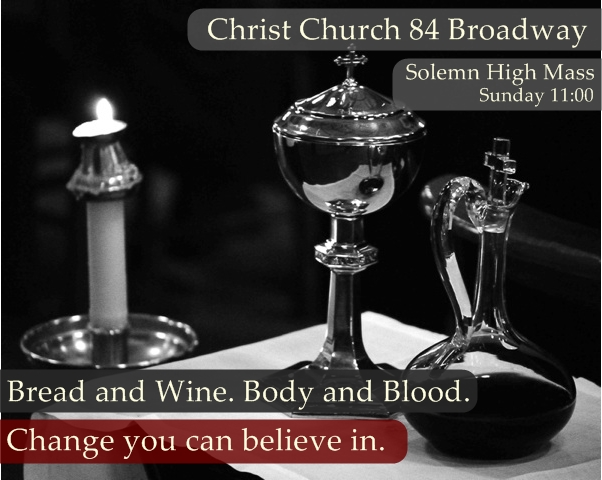
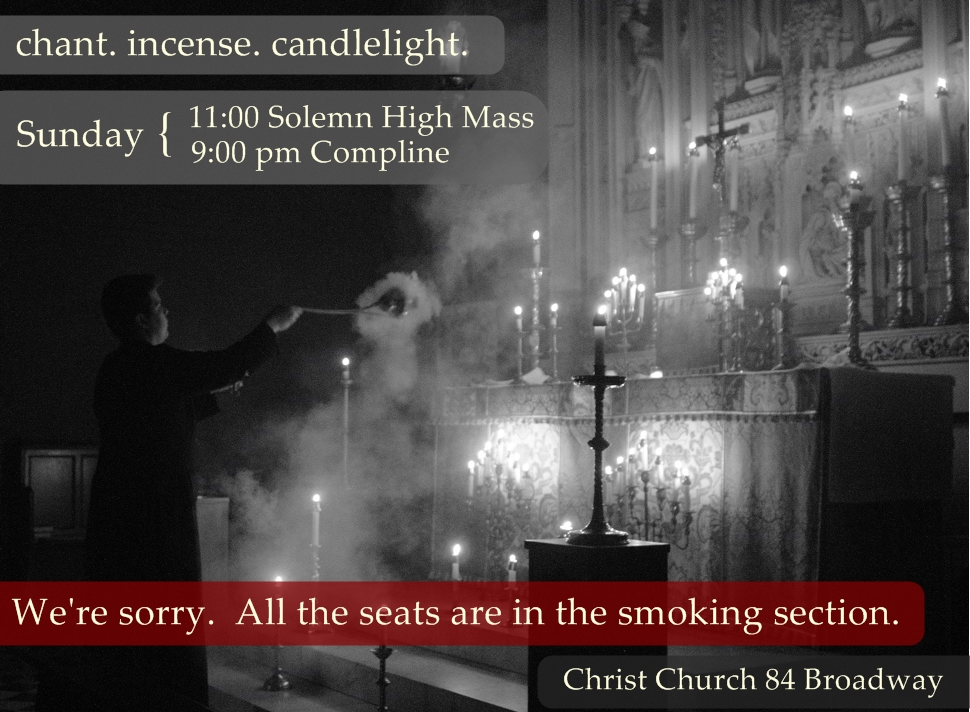
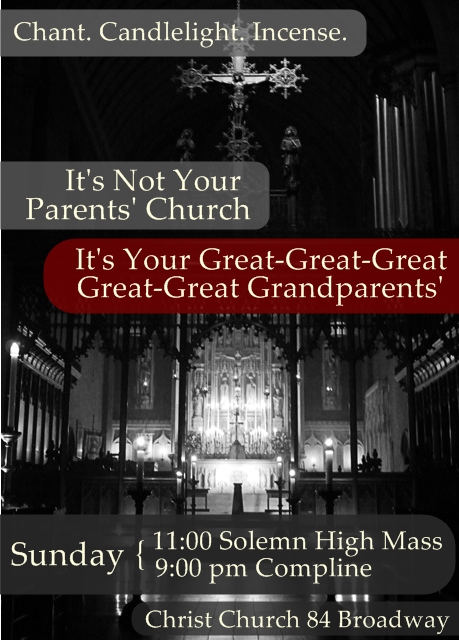
So the posters we have been putting together for Christ Church, New Haven have gotten much comment, so I thought I would put all the ones we have thusfar all in one place.  I will update this as we add more – you can also see them as they come out on Facebook.

One of the goals of these is to stimulate thought, conversation, and interest.  We have also become convinced that communicating what we believe in a concise way is important in a culture with ever shorter attention spans.  We are hoping to offer an authentic vision of this parish and our identity to those unfamiliar with us – with a bit of humor mixed in!

Future ads will focus on baptism, prayer, scripture, service, and more.  I am convinced that believers and visitors don’t need more watering-down and wavering on the part of the Church but greater clarity and a deep commitment to an authentic and deeply traditional way of being Christian (without being confined to mere traditionalism).  We have to know what we are welcoming visitors to – radical hospitality is not simply an open door but deep and passionate conviction that we have something (and Someone) to share that profoundly and utterly changes lives.


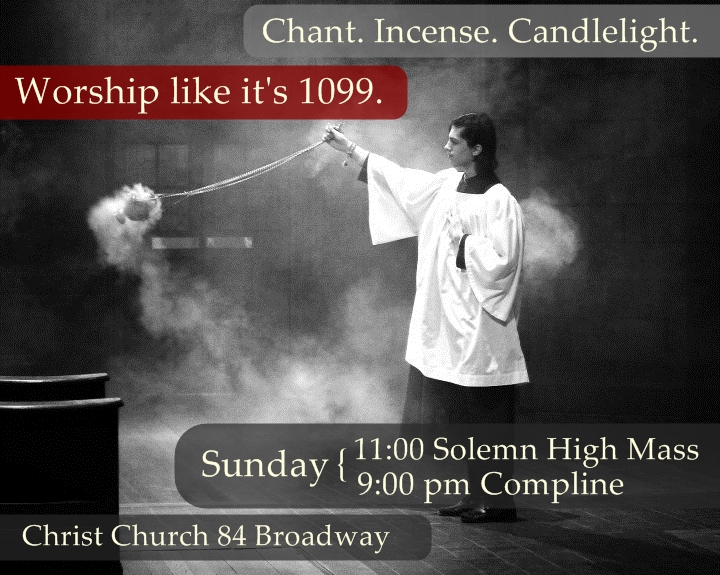
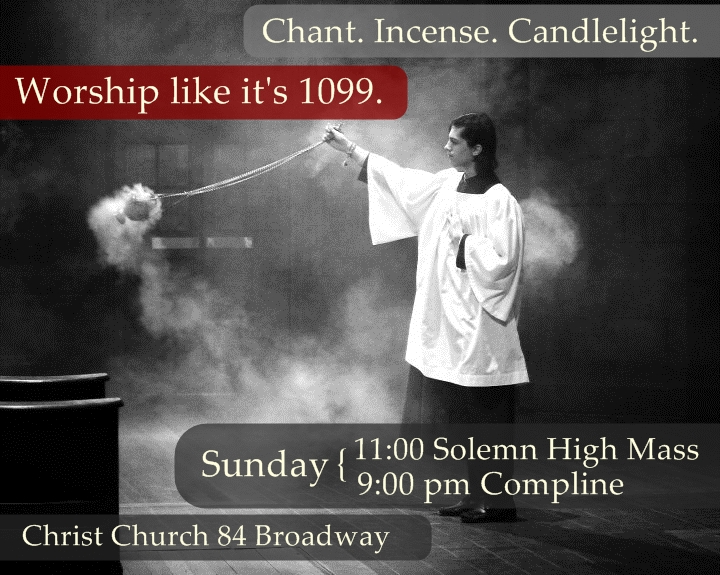
Worship like it’s 1099: Tradition, Liturgy, and “Relevance”

Yesterday evening, I put together and posted the above ad on Facebook.  It has now gotten 63 “likes” and 33 “shares” and counting on Christ Church’s Facebook page  It has also gotten quite a bit of commentary from across the interwebs where it has been shared.  Some of those follow:

“As so many churches strive to be modern and relevant, I applaud Christ Church New Haven in how bold they are about NOT being modern in their worship style at all.”

“It works because they know who they are. It’s less about ‘trying’ to be relevant, than being honest about who they are, and letting folks find out how that may be relevant to their lives.”

“Cool! There are MANY ways for a church to meet people’s spiritual needs… I just can’t figure out why too many churches think mediocrity works. Excellence and authenticity are much more critical than methodology.”

“Thats awesome!! =)”

“Love love love the tradition.”

“we don’t even have a thurible… I love that stuff!”

“This is AWESOME!”

“Ummmm…YES PLEASE!!”

“God, I’d love to attend.”

“I’ve been here for Compline! It’s pretty awesome!”

Now some were less flattering:

“But why would one want to worship like it’s 1099? Am I missing something?”

“Oh, yeah! Back to the days of slavery and where women knew their place…”

So, what is going on here?  In all, I have counted 150 or so “likes” on our page and on the pages of those that shared the ad along with lots and lots of comments.  It is rare that a piece of church media generates such a response.  It has obviously stricken a chord.

The interesting thing is that it was overwhelmingly younger folks sharing and liking the ad.  Those that expressed doubts or outright resentment were from another generation.  They seem angry that young people would find value in something they worked to undo.

On Sunday evenings Compline is filled with young adults.  What is it about this very traditional service that is reaching them in some way or another?

1. An encounter with the Holy: There is a real yearning among people for an encounter with the mystery of the divine.  So-called contemporary liturgy (that may have been contemporary in 1979) is not doing it for folks that are yearning for an experience of the transcendent.  Liturgy that does not point toward the sacredness and presence of the Divine is spiritually dangerous for it teaches us to worship not that which we are called to worship, God, but to place human inventions and concerns on a shaky altar of self-regard.

2. A genuine identity (authenticity): This community knows who it is and what it believes.  In a hyper-marketed, oversold, and deeply cynical age, there is a need for the Church to offer a place of real and deep authenticity rooted in the worship of the Almighty.  When people come in, they won’t know everything that is happening, it won’t be “relevant,” and it won’t be immediately decipherable.  But it is deeply and powerfully authentic.  Every movement and gesture kinetically expresses some bit of our faith.  It is inherently and vitally real.

3. It calls us out of ourselves: So much of the modern world is about dwelling ever more on ourselves, our needs, our desires, our rights, our causes, our, our, our.  Worship that is authentic inverts this and drives the believer to the other.  To God, to our neighbor, to our Lord, and to the whole of Creation.  “Love the Lord thy God…Love thy neighbor.”  All of our worship expresses this summary of the law.  We orient toward God and by that turn opens us to serve those around us.  It begins, however, with God.

4. It does not comfort only: Worship is always a challenge when done well for it demands our best.  We are spending lots of time saying “The Episcopal Church welcomes you.” We have “radical hospitality.” Yet if we only open the doors and tell people to come as they are but don’t call for them to leave transformed then we have sold short the Holy Spirit.  People come to be transformed – so preach, worship, teach, and pray with transformation at the heart of your work.  We have gotten far too comfortable thinking people (especially young adults) only want to be comforted.

Is our worship calling people to Holy transformation?  Do we believe that an encounter with the Holy is powerful enough, holy enough, transformative enough to demand our best?  Does our worship express our unshakable belief that the Holy is dangerous?

Christ Church strives to offer a worship that expresses both unknowable mystery and fierce Holy transformation.  Young people are begging us to offer them more, to ask more of them, to give them a holy purpose.  We are not being asked to be more relevant.

If we want to attract young people we must begin by rediscovering that which attracted us to Jesus Christ in the first place – that mix of holy discomfort and deep yearning that grips us and never lets go.  Strive for the Holy and treat it with reverence, awe, and wonder and give thanks in as full a way as you can possibly imagine for the grace and goodness of God.

Robert+

Please Just Kneel. Thank You.

I have been to a couple of liturgies recently at which the congregation was to kneel.  Inevitably, I end up behind the non-kneelers.  They have either sat so that I have to lean back awkwardly or they have stood so as to make my view (and the view of all those behind them) one that rather distracts from the beauty and solemnity of the service.

I am concerned that there is an assumption that one’s comfort or discomfort with the practice of the worshiping community should empower one to impair the experience of those further back in the congregation – those you share holy space and time with.

I realize that standing through Communion has become the standard practice in many congregations.  Yet, when one goes to another church home, it seems disrespectful to actively make a point of your discomfort or comfort.  (Now, I absolutely realize that the kneelers at our parish can feel like you are engaging in an act of corporal mortification.  If it is severe pain or physical difficulty that causes this then I absolutely understand).

I am much more comfortable kneeling for Communion.  There, I have laid my cards on the table!  However, when I am in a congregation that is overwhelmingly standing, I now tend to stand along with them.  This has certainly not always been my practice.  In the past, I have been more than happy to hold the line for Holy Tradition and make a point to those whose practice I found disrespectful to the dignity of the Sacrament.  Let’s call it adolescent grandiosity!

Liturgy and prayer, however, are not the media for passive-aggressive ecclesial squabbling.  It seems that part of catholicity is entering the space and time of the liturgy in the way that the Body around you is engaging the Holy.

I do wonder, however, what it says about our culture that we have become so uncomfortable with kneeling in the presence of the Holy.  To my mind, kneeling offers us a new way to lay aside our pride and, through the kinetic expression of our devotion, offer ourselves to the Presence.

Many seem to equate kneeling with some kind of groveling and self-flagellation.  It is thought antiquated and degrading.  We even have a Eucharistic prayer that declares that we are “worthy to stand before you” as if kneeling implies unworthiness.

To my reckoning, kneeling implies not our unworthiness, but acknowledges the deep and profound worthiness of God.  In the presence of awe-filled mystery what can we do but fall to our knees and offer praise and thanks?

Scripture is replete with references to offering such reverence:

“when Solomon had finished putting this prayer to the Lord and this plea, he stood up before the altar of the Lord, where he was kneeling, with palms stretched heavenward, and blessed the whole assembly of Israel “(1 King 8, 54-55).

In the New Testament, Peter gets on his knees before Jesus (Lk 5, 8); when Jairus asked him to heal her daughter (Luke 8, 41), when the Samaritan returned to thank him, and when Mary the sister of Lazarus asked for the life of her brother (John 11, 32). The same attitude of prostration before the divine presence and is generally known in the Book of Revelation (Rev. 5, 8, 14 and 19, 4).

S. John tells how he had seen and heard what was revealed and prostrated [himself] in adoration at the foot of the angel of God (Rev 22, 8).

God says through Isaiah: “To me every knee shall bend” (Isa. 45:23). And S. Paul says, “for it is written: ‘As I live, says the Lord, every knee shall bend before me”‘ (Rom. 14:11). Again, S. Paul states “at Jesus’ name every knee must bend in the heavens, on the earth, and under the earth” (Phil. 2:10).

Kneeling together testifies to our great thanksgiving for the mighty work of God among us.  The Incarnation, Crucifixion, and Resurrection are acts of such divine mercy that our response can only be to fall down and give thanks for our creation, preservation, and all the blessings we share.  Adoration and Repentance are at the heart of our love of God.  Kneeling is a visible expression of our acknowledgment of that reality.

Robert+

Of Catholic Anglicanism and Romanism: Which Catholic is Catholic?

“…to adore Christ’s person in His Sacrament, is the inalienable privilege of every Christian and Catholic heart How we do it, the way we do it, the ceremonies which we do it, are utterly, utterly indifferent; the thing itself is what we plead for…”
James DeKoven – October 26th, 1874

I frequently ponder James DeKoven’s speech to General Convention from 1874. “The thing iself…” remains a term that sticks with me. Whether talking about ceremonial, Sacramental theology, Christology, or a host of other Church topics, I find my mind returning to DeKoven’s emphasis on “the thing itself,” the Real Presence of Christ.

The other day, in a conversation, I made a rhetorical overreach and claimed, “Catholic Anglicanism is, perhaps, more Catholic than Roman Catholicism today.” This seemed to cause a bit of a stir amongst those I was talking to and I was asked to elaborate – never a fun question when one is speaking both extemporaneously and hyperbolically!

Yet, now my mind turns to “the thing itself” in relation to this question of Catholic Anglicanism and Roman Catholicism. I am not one of those former Roman Catholics that harbor some deep-seated anger toward Rome in my heart for past offenses done to me and mine. Yet I do carry a real sense of just how the Roman Church has failed in the last decades.

Clergy abuse, indifferent clerics I meet, minimal roles for women in leadership, a stunted sense of lay leadership, a disconnect from the social realities of places like Africa when condemning contraception, and a host of other issues come to mind as I think about the Church I left for Anglicanism. (Of course, Anglicanism is caught in its own struggles now and is, perhaps, being undone by its very attempts at comprehensiveness.)

In the past, “Romanism” was a term of derision for those of advanced churchmanship within Anglicanism. Yet it is a term I find, perhaps uncharitably, to fit the current state of the Roman Church. The papacy, legitimately a seat of honor, has been elevated in a way that is sometimes more political than spiritual. What has developed is not catholicity but Romanism – an unhealthy attachment to the centralized authority and bureaucracy of Rome that short-circuits local oversight and results in a Church bureaucracy that is unresponsive to acute crises or systemic needs.

At the parish I serve, we hear Confessions, offer daily Mass, believe strongly in the Real Presence, say the Daily Office, offer Benediction of the Blessed Sacrament, and hold Our Lady in high esteem. These are all integral parts of a Catholic faith that sustains this community. They point toward “the thing itself” which we hold dear – that we worship a living God that condescends to come among us.

We are also a parish that has women serving as priests, has long supported LGBT causes, and supports a degree of freedom in matters of conscience such as birth control.

For some, this seems like a case of serious cognitive (or at least theological) dissonance. Yet this is the joy of Catholic Anglicanism. We balance holy tradition with reason and Scripture in such a way that the individual is neither left unmoored to their own devices (as with much of mainline Protestantism) nor denied the dignity of conscience (as with much of Romanism). This kind of Generous Orthodoxy, to purloin a term, is supported by the comprehensive underpinnings of a creedal theology and Prayer Book Catholicism.

Our first concern is “the thing itself.” This means that our worship and service are directed toward the Holy One. All that we have we offer in worship, praise, and thanksgiving. It also means that we trust in a competent God that can handle the many issues that divide the Church today.

I believe that Catholic Anglicanism offers the best of traditional Catholicism and also offers substantial and distinctive contributions to the life of the Church.

In 1054, owing much to political machinations, the whole Church divided between Constantinople and Rome. Where was the “true Church” to be found? This would have been a simple matter to adjudicate if one branch or the other had simply adopted some great heretical position so that we could have clarity. Yet they remained faithful to the whole of the Christian faith – albeit with some distinct differences.

Claims to exclusivity by either do not seem wholly justifiable on doctrinal grounds – and both would recognize the other strain as authentically Christian. It is possible to have divisions (outwardly political ones) within the True Church and still have a coherent doctrinal core. In other words, it is possible to focus on “the thing itself” despite differences in bureaucracy and polity.

If we fast-forward a bit to sixteenth century England, we find a case of gross papal abuses. The sale of indulgences, the essentials of the faith neglected, Confession and Communion only at Easter, and doctrines of the Mass that held truth and beauty were taught crudely and mechanically. Sadly, some sort of “Reformation” was needed. There was desperate need for reform as the political sins of men choked the spiritual needs of the Church.

(This is a meandering and overly simplistic view of things, of course. Those with some interest in English Catholicism would do well to read many of Eamon Duffy’s works, especially “The Stripping of the Altars.”)

That said, political reasons again led to Schism within the Church. As Henry VIII, a generally strong defender of the Catholic faith, sought to assert royal supremacy over the Church in England. The final break came in 1570 as Pope Pius V excommunicated Elizabeth.

Once again, we are challenged (due to political machinations) with the question, “Which is the True Church?” And our answer is the same as before – in its fullness. For which part of the Body is not vital?

Moreover, what part of the Faith Catholic did the Church in England repudiate? There were absolutely changes made to the Church. There were myriad shifts of leadership that brought alternating waves of anti-Catholicism and anti-Protestantism into ascendency.

Yet, what held? The Creeds, the Sacramental system, and the apostolic succession. The thing itself, perhaps. We have retained the essentials – and allowed our whole Church a greater say in what we declare about non-essentials.

Catholic Anglicanism represents a great hope quite frankly. We blend a healthy respect for the tradition with a deep regard for the present and the future. Perhaps it was those great battles within our Church between Protestant and Catholic wings that have given us an ability to focus on the thing itself. We have practice at negotiating difference and finding not compromise for the sake of ease, but compromise that reflects the vital breadth of the Church.

I wonder what the modern mind makes of the Roman claim that “We declare, affirm, define, and pronounce that it is altogether necessary to salvation for every human creature to be subject to the Roman Pontiff.”? (Boniface VIII) This was a doctrine proclaimed in 1302, affirmed in 1870, and remains the summary of the Romanist position today.

I daresay that the Catholic Anglican position would be somewhat different. Many of us acknowledge the spiritual guidance and even leadership of the Bishop of Rome. Yet the only salvation I know of is that offered by Christ. All of our worship, prayer, and Sacraments point toward that one great reality – that Christ comes among us offering the grace of the Sacraments to all believers.

For Catholic Anglicans, dogma and doctrine are declared because they are found to be true in our deliberations, tested by reason, and discerned over time. Within the Roman system, dogmas are declared true because the Church defines them as such. This may seem overly simplistic, but I believe it strikes at the heart of the difference between Catholic Anglicanism and Roman Catholicism. We are willing to allow that sinful people administering a Church might be mistaken and that their judgments should always be up for debate, scrutiny, and reflection.

Our claim is simple, “the thing itself” matters most. If systems distract from that then they are non-essential. If doctrine obscures that then it is non-essential. If traditions twist that then they are not truly tradition but are customs.

Within Catholic Anglicanism, Catholic Christianity is practiced without regard to claims of earthly authority or sovereignty.

So when I told my conversation partners that I oftentimes think of Catholic Anglicanism as “more Catholic” what I really meant was, perhaps, that our focus is on the essential, the necessary, and the vital. It is not systems or structures that occupy our energy but the great gift we have been handed by Christ and the apostles –the cure of souls in the name of Christ.

Robert+

Church Planting, Church Growth, Young Adult Ministry, and Evangelism: What we talked about at the Society of Catholic Priests Conference

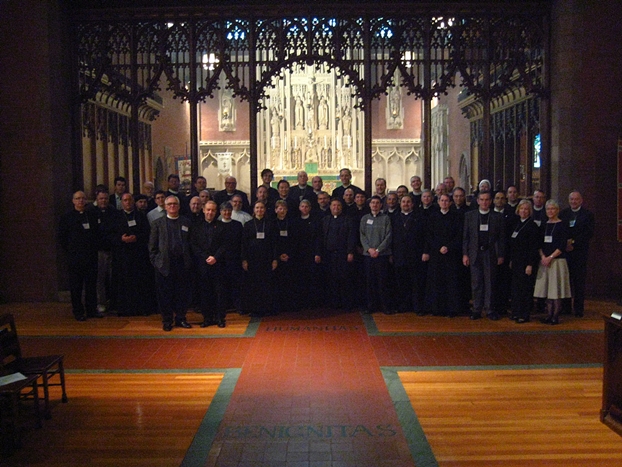
This past week I spent some time at the Society of Catholic Priests in North America’s third annual conference. It was a wonderful time and the Society has become a source of real joy since we worked to get it started three years ago. Particularly meaningful, for me, was spending time with Bishop Frank Griswold, the 25th Presiding Bishop.

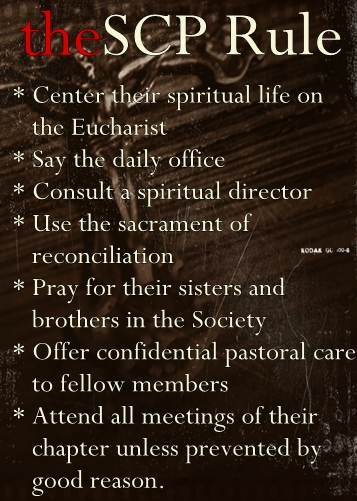
He is one of those people that, by just spending time with him, you feel like a better person, Christian, and minister. His presentation on the Sacrament of Reconciliation was the best approach I have seen to the topic blending theology, spirituality, and a down-to-earth kindness. He has accepted an invitation to be the Episcopal Visitor and Sponsor of the Society and its ministry and witness will be so much the richer for it. A bit of its history and mission may be found here.

One of the attendees had a co-worker send her a text that said that she could not believe that her colleague was missing a staff meeting to “go to Benediction.”

It was an interesting comment – as if deciding to worship would be a ridiculous thing when one could do real work and bring the Kingdom one staff meeting closer.

My friend was able to reply, “Actually, we are in a session right now on church planting.”

How many Episcopal clergy conferences these days are centered on church planting, church growth, evangelism, and young adult ministry?

These are essential topics for any church that hopes to have a future to engage. New churches, new members, new believers, and new generations are part of the growth of a hope-filled and joyous Church.

These endeavors are undergirded and strengthened by the very essential things we did at other points at the conference – worship, fellowship, and contemplation. The strength, vision, and stability that make church planting and growth possible are rooted in the essential, the core, the heart of our faith. We are able to serve God when our will is entirely turned toward him.

What has, traditionally, made the catholic movement within Anglicanism able to flourish when it has is its deep sense of the ongoing grace and presence of God. We strive to make that Presence known in service, worship, and evangelism. Striving for beauty in worship says something about striving for the beautiful in our communities and within ourselves.

We offer not lessons about God but a relationship with him.

It says something deeply disturbing about the Church when we are often tasked with defending beauty. For it, somehow, is not real ministry – or is a waste of time, efforts, energy, or resources.

Dr Derek Olsen, one of the presenters at the conference, puts it this way:

“…the search for beauty is tied deeply into the search for truth and goodness. The arts of ministry, preaching, singing, architecture are arts…we can either do them well or we can do them poorly; we can either choose beauty or we can settle for whatever comes out. However, should we choose to settle for whatever comes out, we are compromising the spirit of the God who created all things wonderfully.”

I would commend his presentation to anyone interested in the intersection of worship and ministry (http://www.scribd.com/doc/67290095/SCP-Ceremonial-9-30-11)

Striving for the beautiful in worship conditions us to strive to make God’s presence more beautifully known in the many other parts of our lives that we are called to make worshipful as well. It inspires and gives hope even amidst things passing away.

From the First Annual Conference in 2009

What I was struck by at the conference was the general level of optimism in the room. There was a sense of real joyful anticipation among those in attendance. Many church meetings these days feel a bit like a wake for the Church:

“Oh, I just remember the good times…”

“You know, God has a plan for these things…”

I keep waiting for someone to say “It looks so peaceful…so natural…”

There is deep-seated fear, sadness, and a sense of loss that are palpable in the Church these days – and there are reasons for grief. Yet, we are now tasked with moving on (grieving a bit) but now getting back to the work of God. The world’s need for news of God’s love is too great for us to indulge in self-pity and strained good-byes to a Church that never really existed.

The only thing the Church has to offer and has ever had to offer is the worship of God who calls us to relationship. That worship is the heart of evangelism. It is the pulse of outreach. It is the essence of the history and future of the Church.

I am not talking of worship in the ritual sense – though that is vital too. I am speaking of something deeper, the turning of the heart toward God. This is what the Church is called to – turn its heart, the heart of its believers, and the heart of the world around us toward God.

It is the genuflection of the heart in awe.

The SCP Conference attendees were full of joy because they understand this. Many of our churches are doing vital work because our first priority is not social service but worship. A worshipful Church that focuses its being on the adoration and proclamation of God in all things is one that can find the strength to stand fast – to dwell in the heart of God – when challenges arise.

A rooted Church can find the inspiration to serve, the joy to evangelize, the courage to speak for justice, and the daring to change its own structures.

There are concert halls that will offer more beautiful music. There are social service agencies that will serve the poor better. There are local community groups that will organize friends and neighbors more effectively. There are political committees that will lobby with greater impact.

If our ultimate reason for being Church, for coming together, is not to worship God in his temple then we should pack up and let professionals in these other fields handle the work.

All of the other things the Church can do, the missions it can undertake, the ways it can be present in the community – all of those things flow out of a worshipful centeredness that must be planted deep in the heart of God.

It was a joy to be among priests so obviously taken with the Holy as we pondered and sought new ways to share that Presence with the world around us.

I will leave off with my favorite line from the conference – again from Dr Olsen:

“First, it’s worth taking a look to see how your servers, your altar guild, yourself, and other folkstreat the vessels after the services are over. Do they treat them like sacred things worthy of respect,or do they handle them carelessly, like something to be tossed around? It’s one thing to treat them with reverence during the service, when everyone’s watching, but what happens when it’s over?”
“Second, it’s worth taking a look to see how your servers, your altar guild, yourself, and other folks treat the people at coffee hour. Do they treat them like sacred things worthy of respect, or do they handle them carelessly, like something to be tossed around? The difference between the two is clear:the vessels no longer have the blessed sacrament within them. The people at coffee hour do.”

Robert+

The Abashed Curate: On Random Acts of Generosity

Today I had one of those encounters with folks that leaves me feeling a mix of deep thankfulness and some embarrassment.  The auto repair shop I use has frequently undercharged or not charged me at all when I bring the car in.  The owner chalks it up to “getting points in heaven” and asks me to pray for him – which I do!

When I go to the Mexican restaurant around the corner the owner is always giving free drinks or appetizers as she once prayed to Our Lady of Guadalupe and her mother was healed.  On the train, I have gotten free train rides (which I often ask be given to someone with children on the train).  I have had restaurants get out tables for me when the place was full.  Occasionally people cross themselves when they walk past as they give a friendly nod.

After ordination, some of this troubled me.  I chalked it up to a clericalism and was a bit ashamed of it.

Yet, I realized that my initial discomfort had its root in one of the challenges of ministry – too much focus on self.  I interpreted these gestures of kindness as being about me and wondered whether I merited that kind of generosity.

Yet these small moments are all about God and the Church and have nothing to do with me at all.

In a busy, hectic, and confusing world, I think people look for ways to connect to the Church and to give back in some small way.  These gifts are an offering of sorts that, with our prayers and thankfulness, we join to those we offer up in Mass.

I thank God and am humbled that in some small way these generous and kind strangers, friends, and neighbors that I meet can feel a sense of giving back to God by being kind to me.

I am not worthy of these kindnesses but God most certainly is and I treasure these moments when I can offer a prayer in exchange for kindness – which is really the project of the Christian life as we offer up some portion of all that God has given us in thanksgiving.  We exchange kindness for Kindness, generosity for Generosity, and love for Love.

Robert+

Of Linen Clerical Collars: On Their Care and Laundering

After a conversation last night after compline with fellow clergy over bourbon we moved from serious topics to the somewhat less serious but still needful question of the obtaining, care, and maintenance of linen clergy collars.  Here are a couple of the salient points:

Wippell obviously carries them.  I have also had great success with J R Evans which makes the coveted 1″ high linen collar (http://www.jre-best-religious-supplies.com/studio-shirts.html)

You might also try Trevor Floyd (http://www.trevorfloyd.com/linencollars.html)

Yes, they are well worth the effort.  Undoubtedly, you will invest more time in them than a collar that can be tossed in the dishwasher but they are decidedly more comfortable.  “Clericool” which is the name Almy has given their plastic collar is quite the misnomer – having a plastic band around your neck in the heat is definitely not a cooling sensation.

If you search for collarette, you will find items such as these - they are not appropriate clergy attire.

You can achieve the tab look with a hint of white showing over the black band by obtaining a collarette – Almy and Wippell both make them.  The Wippell is slightly superior as it does not have snap.

They are easy to use and the collar simply slides into them.

Laundering

There are a couple of options for caring for collars.

You can wash and starch them yourself – which gives a high degree of personal satisfaction.  Great instructions for this may be found on Fr Mark Collins’s blog: http://fathermarkcollins.blogspot.com/2008/10/how-to-starch-clerical-collars.html

You can send them off to a specialty company that will do a fine job of getting them back into tip-top shape: I commend Barker Group in Dorset (http://www.barkergroup.info/stiff_collar_laundering.html) as they have a wonderful tradition of laundering stiff collars.

You can take a chance by trial and error with a local launderer.  I would take one that is in good shape along to show them what they should look like.

Bonus

For keeping your blacks black – Perwoll is recommended (http://www.amazon.com/Perwoll-Black-Darks-Formally-Magic/dp/B0035YK7ME/ref=sr_1_1?ie=UTF8&qid=1316455349&sr=8-1)

It is a detergent that is specially formulated to keep black colorfast and comes highly recommended!

On Modernism: of Its End and the Liturgy

I read an article recently on the decline of the Modernist movement in art. The piece was entitled “The Dustbin of Art History: Why is so much contemporary art so awful?” (http://www.prospectmagazine.co.uk/2010/05/why-is-modern-art-so-bad/)

The article got me thinking about liturgy and the current “trends.” The modernist movement had an undeniable impact on liturgical practice. The stripping away of mystery, the desire for “accessibility,” the movement from a vertical encounter with God to a horizontal exchange about God, and the drive for “function” over embellishment have marked much of contemporary liturgy.

One source on modern art describes the modernist art project as being about seeking to be “experimental, imaginative, exciting, and free.” It is based on “inner vision, breaking from the past, and self-consciousness” and “whatever was established or instituted must be deconstructed, reconstructed, questioned, and even destroyed.”

We see the constant craving within churches to accomplish much of this. There is a drive to be imaginative, exciting, and experimental – to break from the past and inspire the congregation to some new level of awareness.

Modern liturgical praxis seems often wrapped up, however, in the same qualities that the article cites as marking the decline of modern art: Formulae, narcissism, sentiment, and cynicism.

Formulae

What was once ground-breaking and exciting (and a necessary challenge to ossified church dynamics) has now become dogmatic adherence. The aforementioned article states, “…we are told, originality is over, appropriation is in, style is dead, pluralism is the order of the day. Yet this is true of the end-phase for any great movement.”

I recently watched a discussion of liturgy in a parish. The person leading the discussion said to her audience, “We might try some new language, but we are not trying to force you back to the bad old days where you had kneelers and everyone had to kneel to get Communion.”

What had once been ground-breaking, that “we are made worthy to stand before” God and Christ, had now become inviolable and unquestionable praxis. The new and the theologically significant had become just formulaic admonition.

It is not that I think standing for Communion is “wrong” but that the attitude around it – as the obvious way to do it right – needs questioning. In an age when the dominant culture is absolutely steeped in narcissism we may need a place where we kneel every once in a while. This is just one small example of the rejection of the “old” becoming its own dogma.

Narcissism

What is the point of the liturgy? The answer now seems to be “us!” Our enlightenment, our edification, our enjoyment, our participation. When I am in planning meetings about liturgy in various and sundry places, inevitably the questions seem to center on what people will get out of it. Will it move them? Will they like it?

This is a fundamental misunderstanding of the center of worship. The adoration of God is the primary purpose of worship. It is the work of the people offered for the praise of God.

Yet, we now want to be in a circle so we see each other. We want to interject exclamations in the Eucharistic prayer. We want to stand. We want the language to feel less penitential. We want shorter sermons. We want a longer peace (so we can catch up).

Yet doing the “traditional” without intentionality and joy is equally destructive. When mass is offered because that is what we did the Sunday before, we are equally off-course.

When worship becomes about self-gratification and the comfortable as opposed to self-giving (when it becomes formula and rule), then we have profoundly and utterly lost the focus of the action. Worship is a thanksgiving for the action of God not a celebration of our own action.

We seem increasingly unwilling to enter another’s space, to be made uncomfortable, to be challenged – because we don’t have to be. So worship becomes ever more about providing a comfortable environment (or an exciting one) rather than a holy one.

It also becomes about the narcissism of the celebrant or the preacher as they seek to be seen as enlightened or warm or funny or whatever other need we think we want filled for it is “they” that give meaning to the liturgy and the scripture.

The Book of Common Prayer protects the congregation from the neediness of any one priest. We are too often subject to the tyranny of the new and the living in which the preacher or celebrant who is not “relevant” is less than – for they are not giving us what we want.

While we obsess about becoming relevant we lose sight of what makes the Church truly relevant, its willingness to stand and hold culture accountable for the sake of Jesus Christ. Standing against greed, oppression, injustice, and hate are all brought about by a sense of the dignity of all humanity that is imparted in the dignity with which we approach God. It is not hearing about God that brings these radical challenges to society but an encounter with God – which can never be trivialized.

The Christian life is not about what we want but about what we need. We now have entire TV channels, stores, and websites devoted to every whim and desire of the individual. Church cannot be one more place where the wants of “me” overshadow the profound and real presence of God.

Pluralism and self-actualization have now become the order of the day. Rather than plumb the depths of our shared heritage – we now seek to ever expand the options while degrading our shared identity and mutual dependence for the sake of self-expression.

Sentiment

For the sake of dismantling the old we brought in the “new.” Formal prayers, careful hymns, choral mass settings, east facing altars, pulpits, kneelers, stained glass, organs, and the rest were deemed archaic and fussy. So we brought in things that made us feel better somehow. We mistook a sense of happiness for the true comfort for the Holy Spirit.

The article on art offers this, “Art has become small, superficial and self-indulgent in its emotional range: sentimental rather than truly intellectual or moving.”

We have lost sight of what it means to offer worship full of dignity and beauty (the best we have to offer) to God. It is that pursuit that truly moves the heart and mind in worship. When offered with grace, dignity, and true joy (as opposed to mere happiness) worship naturally becomes a thing which transports and lifts us beyond the superficial and the bland.

As the “old” was tossed out what did we replace it with? The sentimental – for it was what we knew and made us happy out of church so why not bring it into church? Rather than the common being made holy we are driving for the holy to be common.

All the while, as church begins to look more and more like daily life and the extraordinary exchange that takes place between the divine and humanity is trivialized and made an extension of what makes us happy – what is cute.

As the author points out about art, “…these works of art are not necessarily ‘bad’—neither are the paintings of Bouguereau and Boucher—but they are kitsch.” Are we settling for kitsch in worship these days?

The liturgy need not be a thing of elaborate opulence to be deeply beautiful. Many of the most moving masses I have been part of have been low mass at 8:00 am or 5:30 pm on a Thursday. Their beauty grows out of the way the language, rhythms, and patterns become a part of us – transforming us without our even realizing it.

I have seen extraordinarily beautiful, even breathtaking, single black lines drawn by Chinese brush artists on a stark white background – yet those single lines require years and decades of training and striving for perfection. It is not the form only that defines that beauty but the deep longing and aspiration for the beautiful that strives beyond the self.

Cynicism

What is before us? The author says of the end of the modernist movement, “A surprisingly honest sense of failure, hopelessness and a bankruptcy of ideas are fundamental components of this end-phase…”

There is that thin thread that runs through conversations with people about the church more broadly and worship more specifically that “this is all we can do.” The controlled descent mentality has afflicted not just out thinking about the future of the Church but our thinking about worship.

Madame de Pompadour is depicted looking at her reflection, and holding her powder brush as if she is an artist painting a self-portrait. Here is art celebrating its own superficiality. In doing so, it absorbs any criticism made against it…”

Where are we like the artist painting the self-portrait? Obsessed with the narrative, story, picture of the self while looking away from the world around – because we are doing what we can? We are focusing on what we have been culturally formed to focus on – us.

Instead of offering all that we have, stretching ourselves to do more, striving to offer ever more perfect praise, we get by, and because it is comfortable, common, cute, and “new” it gets by without critique.

I recently attended a mass that was designed to trigger a response and had a particular ideological bent. Someone who went with me said, “that was just off.” It was actually rather well done (as a piece of craft) and yet something was critically and deeply lacking. The mass was not offered as a way to ask God to help us or even to praise God for all that has been given to us – it was offered as a way to edify and instruct and motivate the congregation to new action. It was worship with an agenda – rather than worship with a Purpose.

Those who planned and offered the service knew that this worship was going to take advantage of and manipulate rather than to offer praise and glory. It was cynical even as it was well-meaning.

When worship becomes about us then it also becomes a tool and spectacle to manipulate us rather than to deeply transform us as we offer our selves, and souls, and bodies.

If an end then what next?

For many, what was “new” has become underwhelming. Anecdotal evidence might be found in the number of young people at Compline at Christ Church, New Haven and in Seattle. It might be seen in the number of young adults looking at semi-monastic communities. It might be found in the renewed interest in the Latin Mass in the Roman Church. It might be seen in the number of young people attending Solemn Mass in Louisville rather than the “alternative” service in the chapel. It might be found in the renewal of interest among non-liturgical traditions in the Creeds and Sacraments.

Recapturing dignity and mystery seems to be an unspoken need of a generation that knows there must be more.

This is the stuff of a future entry!